
Azerbaijan's loan portfolio to the economy is growing faster than the deposit base, and at the same time credit is becoming more expensive. According to the Central Bank of Azerbaijan, at the end of July 2026 the outstanding stock of loans to the economy stood at 34,155.1 million manats versus 30,257.9 million a year earlier — a FinFly calculation based on official observations gives an increase of about 3,897.2 million manats, or around 12.9%. Deposits and placements over the same period rose from 41,776.1 million to 44,501.1 million manats, that is, by approximately 2,725.1 million, or about 6.5%. At the same time, the average rate on manat loans in August 2026 was 15.74% versus 15.22% a year earlier. The key contrast is not that lending has accelerated, but that it is accelerating at a higher price of credit.
What exactly the figures show
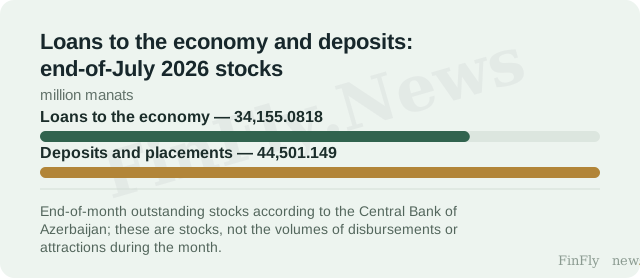
The comparison of the two stocks — loan and deposit — is valid only as a comparison of end-of-month stocks, and both series are taken from Central Bank of Azerbaijan publications for the same period. Loans to the economy as of July 31, 2026 — 34,155.1 million manats, a month earlier — 33,881.1 million; the FinFly calculation gives a monthly increase of about 274.0 million manats, or around 0.81%. Deposits and placements on the same date — 44,501.1 million manats versus 44,155.3 million a month earlier, that is, about 345.8 million, or approximately 0.78% for the month. On a month-over-month basis the rates almost coincided, and the entire annual gap was formed by a longer trajectory rather than by a single July movement.
The annual comparison shows the divergence more clearly: the loan portfolio added about 12.9%, the deposit base about 6.5%. These are categories that are different by definition: loans to the economy are the aggregate portfolio of credit institutions, while deposits and placements under IMF methodology include the funds of non-residents, the central government, public organizations and municipalities, so they cannot be interpreted as a resource base exclusively for private lending. Both indicators are end-of-month outstanding stocks, not amounts disbursed or attracted during the month. Growth in the stock is not equal to growth in new disbursements: it includes accrued interest, revaluation and rollovers.
Why this does not promise cheap credit
The average rate on manat loans in August 2026 — 15.74%, a year earlier — 15.22%, two years earlier — 14.48%. This is a monthly weighted average across all maturities, not the rate on a specific product. What matters here is not the direction of the portfolio in itself, but the combination: faster growth in the outstanding stock of loans is accompanied not by a decline but by an increase in the average price of a manat loan. It does not follow from this that the rate rose because of portfolio growth — no link has been established. But the opposite is also not true: the dynamics of the aggregate portfolio give no grounds to expect an easing of price conditions.
For a company planning to borrow in manats, this means a specific decision boundary. It is reasonable to build the debt-servicing budget on the basis of a rate no lower than the currently observed level, rather than on the assumption of an imminent cheapening of credit. At the same time, the portfolio stock itself is not a sufficient basis for changing the borrowing budget, the purchase price or the schedule of raising funds: it is a monetary stock, not a turnover of payments, not nominal demand and not contractual price volatility. The decision requires another observation specific to the transaction — actual bank offers for the required maturity and currency, as well as the terms of the specific product. If the portfolio continues to grow faster than deposits while the average rate rises further, the gap in growth rates will look persistent rather than one-off; if the rate reverses downward, the picture will change. This is an observation, not a forecast.
The main point in these data is not the very fact of loan portfolio growth, but that it is growing faster than the deposit base while the average rate on manat loans is simultaneously rising. The outstanding stock of loans to the economy added about 12.9% over the year, deposits and placements about 6.5%, and the average rate rose to 15.74%. For a borrower, this is a signal to budget the cost of debt at the current level, not on the expectation of an easing. There is a significant limitation: these are end-of-month stocks, they do not show loan quality or the approval rate of applications and do not establish a causal link between the rate, deposits and the portfolio.