
Software development and consulting in this field have become the fastest-growing of Azerbaijan's separately named information and communications segments. For January–August 2026, the State Statistics Committee reported growth of 39.4% for these services, versus 2.4% for mobile telephone communications. However, in monetary terms the ratio is reversed: 435 million manats for software development and 868 million for mobile communications. Fast growth and the largest market are not the same thing here.
Two different positions within ICT
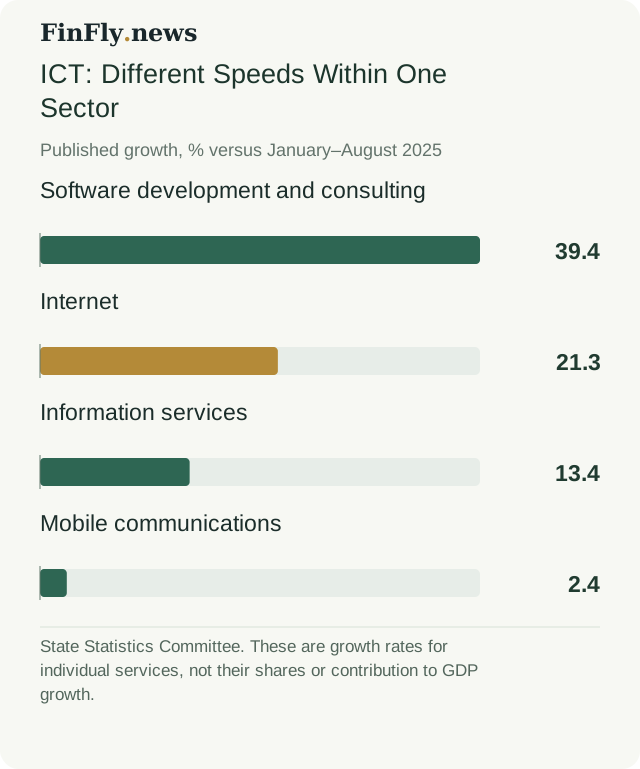
The sector as a whole provided services worth 2,748.1 million manats, increasing their volume in real terms by 10.7% compared with January–August 2025. In the current structure, mobile communications accounts for 31.6%, while software development and related consulting accounts for 15.8%. Internet services take another 16.6%, or 455 million manats, with a published growth rate of 21.3%. The overall ICT figure conceals markedly different markets, not a single homogeneous technology business.
For a supplier, this distinction changes the framing of the task. A high growth rate for software development shows an expansion in the accounted volume of services, but it does not say which products are in demand, who the buyer is, or how many companies are receiving orders. The statistics provide no basis for attributing the growth exclusively to AI, startups or exports. In mobile communications, a larger monetary scale coexists with a substantially more modest growth rate. That alone is not enough to compare profitability or ease of entry into either market.
Acceleration without a monthly illusion
The previous release for January–July showed software development growth of 34.8%. In the eight-month release, the rate reached 39.4%: the difference is 4.6 percentage points, according to a FinFly calculation. This is a strengthening of the cumulative annual dynamics, not a gain for a single August. For the internet, the comparable cumulative rates are 22.0% and 21.3%. Two sub-sectors do not necessarily move in sync even within a fast-growing sector.
At the same time, the increase in the volume of software cannot automatically be declared a structural upheaval. Its share in services was 16.0% for January–July and 15.8% for January–August. These are different cumulative periods, and such a comparison does not replace an annual assessment of structural change. But it clearly shows that an acceleration in the published rate does not mean the share in current turnover necessarily increased between two consecutive releases.
From sector growth to orders
For a developer, the practical value of the statistics lies in the argument for examining a specific demand segment more closely, not in a promise of automatic sales growth. Conditionally, an expansion of the services market may increase the number of potential projects; at the same time, a company's result will depend on specialization, price, contractors and access to customers. These conditions are not measured by this release. A financial plan based on transferring the sector's 39.4% to one's own revenue misses precisely this transition.
There is also a limit to the macroeconomic scale: the share of information and communications in GDP for January–August is 2.0%. The volume of services provided is not equal to the sector's value added, so dividing 2,748.1 million manats by total GDP to calculate its share would be incorrect. A fast-growing sector can create notable opportunities for individual companies while remaining a small part of the entire economy.
Two separate observations are useful for assessing the sustainability of this trend: whether the high growth rate of development services persists and whether their weight changes in a comparable annual structure of the sector. The first describes dynamics, the second describes scale. So far, the data confirm rapid growth in software development, but not its transformation into the largest part of Azerbaijan's ICT market.