
In August 2026, the weighted average rate on loans in manats was 15.74%, and on deposits in manats — 9.12%. Both figures are published by the CBA, and both relate to one month, one currency and one table. It is precisely this coincidence of period and currency that makes the gap between them an observable fact, rather than a comparison of different eras. But the gap is the difference between two market-wide averages, not the price of money for a specific company. It says how the attraction and placement of funds in manats relate on average, and says nothing about what a bank's offer to a specific borrower will be.
What exactly the two average rates show
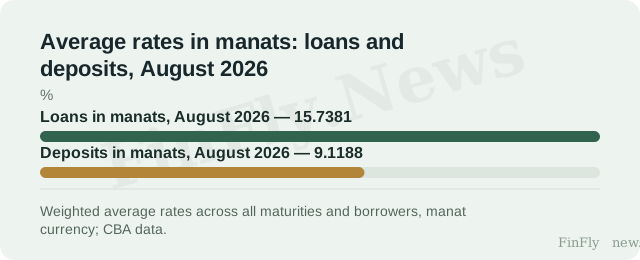
The CBA publishes manat and foreign currency rates separately, so it is correct to compare only manat series with each other. In August 2026, the average rate on loans in manats was 15.74%, on deposits — 9.12%. Both values are weighted averages across all maturities and all borrowers, not the rate on a specific contract. The gap between them in a single month is a characteristic of the market as a whole, not an assessment of the return on an individual transaction. For a company planning borrowings in manats, something else is more important: the average loan rate in August 2026 is higher than in August 2025, when it was 15.22%. This means that the benchmark cost of new manat debt has shifted upward relative to last year.
The deposit rate behaves differently: in August 2026 it was 9.12% versus 9.28% a month earlier. That is, over one month the loan average rose while the deposit average fell. This does not prove that banks became more expensive to fund or that margin increased: both values are aggregates across different maturities and different clients, and their movement may reflect a change in the structure of portfolios, not a change in conditions for an individual borrower or depositor. The observable fact is more modest and more reliable: in August 2026, the average cost of a manat loan and the average cost of a manat deposit differed, and this difference persisted against the backdrop of multidirectional monthly movement.
Where the boundary of a business decision lies
For a company that is forming a borrowing budget or planning to place free funds in manats, these two averages set only a benchmark, not a decision. The average loan rate is an aggregate across all maturities and borrowers; the rate that a specific company will receive depends on its maturity, collateral, industry and credit history, and these parameters are not visible in the published average. Therefore, the gap between 15.74% and 9.12% by itself justifies neither a revision of the borrowing budget nor a change in prices or the procurement plan. If a company is considering a manat loan, it needs not the market average but a specific bank offer for its profile and maturity — that is the missing observation for a decision.
The limitation here is fundamental: the average loan rate is not equal to the refinancing rate and is not equal to the bank's cost of funding. The CBA policy rate in effect since 5 February 2026 is 6.5%, but this is a separate instrument, and its level cannot be subtracted from the average loan rate to obtain a "cost of risk" or "margin". Likewise, averages across different maturities cannot be added or subtracted: these are different populations. The next comparable observation is the next monthly update of the average rates published by the CBA: whether the average manat loan rate shows further movement relative to 15.74% and how the average manat deposit rate behaves at the same time.
The gap between the average manat loan rate (15.74%) and deposit rate (9.12%) in August 2026 is an observable characteristic of the market, not a ready-made benchmark for an individual company. It says that on average placing funds in manats costs more than attracting them, but does not say at what rate a specific bank is prepared to lend to a specific borrower. For the borrowing budget, the decisive factor remains the individual offer, not the average across all maturities and clients. The next update of the average rates published by the CBA will show whether this gap persists and in which direction both averages move.