
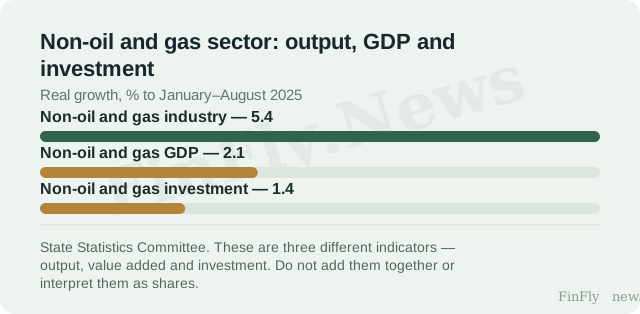
Azerbaijan's non-oil and gas industry grew in real terms by 5.4% in January–August 2026. But the entire non-oil and gas GDP added only 2.1%, and investment in this sector — 1.4%. All three indicators are positive, yet they describe different breadth and different sides of activity. Industrial growth cannot automatically be extended to the entire economy outside oil and gas.
According to the State Statistics Committee's macroeconomic summary, non-oil and gas industrial output amounted to 14,605.9 million manats, non-oil and gas GDP — 61,527.6 million. The first figure reflects industrial output, the second — value added of a broader range of industries. Their ratio is not a correct estimate of industry's share in the non-oil and gas economy: that would require comparable value added indicators.
Behind industry — other sectors
In the overall sectoral breakdown of GDP for the same eight months, markedly different results are visible. Information and communication increased value added by 10.7%, transportation and storage — by 8.7%, trade and repair of vehicles — by 3.9%. In other services, growth was 0.8%, while construction recorded a decline of 12.5%. These data help to see the heterogeneity of activity, although in themselves they are not a ready-made decomposition of non-oil and gas growth.
It is also essential to distinguish between industrial classifications. The State Statistics Committee separately reports growth in manufacturing of 3.4%, to 14,912.1 million manats of output. This is a different indicator than non-oil and gas industry with its 5.4% growth. One cannot be substituted for the other. Similarly, industrial output and industrial value added are different statistical measures, even if in news headlines both are denoted by the word "industry".
For an enterprise, this distinction has practical meaning. A manufacturer may see growth in orders in its product group when the aggregate activity of its potential customers expands much more slowly. The opposite situation is also possible: a favorable sectoral aggregate does not guarantee demand for a specific product. None of the overall rates says anything about capacity utilization, profitability or the financial position of an individual plant.
The investment backdrop is more restrained
Non-oil and gas investment in fixed capital reached 8,431.1 million manats. Its real growth of 1.4% is significantly more modest than the overall investment rate of 10.0%; in the oil and gas sector, investment increased by 32.4%. Therefore, the overall rise in investment cannot be used as confirmation of equally rapid expansion of the production base specifically in the non-oil and gas sector.
But from modest investment growth it does not follow that output will inevitably slow in the next period. It can also grow through the utilization of already created capacities or through efficiency gains. These are economic mechanisms, not an established explanation of the current figures: the releases do not allow their role to be measured. To assess prospects, one needs to distinguish between existing output and investments that may affect future production possibilities.
The main test is the breadth of growth
For a supplier working with non-oil and gas clients, it is more useful to assess a set of sectoral signals than to rely on a single high industrial percentage. Rising output, expanding orders in services and increased investment are not interchangeable evidence. The more areas show sustained improvement on a comparable basis, the more substantive the discussion of broad growth, rather than isolated points of activity.
In the next statistical releases, this is precisely what is subject to verification: whether the gap between industrial dynamics and broader non-oil and gas GDP is narrowing, whether signs of expanding investment activity appear. Based on a single period, one can neither declare diversification complete nor deem it unsuccessful. For now, the figures show industrial growth, but not an equally strong upturn in all parts of the non-oil and gas economy.