The weighted average rate on manat deposits in September 2026 was 9.16% — above 9.05% a year earlier and 8.60% two years earlier, but below the local peak of 9.47% recorded in March 2026. The main story in these data is not tenths of a point, but the shape of the trajectory: the rise to March was followed by a decline, and then a new slow increase. It is this non-linearity, rather than a single level, that sets the frame for comparing bank terms.
What the figures show: a rise, a pullback and a new upward movement
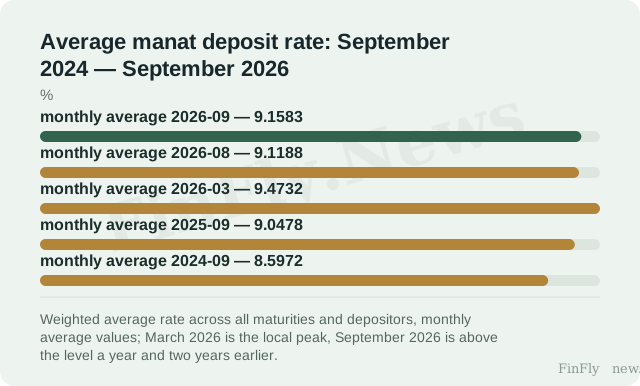
The September value of 9.16% is 0.04 percentage points above the August figure of 9.12% and 0.11 points above last year's 9.05%. However, within the two-year window the trajectory was not monotonic: in March 2026 the average rate reached 9.47%, meaning the September level remained below the March level. This is the weighted average rate across all maturities and depositors, not the return on a specific deposit, so it describes the general level of the cost of manat funding, not the terms of an individual banking product.
The CBA policy rate of 6.5% has been in effect since 5 February 2026. Comparing the 6.5% level with the 9.16% level is not a calculation of causality: these are two different quantities — an administrative rate and a weighted average market deposit rate. Their gap shows only that the cost of attracting manat liquidity is formed more broadly than by a single regulator decision, and that for business the funding benchmark is the observed deposit rate, not only the official one.
What this means for a specific decision and where the boundary of interpretation lies
For a company comparing terms for placing free manat liquidity, the average rate of 9.16% for September 2026 is a basis for comparing offers from specific banks, not a guaranteed return. For a company planning borrowings, another observed quantity matters more: the average manat rate on loans in September 2026 was 15.79% versus 15.31% a year earlier. The gap between the cost of borrowed and placed manat funding remains substantial, but by itself it does not set the price of credit for an individual company: that depends on the terms of a specific credit product, which are not presented in these data.
The limitation here is fundamental: the average deposit rate is not the rate on a specific deposit and not the funding cost of a specific bank. It does not show how the return on placement or the price of credit for an individual company will change, and it does not replace monitoring the terms of specific products. The next comparable observation is the average manat deposit rate for October 2026: whether it continues its upward movement from 9.16% or returns to the decline observed from March to August 2026.
The main conclusion from the September data is not in tenths of a point, but in the shape of the trajectory: the average manat deposit rate passed through the March peak of 9.47%, pulled back and rose again to 9.16%. For business this means that the cost of manat funding is determined not by a single regulator decision, but by a combination of market conditions. The practical benchmark is to compare specific bank offers with the observed average, rather than deriving from it a guaranteed return or borrowing price.