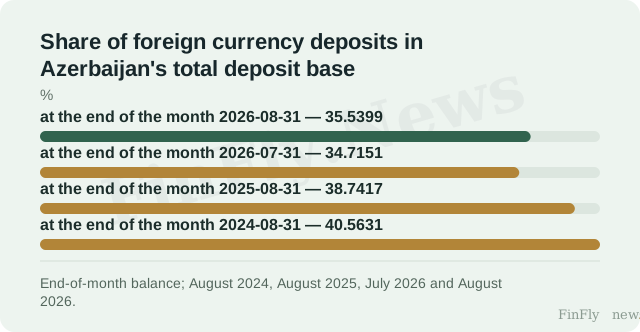
The annual growth of the deposit base and its currency structure diverged in direction in August 2026. According to the Central Bank of Azerbaijan, total deposits and placements in credit organizations at the end of August amounted to 46,052.98 million manats — 11.1% more than at the end of August 2025, and 3.49% more than the July balance. At the same time, the share of foreign currency deposits over the same month rose by 0.82 percentage points, to 35.54%, whereas a year earlier it stood at 38.74%. That is, the balance is increasing, while the foreign currency share within it has stopped shrinking on a monthly basis.
What exactly the figures show
Total deposits are the end-of-month balance calculated according to IMF methodology, not the flow of new deposits during the month. It includes deposits of non-residents, government bodies, municipalities and public organizations, so it is broader than household savings. The annual comparison gives 46,052.98 million manats versus 41,441.30 million manats at the end of August 2025; the monthly comparison is versus 44,501.15 million manats at the end of July 2026.
The share of foreign currency deposits is a separate indicator of the structure of the same base. At the end of August 2026 it equaled 35.54%, at the end of July — 34.72%, at the end of August 2025 — 38.74%. The annual decline of 3.20 percentage points and the monthly rise of 0.82 percentage points coexist: the long trend and the short movement point in different directions, and it is precisely this divergence, rather than the growth of the balance itself, that is the substantive observation.
Why this matters for bank funding
For a bank planning its liability structure, what matters is not only the volume of the base but also the currency in which it is denominated. If the rise in the foreign currency share proves sustained, funding will shift more strongly toward the foreign currency portion, and then the cost and maturity of foreign currency liabilities will become a separate subject of negotiations with counterparties. If the August movement proves one-off, however, and the annual trend toward lower dollarization persists, the benchmark for manat products will remain as before.
These two cases cannot be distinguished on the basis of a single month. The end-of-month balance can change because of exchange-rate revaluation, budget and non-resident flows, rather than savings behavior. Therefore deposit statistics by themselves do not justify revising the borrowing budget, tariffs or the procurement plan: such a decision requires data on actual attraction rates and on the maturity of liabilities, which this observation does not contain. The indicator describes a stock, not the turnover of payments and not the contractual volatility of prices.
August 2026 offers a rare combination: the deposit base is growing at double-digit rates in annual terms, while the foreign currency share within it is increasing on a monthly basis, interrupting the annual decline. This confirms neither a weakening of confidence in the manat nor its strengthening — the observation records the structure of the balance, not the motive of depositors. The practical conclusion is conditional: the sustainability of the dollarization reversal will determine which particular set of liabilities banks will have to revise first.