
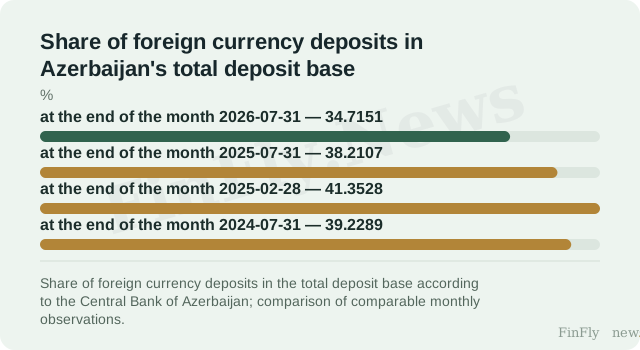
The Central Bank of Azerbaijan records total deposits and placements in credit institutions at the end of July 2026 at 44,501.1 million manats. Over the year, the balance grew by 6.5%, while the share of foreign currency deposits over the same period declined from 38.2% to 34.7%. The main story here is not the growth of the balance itself, but that it is accompanied by a decline in the foreign currency share: the structure of the base is shifting toward manats, and this is a movement within the balance, not evidence of an inflow of new deposits.
What exactly the figures show
The total deposit balance at the end of July 2026 is 44,501.1 million manats. A month earlier it stood at 44,155.3 million, meaning growth in July was 345.8 million manats, or 0.78%. The annual dynamics are more noticeable: in July 2025 the balance equaled 41,776.1 million, and the gap of 2,725.1 million manats gives 6.5% growth. This is the end-of-month balance under IMF methodology, not the flow of new deposits over the period.
The share of foreign currency deposits over the same year was 34.7% versus 38.2% a year earlier. In February 2025 it was higher — 41.4%. In other words, the manat portion of the base is growing faster than the foreign currency portion, and the structure is shifting toward the national currency. This is a structural shift within the balance, not evidence that households have massively taken money to banks.
Why this matters for bank funding
For a bank planning funding, what matters is not the total balance but its foreign currency and manat portions separately. If the share of foreign currency deposits continues to decline while the base keeps growing, a bank whose assets are denominated in foreign currency will face a relative contraction in foreign currency funding — and then it will have to either raise foreign currency at a higher cost or restructure its assets. This is conditional logic, not an observed result.
The opposite scenario is also possible: if growth of the base slows while the share of foreign currency deposits reverses upward, the bank will need to prepare foreign currency liquidity in advance. However, the deposit balance by itself says nothing about the cost of funding or that loans will become cheaper: a stock of money is not the price of credit and not payment turnover. To decide on revising rates or the borrowing budget, data are needed on actual attraction rates and the maturity structure of liabilities, which are not present in this observation.
The main conclusion is cautious and limited: over the year the deposit base grew by 6.5%, while the share of foreign currency deposits was 34.7% versus 38.2% a year earlier. This is a joint movement of the balance and the structure, not evidence of an inflow of new deposits or of sustained de-dollarization. The end-of-month balance includes deposits of non-residents, government bodies, municipalities and public organizations, so the change may reflect exchange-rate revaluation, budget balances or seasonality. The next comparable observation is the deposit balance and the share of foreign currency deposits at the end of August 2026: whether the decline in dollarization is confirmed while the balance continues to grow.