The Central Bank of Azerbaijan records the share of foreign currency deposits in the total deposit base at 35.54% at the end of August 2026. Year on year, the indicator declined: in August 2025 it stood at 38.74%, meaning the difference is about 3.2 percentage points. But the latest month gave the opposite signal: compared to July 2026, the share rose by 0.82 percentage points from 34.72%. It is precisely this divergence in directions, rather than the level itself, that determines how cautiously the indicator should be read: the annual line and the monthly movement describe different horizons, and neither automatically cancels out the other.
What exactly the share of foreign currency deposits measures
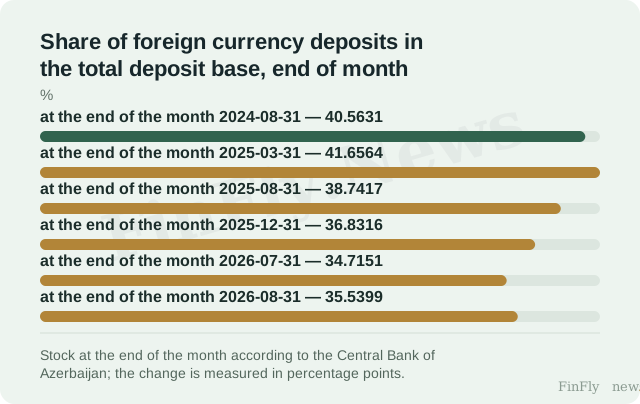
The Central Bank of Azerbaijan's indicator is the share of foreign currency deposits in the total deposit base at the end of the month, that is, a stock rather than a flow of deposits over the period. According to the IMF methodology on which the regulator relies, the deposit base includes deposits of non-residents, the central government, public organizations and municipalities. This is broader than household and corporate deposits, so the movement of the share reflects the composition of the base as well, not only depositors' choices. The change is measured in percentage points: the annual shift is minus 3.2 p.p., the monthly one is plus 0.82 p.p.
The total deposit base grew over the same year: at the end of August 2026 it amounted to 46,052.98 million manats versus 41,441.30 million manats a year earlier, that is, by approximately 11.1%. The decline in the share of foreign currency deposits occurred against the backdrop of an expansion of the entire base, not its contraction. At the same time, the share is not a measure of confidence in the manat and not proof of a change in depositors' preferences: exchange-rate revaluation and the composition of the base are not broken down in the provided data, so the direction of the share cannot be automatically translated into depositor behavior.
Where the boundary lies for a funding decision
For a company or bank planning funding in manats, the annual trend of a declining share of foreign currency deposits does not by itself determine the volume of manat balances: the provided sources contain only the share of foreign currency deposits and the total volume of deposits, while separate volumes of foreign currency and manat deposits are absent, so a breakdown into components using this data is impossible. The intermediate link — from the share of foreign currency deposits to the price and availability of manat funding for a specific borrower — has not been verified using this data: the sources contain neither rates nor volumes of manat borrowing. The August rise in the share by 0.82 p.p. additionally means that the structure of balances cannot be extrapolated along the annual line.
The share of foreign currency deposits is a stock at the end of the month, not a turnover of payments, not nominal demand and not contractual price volatility. A shift between monetary aggregates is not proof of a change in payment methods, and a change in the share is not equal to a change in the cost of credit. For a decision on the borrowing budget, pricing or procurement, a separate indicator tied to the decision is needed — for example, actual rates and volumes of manat borrowing for the same month; without it, a single share does not justify revising a plan.
The main point in this data is not the level of 35.54%, but the divergence in directions: annual de-dollarization versus the August rise in the share. Until exchange-rate effects and the composition of the base are broken down, it is reasonable to treat this as an observation about the structure of balances, not as a signal about confidence or a change in depositors' preferences. The next comparable observation is the share of foreign currency deposits at the end of September 2026: a continuation of growth after the August rebound will confirm a reversal, while a return to decline will preserve the annual trend.