
At the end of July 2026, the share of foreign currency deposits in Azerbaijan's total deposit base was 34.715%, according to data from the Central Bank of Azerbaijan. This is 0.427 percentage points below the June figure of 35.142% and 3.496 percentage points below 38.211% a year earlier. What matters is not only the direction but also the backdrop: total deposits and placements in the same month rose to 44,501.149 million manats, against 44,155.319 million a month earlier and 41,776.090 million a year earlier. The decline in the share of foreign currency balances is occurring against a growing total base, not a contracting one. It is precisely this divergence in directions that deserves scrutiny.
What exactly the figures show
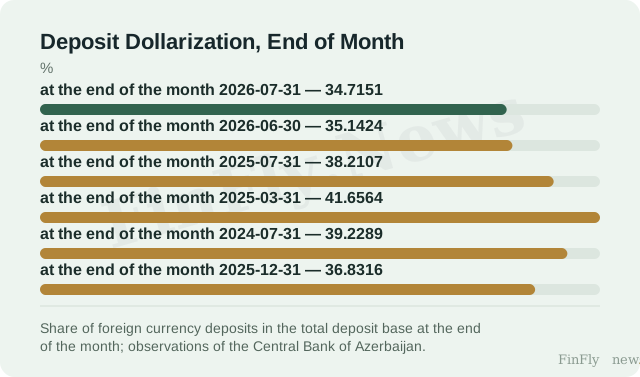
The indicator is measured as the share of foreign currency deposits in the total deposit base at the end of the month, that is, it is a stock, not a flow. A decline in the share of 0.427 percentage points over the month and 3.496 percentage points over the year describes a change in the structure of the aggregate stock. The total base, meanwhile, increased: growth over the month was 345.830 million manats, and over the year 2,725.059 million manats. Both movements are observed simultaneously, and this is the key feature of the picture.
It does not follow from this that foreign currency balances declined in absolute terms. The share can also decrease while the foreign currency component grows, if the manat component grows faster. In the observations provided, the indicator is not broken down into foreign currency and manat parts, so such a breakdown is not derived here. The correct statement is more modest: the structure of the aggregate stock shifted toward a smaller share of foreign currency funds amid a growing total volume.
Where the boundary of the practical conclusion lies
For a bank or a corporate treasury, this indicator is a guide to the structure of funding, not a signal for an immediate revision of the borrowing budget, prices, or the procurement plan. The share of foreign currency balances is not equal to payment turnover, nominal demand, or contractual price volatility. If the share continues to decline against a growing base, this may change the foreign currency liquidity profile; if it reverses upward, the foreign currency risk profile. But a decision requires observation that is not present in these data: a breakdown of balances by currency and maturity, as well as data on how foreign currency balances themselves changed in absolute terms.
A separate caveat concerns composition. Under IMF methodology, deposits include funds of non-residents, the central government, public organizations, and municipalities. This is a standing methodological caveat of the CBA, not an observation about a change in composition between periods; it may be a source of incomparability, but such an influence is not derived from the data provided and requires separate verification. The influence of the exchange rate and composition on the movement of the share is likewise not derived from the available observations.
The observed configuration — a declining share of foreign currency deposits against a growing total deposit base — by itself proves neither a change in confidence in the manat, nor an exchange rate effect, nor an inflow of manat deposits. It is a structural shift in the stock recorded at the end of the month. Practical meaning emerges only in conjunction with additional data breakdowns. The next comparable observation is deposit dollarization and the total deposit base for August 2026: whether it confirms a further decline in the share amid continued growth in aggregate balances.