
Azerbaijan's broad money supply at the end of July 2026 amounted to 53,925.49 million manats against 47,680.26 million a year earlier — growth of 13.1% calculated on comparable monthly stocks. However, the narrower aggregate M2 over the same annual interval grew by 19.6%, to 43,841.84 million manats. Both indicators are end-of-month stocks according to the CBA, and both are growing. The difference is not in direction but in speed: the narrow aggregate accumulated faster than the broad one. It is this relationship, and not the fact of growth itself, that sets the substantive question for business.
What exactly the end-of-July stocks show
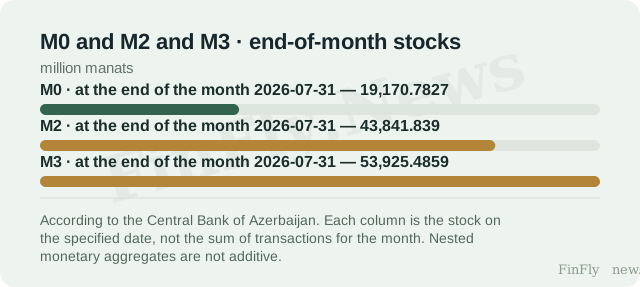
M3 is broad money supply; M2 is a narrower aggregate, alongside which the CBA tables present the cash aggregate M0. These are not independent quantities and not components of a single total: they cannot be added together. What is comparable is something else — the growth rates over an identical period. Over the month, from the end of June to the end of July 2026, M3 added 1.89%, M2 — 1.36%, M0 — 0.93%. Over the year the ranking is different: M3 +13.1%, M2 +19.6%, M0 +15.1%. The two cuts give a different order of the aggregates, and this difference in itself requires caution in conclusions about the dynamics.
It is useful to keep the distinction between stock and flow. All the values given are end-of-month balances, not sums of transactions for the month. From the fact that M3 in July is above the December 2025 level (49,860.31 million manats), it follows only that the July stock exceeded the previous mark. It does not follow from this either an acceleration of settlements, or growth in nominal demand, or a change in payment habits. A change in the relationship between the aggregates is also not evidence of a change in methods of payment: the aggregates differ in composition, not in payment technique.
Why the divergence in rates matters more than overall growth
If M2 grows faster than M3, then the difference between M3 and M2 over the year has narrowed: the component that distinguishes the broad supply from the narrower one decreased over the year, rather than growing more slowly than the rest. What exactly is included in this difference does not follow from the CBA series provided: they give only the values of M0, M2 and M3 without a methodology for the composition of the aggregates. This is a conditional consideration about composition, not an established cause: it does not follow from the CBA tables what exactly caused the divergence, and to substitute here movements in the exchange rate, rates or incomes would be speculation. The correct formulation is that the dynamics of the aggregates differed, while the specific mechanism of this difference cannot be determined from the available data.
For a specific task this creates a decision boundary. A company that is revising its borrowing budget, price list or procurement plan cannot rely on this indicator alone: the stock of money is not equal to payment turnover, nominal demand or contractual price volatility. For such a decision to have any basis at all, a separate benchmark tied to the decision is needed — for example, the actual cost of funding under its own credit lines or the observed terms of settlements with suppliers. Without this, monitoring the aggregates remains background rather than a signal to revise terms.
The main thing in the July data is not the growth of the broad money supply as such, but the divergence in rates: over the year M2 added 19.6%, whereas M3 — 13.1%. This difference describes the dynamics of the aggregates, not a proven cause and not a guarantee of future dynamics. The limitation here is fundamental: end-of-month stocks, from which, according to a CBA footnote, deposits of non-residents and the central government are excluded, show neither prices, nor rates, nor incomes, so they cannot be carried over into a forecast of inflation or the exchange rate. The next comparable observation is the M3, M2 and M0 balances at the end of August 2026: whether the July level of M3 will hold above the December 2025 mark and whether M2's lead over M3 will persist.