The Central Bank of Azerbaijan on 23 September 2026 kept its policy rate at 6.5% and the upper bound of the interest rate corridor at 7.5%, while lowering the lower bound by 0.5 percentage points — to 5%. This step looks all the more notable against the backdrop of State Statistics Committee data: in August 2026, consumer prices rose by 5.7% year on year, while food, alcoholic beverages and tobacco rose by 7.2%. Food inflation turned out to be higher than the policy rate, but remained below the upper bound of the corridor. It is precisely this divergence — between an unchanged rate and accelerated food inflation — that deserves scrutiny.
What exactly changed in the CBA decision
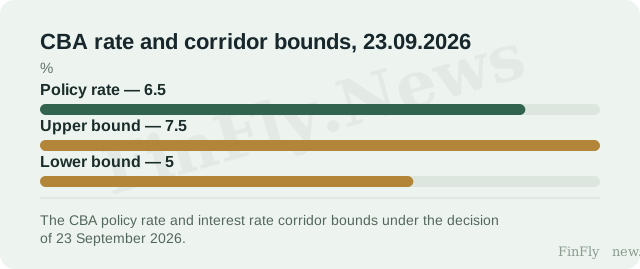
The Central Bank of Azerbaijan left its policy rate at 6.5% and the upper bound of the corridor at 7.5%, but lowered the lower bound by 0.5 percentage points — to 5%. In the regulator's statement, the decision is explained by the dynamics of actual and projected inflation, the situation in the foreign exchange market, changes in banking sector liquidity and trends in global monetary conditions. The lower bound of the corridor is not the rate on loans or deposits, but a benchmark for short-term bank liquidity. Therefore, lowering the lower bound does not in itself mean that banks will start issuing cheaper loans or paying less on deposits.
For comparison: annual inflation for all goods and services in August 2026 was 5.7%, while food, alcoholic beverages and tobacco rose in price by 7.2% year on year. Food inflation turned out to be higher than the policy rate of 6.5%, but did not exceed the upper bound of the corridor of 7.5%. This does not prove that the rate or the corridor caused the price dynamics: the CBA publication explains the lowering of the lower bound by support for the interbank market amid excess liquidity, rather than by a reaction to inflation. Data on actual bank rates on deposits and loans are absent from the sources, so transferring the regulator's decision to conditions for bank clients is not confirmed.
Why this matters for business and what remains outside the scope
For a company planning its borrowing budget or pricing policy, the CBA decision is not a ready-made signal to act, but a boundary beyond which additional data must be sought. If a business sees that food inflation (7.2% year on year) is higher than the policy rate (6.5%), this may indicate that pressure on costs persists, but it does not provide grounds for revising the credit budget or price lists. A key link is missing: actual bank rates on loans and deposits, which are not given in the CBA publication. Without them, it cannot be asserted that the regulator's decision has already been transmitted into the cost of money for business.
The limitation here is fundamental: the monetary decision and inflation are different series with different logic. The rate and the bounds of the corridor are instruments of the regulator, while inflation is the result of many factors, including prices for food, services and non-food goods. Lowering the lower bound of the corridor to 5% with an unchanged rate of 6.5% does not prove that loans will become cheaper, and does not refute the possibility that they will become more expensive. The next comparable observation is the next published CBA decision on the rate and corridor, as well as the State Statistics Committee publication on the CPI for September 2026. They will show whether the divergence between food inflation and the policy rate persists.
The CBA decision of 23 September 2026 left the policy rate at 6.5% and the upper bound of the corridor at 7.5%, lowering the lower bound to 5%. Against this backdrop, food inflation in August 2026 was 7.2% year on year — above the rate, but below the upper bound of the corridor. This divergence is not proof of a causal relationship, but a reason for business not to rush into revising credit and pricing plans. The key missing link is actual bank rates on loans and deposits, which are not in the CBA publication. The next check is a new regulator decision and CPI data for September 2026.