Two adjacent segments of Azerbaijan's money market moved in opposite directions in early October 2026. The one-day interbank rate AZIR stood at 5.8757% on October 8 versus 5.7632% the day before, i.e. it added 0.1125 percentage points. The yield on the CBA's 28-day notes at the October 7 auction dropped to 6.47% from 6.5% at the September 30 auction. This is not a rate decision or a change in the policy course: the policy rate of 6.5% has been in effect since February 5, 2026, and the lower bound of the corridor of 5% since September 24, 2026. What matters is something else: the cost of money for different maturities has ceased to be uniform.
What exactly diverged and by how much
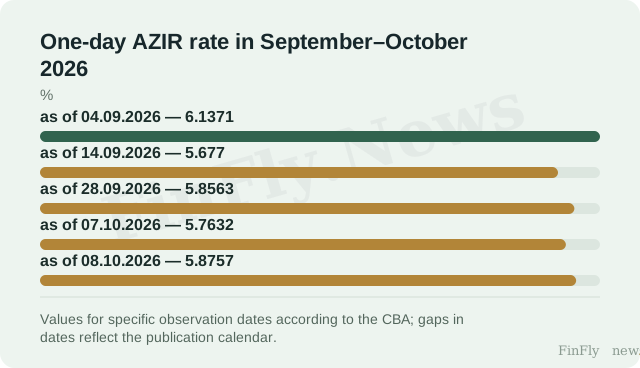
The one-day segment was not stable in September–October 2026. According to the CBA, on September 4 AZIR was 6.1371%, on September 14 — 5.677%, on September 28 — 5.8563%, on October 7 — 5.7632%, and on October 8 — 5.8757%. The spread between observations reaches almost half a percentage point, and the latest move fits within that same range. In other words, the rise of 0.1125 p.p. is a fluctuation within the band that has already taken shape, not a break out of it. The lower bound of the corridor of 5% has been in effect since September 24, 2026, and all the AZIR values cited remain above it.
The monthly segment behaves differently. The yield on the CBA's 28-day notes at the July 29, 2026 auction was 5.63%, at the September 30 auction — 6.5%, at the October 7 auction — 6.47%. A decline of 0.03 p.p. over a week is small in itself, but it continues a line different from the one-day segment: the notes trade noticeably above AZIR. The gap between 6.47% and 5.8757% is not a spread that we calculated, but a direct comparison of two published values for adjacent dates. It shows that for money for a month the market asks more than for money for a night.
Why this matters for a specific decision and what the data do not show
For a company planning short-term funding in manats, this configuration sets the boundary of a decision, not the answer. If the need is covered overnight, the benchmark is a rate of about 5.88%; if the horizon is a month, the benchmark becomes the note yield of 6.47%. Provided that the one-day rate continues to fluctuate near its current level, extending borrowing at a fixed rate will cost more than a series of overnight transactions; under the opposite movement, the picture changes. But neither AZIR nor the note yield is a loan rate for a non-bank borrower: these are indicators of the interbank market and the regulator's auctions, and the risk premium of a specific borrower is not included in them.
The limitation here is fundamental. The one-day move in AZIR and the weekly decline in note yields prove neither a change in the monetary policy course nor a causal link between the segments. The policy rate of 6.5% has been in effect since February 5, 2026, the upper bound of the corridor of 7.5% since the same date, the lower bound of 5% since September 24, 2026; decisions on these parameters have not changed. The next comparable observation is the next daily AZIR value after October 8, 2026, together with the next CBA auction of 28-day notes. If the one-day rate remains near 5.88% while note yields decline further, the divergence of the segments will persist; if AZIR returns to levels around 5.76%, the move will prove to be one-off.
The divergence of the two money market segments is a fact about the maturity structure, not a signal of a policy reversal. The one-day rate fluctuates within a band above the lower bound of the corridor, monthly notes trade above the one-day rate, and the policy rate and the corridor bounds remain unchanged since their effective dates. For business, the practical conclusion is more modest than it seems: the cost of short-term money depends on the chosen maturity, and one should focus on the instrument that matches the horizon of the need, not on the freshest number.