
The one-day interbank rate AZIR stood at 5.8% on 15 October 2026, according to the Central Bank of Azerbaijan. The yield on 28-day notes of the same regulator at the auction on 14 October 2026 was 6.44%. One regulator, adjacent dates, a short horizon — yet two different levels. The substantive fact here is not the AZIR level itself, but that overnight funding and the CBA's one-month instrument were priced differently on these days, with the money market rate coming in below the yield on the notes.
What the figures show
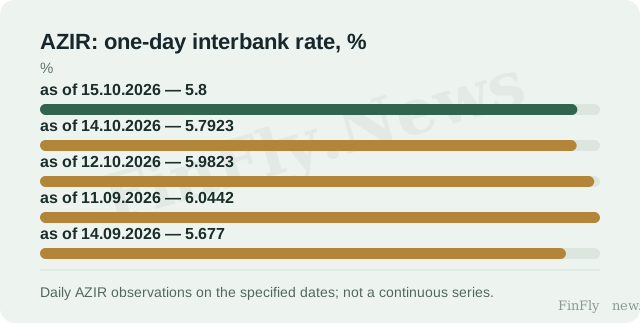
AZIR is the one-day interbank money market rate, the price at which banks lend to each other for a day. The yield on 28-day CBA notes is the result of a separate auction on a specific date, not a continuous series. On 14 October 2026 it was 6.44%; a week earlier, on 7 October, it was 6.47%. The difference between 5.8% and 6.44% is neither an error nor a contradiction: the instruments differ in term and in nature. But it shows that the short segment of the money market and the regulator's one-month instrument were priced unequally on these days.
Within AZIR itself, fluctuations are noticeable: on 11 September 2026 the rate was 6.0442%, on 14 September — 5.677%, on 12 October — 5.9823%, on 14 October — 5.7923%, on 15 October — 5.8%. The one-day rate moves. Since 24 September 2026 the lower bound of the corridor has been 5.0%; previously it was 5.5%. The observation on 15 October places AZIR near this bound, but a single point does not describe a sustained position. The policy rate of 6.5% and the upper bound of the corridor of 7.5% are given in the data with a single effective date — 5 February 2026 — without a series of changes.
Where the decision boundary for business lies
For a company or bank that funds itself at short money market rates, the AZIR level on a specific date is a reference for the cost of overnight resources, while the yield on the notes is a reference for the one-month instrument. The intermediate link here is decisive: access to the interbank deposit market, the size of the contract and the ability to raise the amount for the required term determine whether the AZIR observation will be reflected in a particular organisation's actual funding cost. Without these conditions, the rate level by itself does not change a borrowing budget.
AZIR is a rate between banks, not a loan or deposit rate for clients. The link between the interbank rate and retail rates is not shown in the provided data, so the AZIR level is insufficient for decisions on loan or deposit products. A separate observation is needed — rates on specific products, not the money market value. The gap between 5.8% and 6.44% is correctly read as a comparison of two observations on nearby dates, not as a measurement of a sustained term premium.
The main fact is not the AZIR level itself, but its position relative to the lower bound of the corridor while the yield on 28-day CBA notes is noticeably higher. This is a difference between the overnight and the one-month instrument, not a signal of a change in the regulator's policy: the policy rate of 6.5% and the upper bound of 7.5% are represented in the data by a single effective point, and no conclusion about their being unchanged follows from it. For business, the observation remains a reference for short-term funding, but it does not replace data on rates for specific products.