The weighted average rate on loans in manats in September 2026 was 15.79% — the maximum in the available observation history since September 2024. Over the month, the indicator added 0.05 percentage points; over the year, 0.48 points. The CBA policy rate has been stated at 6.5% since February 5, 2026. These two numbers describe different things: the policy rate is a monetary policy instrument, while 15.79% is the weighted average cost of manat loans across all maturities and borrowers. For a company planning borrowings, it is the second that is closer to what it will see in the contract, but even that is not its individual offer.
What exactly the average rate shows
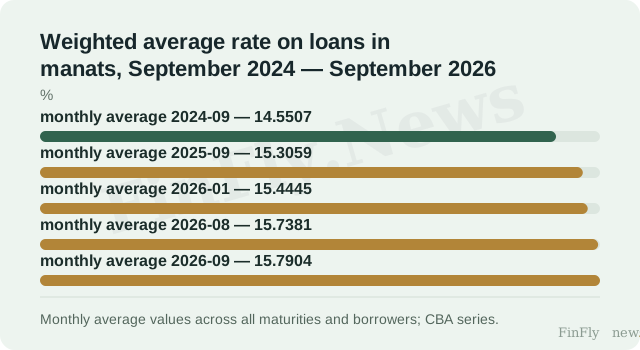
The CBA indicator is the weighted average rate on loans in manats across all maturities and borrowers, monthly average. It is not the rate of a specific bank and not the rate of a specific client: transactions differing in risk, maturity and collateral are collapsed into a single number. Therefore 15.79% is an aggregate, not an offer that a company will receive. The dynamics within the available history are uneven: in September 2024 the average rate was 14.55%, in September 2025 — 15.31%, in January 2026 — 15.44%, in August 2026 — 15.74%, in September 2026 — 15.79%.
The policy rate of 6.5% has been in effect since February 5, 2026. This is a level, not an average across transactions, and it relates to CBA instruments, not to banks' loan portfolios. Comparing the interest rate on loans with the policy interest level as a ratio is incorrect: these are quantities different in meaning, and the size of the gap between them does not follow from these data. The correct observation is simpler — the actual average cost of a manat loan in September 2026 was noticeably higher than the policy rate level, and this gap persisted.
Where this changes a business decision
The practical conclusion for a company planning borrowings in manats is not to abandon a loan, but not to build its debt-servicing budget on the policy rate. If 6.5% is used in the calculation while the actual weighted average rate on manat loans is around 15.79%, the budget gap may prove substantial. But the average rate is also not a rate available to a specific company: it describes neither its sector, nor maturity, nor collateral. For a budget stress test, a rate on a comparable transaction is needed — a bank's offer for a specific maturity and type of collateral. The average rate here is background, not a benchmark.
This indicator alone is insufficient for revising a credit budget, procurement plan or pricing. The average rate does not say what rate is available to a specific company, and does not describe the terms of already existing contracts. A decision requires observation tied to the transaction itself: the rate offered by the bank for a specific maturity and type of collateral. As long as there is no such observation, the average rate remains background, not a basis for changing obligations.
The September value of 15.79% is the maximum in the available history, and it coexists with the policy rate level of 6.5% stated since February 5, 2026. For a borrower, what matters is not the policy rate as such, but that the average cost of a manat loan is formed separately from it. The next comparable observation is the average rate on loans in manats for October 2026: whether it will show continued growth above the September level or a reversal, and whether an official publication on a change in the CBA policy rate will appear.