
The digital economy has a thoroughly material foundation: cables, power supply, servers and the specialists who keep them running. But the presence of that foundation does not yet answer the main economic question: who will pay for the services and what share of the revenue will remain in the country. For Azerbaijan this question is especially relevant after the news about connectivity across the Caspian and the rapid growth of the information and communication sector.
Two events in one week
On October 15, the presidents of Azerbaijan and Kazakhstan opened the trans-Caspian fiber-optic communication line. FinFly reported on this in a separate article. The launch of the line expands infrastructure capabilities, but by itself it does not yet show its commercial utilization and revenue from customers.
Earlier in the week, the State Statistics Committee reported that real value added in information and communication for January-September grew by 11.1%, while the country's GDP increased by 1.5%. The share of information and communication in GDP was 2%. The sector is growing fast, but its weight is still substantially smaller than the growth rate that makes the headline.
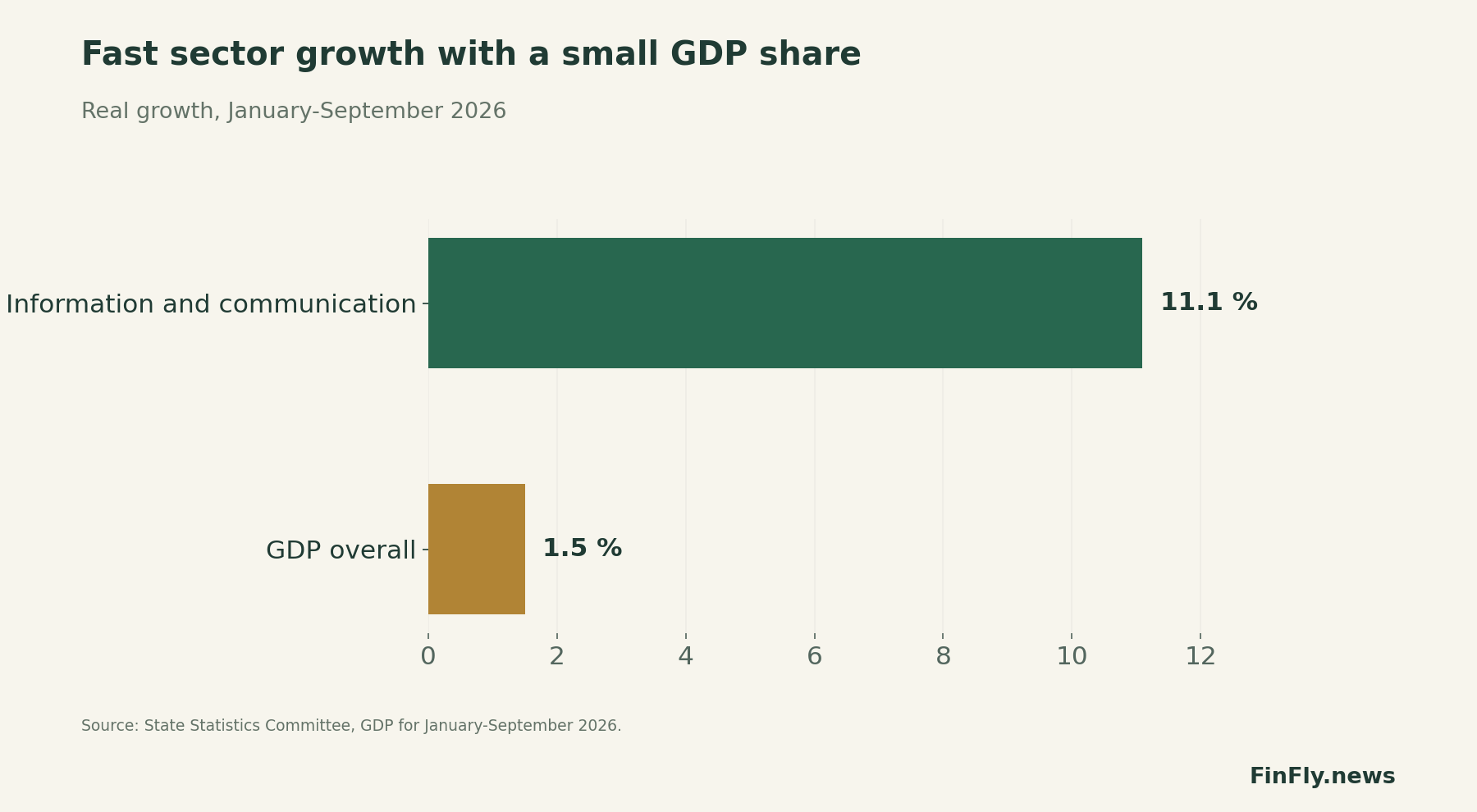
These data do not prove that the growth was driven specifically by startups or software exports. The industry category combines different types of activity. To understand the sources of the increase, separate indicators are needed for communications, software services, external sales and the number of customers. Attributing the entire result to one group of companies without such detail would be incorrect.
Transmitting data and selling a product
International connectivity makes it possible to sell bandwidth and build new routes. For an operator this is a business of network utilization, reliability and contracts. For a software developer the task is different: to solve the client's problem in such a way that the client regularly pays for using it. Good infrastructure makes the work easier, but it does not replace demand.
Between these two levels lie cloud services, equipment hosting, information security and maintenance of corporate systems. Local value added can form here. But each segment requires its own economics. For a data center, energy, cooling, utilization and redundancy matter. For a development team, the cost of hiring, sales and customer retention matter. A single overall ICT growth percentage does not show the state of these businesses.
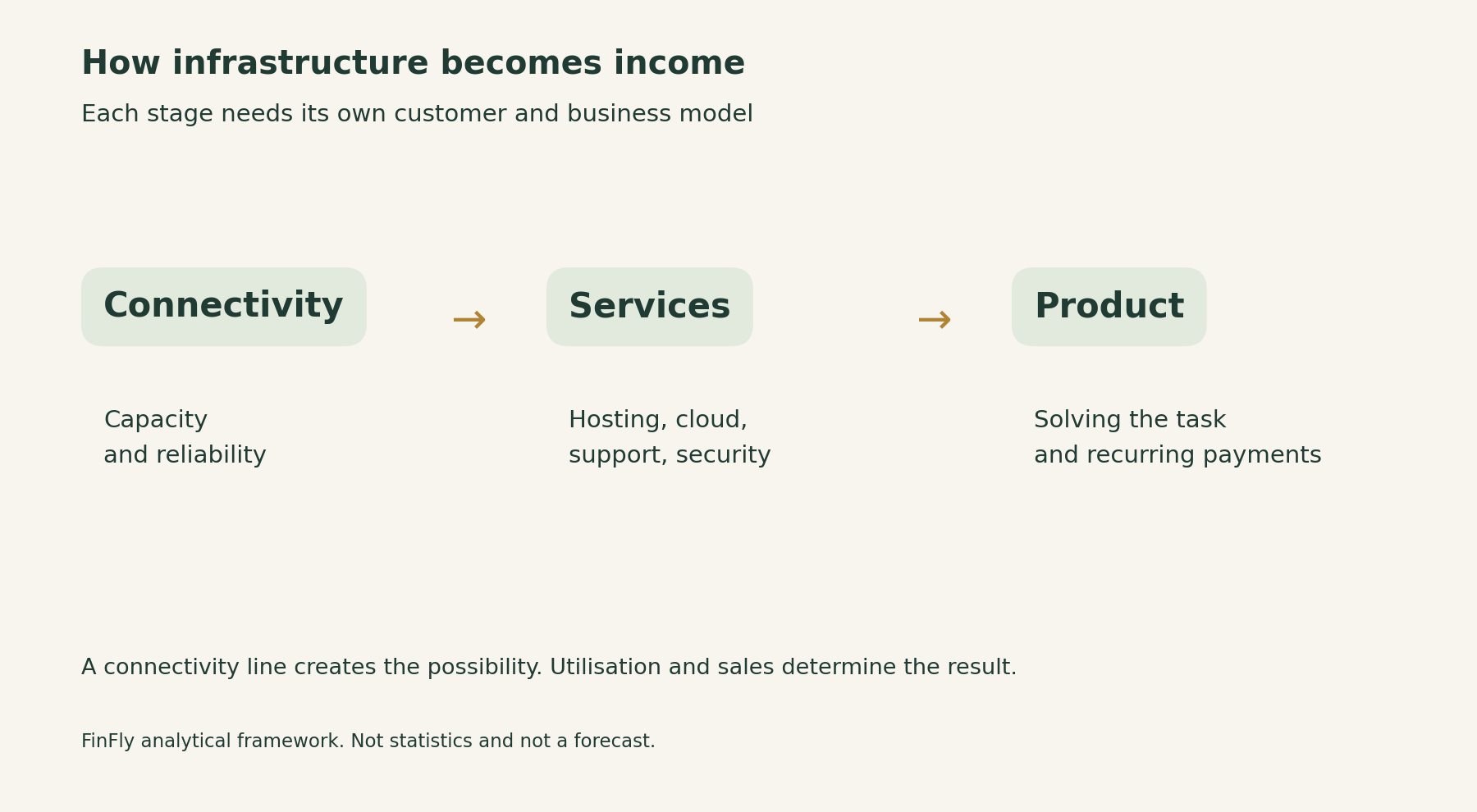
A new route can increase choice for international clients. However, they compare more than geography. They need verified service availability, clear rules for handling data, technical support and a predictable price. Therefore a competitive advantage arises not at the moment of the opening ceremony, but when the infrastructure consistently fulfills contractual obligations.
Where the money remains
The economic effect depends on what exactly is produced inside the country. Reselling imported equipment can increase turnover, but most of the payment will go to an external supplier. Development, operation and maintenance create a different structure of expenses and revenues. For assessment it is useful to count local wages, taxes, profit and services purchased domestically, and not only the sum of contracts.
This does not make the equipment trade useless. It can ensure the adoption and availability of technologies. But it cannot, without explanation, be placed on the same level as exports of one's own software product. These models differ in their dependence on external suppliers, their scalability and the sustainability of recurring revenue.
For small companies, the most realistic entry point may be a specific task of an existing business: inventory accounting, payments, document flow or data protection. Here value is measured by the customer's time savings, reduced losses and sales growth. If a product does not deliver such a result, a reference to the promise of digitalization will not help retain the client after the first contract.
What will distinguish digital growth from a construction phase
The commercial result of digitalization is reflected by infrastructure utilization, repeat contracts, service exports and revenue per employee. For product companies, subscription renewals and the cost of customer acquisition matter. For network operators, reliability and paid bandwidth matter. These indicators describe different business models and make it possible to separate infrastructure expansion from sustainable commercial demand.
Azerbaijan has gained another infrastructure opportunity. Its value will be determined by how successfully paid services form around connectivity. The rapid growth of the sector gives reason to study this market more closely. And the main proof of success will be customers who return and pay because they get the result they need.