
For January–August 2026, according to data from the State Customs Committee of Azerbaijan, exports of goods amounted to 21,815.04 million dollars, imports — 11,423.35 million dollars, and the positive balance — 10,391.69 million dollars. The main point here is not the size of the surplus, but its structure: the value of exports of crude oil (9,281.89 million dollars) and natural gas (5,710.87 million dollars) is shown as separate positions, and each of them is comparable to the magnitude of total imports for the same period. The positive balance rests on a narrow group of commodity positions, not on a broad export basket.
A surplus that rests on two positions
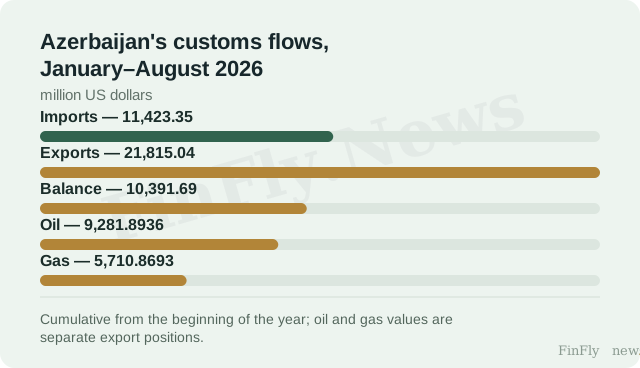
In the provided data, the value of oil and gas exports is shown as separate positions, each of which is comparable to the magnitude of imports for the same period (11,423.35 million dollars). This does not mean that the surplus is created only by them: there are other positions in exports as well, and the balance is the difference between total exports and total imports. But the scale of the two commodity items shows how narrow the support of the positive balance is: a change in the value of either of them directly affects the final balance.
Volumes emphasize the same picture: 14.68 million tonnes of crude oil and 16.38 billion cubic meters of natural gas over eight months. Value and volume in customs data are accounted for separately, so value cannot be derived from volume by simple multiplication. For business, this means that the stability of the balance depends not only on physical supplies, but also on price conditions, which are not separately disclosed in these data.
What this means for an importer and where the limit of the conclusion lies
If a company purchases imported goods or depends on commodity exports, it should plan for sensitivity to the value of oil and gas. A change in the value of these two items directly affects the final balance of 10,391.69 million dollars. This is conditional logic, not observed causality: customs data record the value of flows, but do not show how a change in the balance translates into the availability of currency, credit, or prices for a specific enterprise.
Therefore, the surplus by itself is not a sufficient basis for changing a procurement budget, pricing policy, or borrowing plan. The customs balance is the difference between exports and imports according to customs data, not a foreign exchange inflow into the economy, not an indicator of self-sufficiency, and not an indicator of the well-being of importers. For a decision, an observation specific to a particular business is lacking: for example, data on its own contract prices and foreign exchange revenue.
Azerbaijan's customs surplus for January–August 2026 is a cumulative total in which the positive balance rests on a narrow group of commodity positions. This proves neither the causes of the surplus nor its stability: there is no comparable base from last year, no monthly dynamics, and no publication date. For business, the conclusion remains conditional: sensitivity to the value of oil and gas should be taken into account, but the balance alone is not enough to revise purchases or borrowing.