
In January–August 2026, Azerbaijan's customs balance amounted to 10,391.69 million US dollars: exports — 21,815.04 million, imports — 11,423.35 million. What matters here is not the size of the surplus but its structure. Two commodity positions — crude oil (9,281.89 million) and natural gas (5,710.87 million) — together exceed in value all of the country's imports for the same period. The surplus rests on a narrow raw-material set rather than a broad export assortment, and this changes the meaning of the indicator for those planning purchases and settlements.
The balance as the result of two items, not broad exports
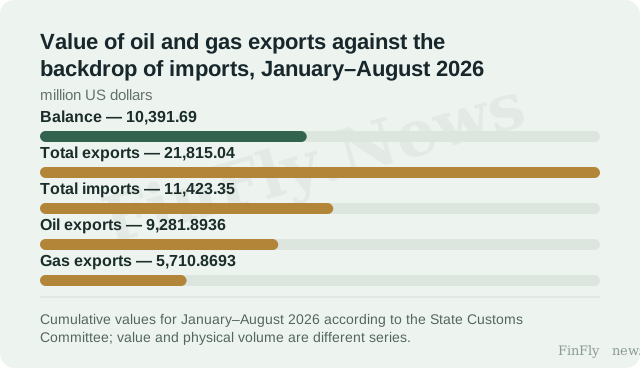
The State Customs Committee publishes the balance on a cumulative basis: exports minus imports for eight months. Of the 21,815.04 million dollars in exports, crude oil accounted for 9,281.89 million and natural gas for 5,710.87 million. Imports for the same period were 11,423.35 million. In other words, two raw-material positions exceed in value all goods brought in, while other export directions in total are noticeably smaller than them.
Such concentration is not a detail of sectoral statistics but a characteristic of the surplus itself. When a positive balance is formed by a few large items, its stability depends on the behavior of precisely those items, not on the overall state of the export set. The indicator remains correct as a customs total, but it ceases to be an indicator of broad competitiveness: it describes the ratio of two raw-material flows and all imports, not diversified exchange.
What this means for business and what it does not show
For a company that purchases imports or receives foreign-currency revenue from raw-material supplies, the practical conclusion is conditional: if oil and gas prices change while physical volumes remain the same, the balance will shift. Physical volumes for January–August 2026 amounted to 14.68 million tonnes of oil and 16.38 billion cubic meters of gas. But value and volume are different series, and they cannot be used to decompose the change in the balance into price and physical parts. Therefore this indicator alone is not enough to change a procurement budget, pricing, or payment schedule.
The limitation is significant: this is a cumulative total for eight months without a comparable history in the provided data, without a commodity breakdown of imports, and without information on prices and the exchange rate. The customs balance is not the current account balance and not a budget surplus: services, income, and transfers are not reflected here. The next comparable observation is the publication for January–September 2026: to compare the cumulative balance, the value and the physical volume of oil and gas exports, in order to see whether the surplus moves with prices or with volumes.
A surplus of 10,391.69 million dollars is the result of a narrow raw-material base: oil and gas exceed in value all imports. For business this means sensitivity to the prices of these two positions, but it does not provide grounds to revise a procurement or payment plan: data on prices, the exchange rate, and the commodity structure of imports are needed. What is worth watching is how the value and physical volume of raw-material exports relate in subsequent cumulative publications.