The one-day interbank rate AZIR on 7 October 2026 was 5.7632%, according to the CBA. This is below the policy rate of 6.5% in effect since 5 February 2026, and below the yield of 28-day notes of 6.47% at the auction on the same day, but noticeably above the lower bound of the interest rate corridor of 5.0% in effect since 24 September 2026. In other words, money between banks is trading not at the floor of the corridor, but in its middle part, while the short official benchmark remains more expensive than the market. It is precisely this divergence — the market is cheaper than the official benchmark, but not at the lower bound — that is the main subject of observation.
What the figures show
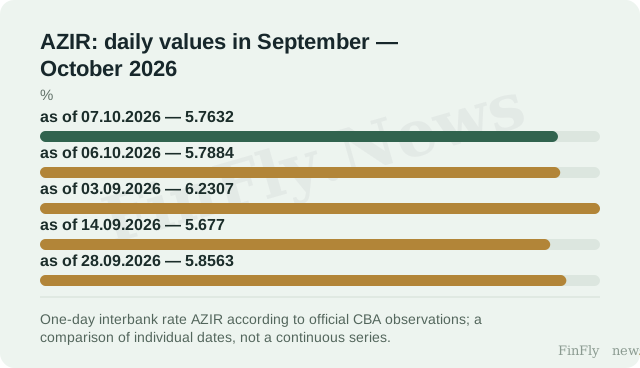
AZIR on 7 October 2026 — 5.7632%, the day before — 5.7884%, that is, a decline of 0.0252 percentage points, according to a FinFly calculation based on official observations. Within September the rate fluctuated: 6.2307% on 3 September, 5.677% on 14 September, 5.8563% on 28 September. The spread of these daily values shows that the one-day market is mobile, not that the rate is steadily moving in one direction. The comparison with 6.2307% in early September and 5.7632% in October is a comparison of two dates, not proof of a trend.
The CBA benchmarks are structured differently. The policy rate of 6.5% has been in effect since 5 February 2026, the upper bound of the corridor of 7.5% — since the same date, the lower bound of 5.0% — since 24 September 2026, previously it was 5.5%. The yield of 28-day notes at the auction on 7 October — 6.47%, at the auction on 30 September — 6.5%, on 29 July — 5.63%. AZIR is below the policy rate and the notes, but above the lower bound of the corridor: the market is not pressed to the floor, although it is cheaper than the official benchmark. It is important to distinguish between these instruments: the yield of notes is the result of an auction for a specific instrument on a specific date, not a policy rate, therefore its comparison with AZIR is conditional and does not mean a single benchmark.
What this means for business and what it does not prove
For a treasury that plans short-term funding in manats, the configuration as of 7 October 2026 means: one-day money on the interbank market costs less than the policy rate and the yield of notes. But this condition will persist only as long as AZIR does not converge with the lower bound of the corridor of 5.0% or until the CBA revises its parameters. In itself, this observation does not justify a change in the borrowing budget, prices or procurement plan: AZIR is a rate between banks on a specific day, not a rate on a loan or deposit for businesses and the population.
The limitation here is fundamental: the decline in AZIR from 6.2307% on 3 September to 5.7632% on 7 October does not prove a causal influence on retail or corporate rates. For a funding decision, a separate benchmark is needed — the actual cost of a short-term loan or placement for a specific borrower, not the interbank rate. The next comparable observation is the daily AZIR values after 7 October 2026 and the nearest auction of 28-day notes: whether the rate remains in the range of 5.7–5.9% or begins to converge with the lower bound of 5.0%, and whether the yield of notes changes relative to 6.47%.
The main point in the observation of 7 October 2026 is not the level of AZIR itself, but its position: 5.7632% is below the policy rate of 6.5% and the yield of notes of 6.47%, but above the lower bound of the corridor of 5.0%. This means that the one-day interbank market is cheaper than the official benchmark, yet is not at the floor of the corridor. For business this is a condition, not a guarantee: the cost of short-term funding is determined by specific contractual rates, not by the rate between banks. What is worth watching is whether AZIR approaches 5.0% and how the yield of notes behaves relative to 6.47%.