
For January–August 2026, the customs value of crude oil exports amounted to 9281.89355 million US dollars, while total exports of goods reached 21815.04 million dollars, and exports of natural gas — 5710.86927 million dollars. Oil remains the largest single item of export revenue, but its value is not equal to the entire export, nor to budget revenues, nor to the profit of oil companies. Gas is a separate commodity item that can neither be added to oil as a single commodity, nor substituted for the oil item.
What the figures for January–August show
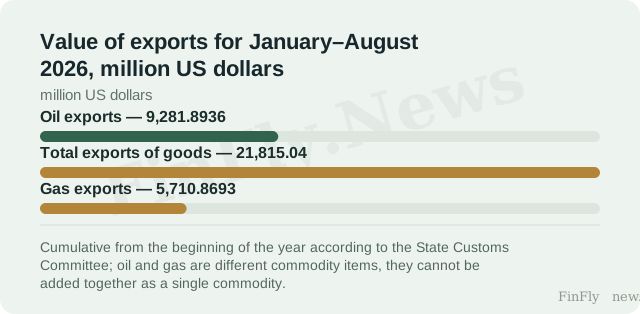
The State Customs Committee publishes these values on a cumulative basis from the beginning of the year, that is, for the eight months of 2026, and not for a single month. The value of oil exports is 9281.89355 million US dollars, the value of gas exports is 5710.86927 million US dollars, total exports of goods are 21815.04 million US dollars. Imports for the same period amounted to 11423.35 million dollars, and the foreign trade balance — 10391.69 million dollars. This is the customs value for specific commodity items, not budget revenues and not the financial result of companies.
Volume indicators come separately from value indicators: oil exports — 14.6779516 million tonnes, gas exports — 16.37757925 billion cubic metres. Value and volume in the source are not linked by a calculation of price per unit, therefore from these lines it is impossible to derive either an average price or the contribution of price to the change in value. There is no comparable period of the previous year in the provided data, therefore the direction of dynamics for these lines is not assessed.
The decision boundary for business and what is missing
For a company whose revenue or budget expectations are tied to oil export revenue, the practical boundary runs along the composition of items: oil, gas and other goods are different items, and the value of oil exports does not replace total exports. If the condition for a decision is specifically the oil item, then gas and the rest of exports must be kept separate, and not collapsed into a single indicator. This is a difference in the structure of revenue, not a signal to change the borrowing budget, prices or purchases.
The value of oil exports by itself describes neither payment turnover, nor nominal demand, nor contractual price volatility, nor the receipt of funds into the budget. For a decision on the borrowing or procurement budget, an observation specific to that decision is missing: for example, disclosure of price per unit or a monthly breakdown, as well as a comparable period of the previous year. Without them, the value of exports remains a descriptive quantity, and not a basis for revising plans.
The main conclusion is structural, not dynamic: for January–August 2026, oil forms the largest single item of export value, but does not exhaust it, and gas is a separate item. Such a ratio should be read as a description of the composition of exports, and not as proof of causes, a sustained shift or a link to the budget. The next comparable observation is the publication of the State Customs Committee for January–September 2026: to compare the value and volume of oil and gas exports with the cumulative total for January–September of the previous year, that is, the cumulative total for nine months with the cumulative total for nine months of another year, and not with the same period.