
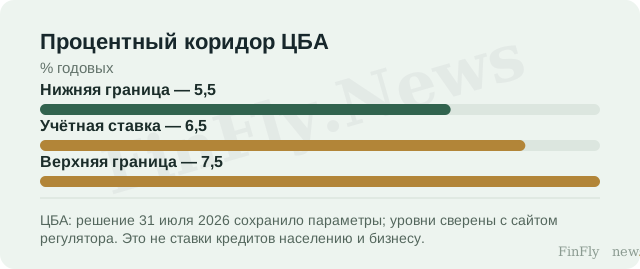
The Central Bank of Azerbaijan's decision to keep its policy rate at 6.5% does not mean an absence of monetary policy decisions. In its explanation on 31 July 2026, the regulator described two opposing factors: an upward revision of the inflation forecast supports a tighter approach, while a significant excess of foreign exchange supply over demand supports a looser one. The unchanged interest rate corridor was the result of this balance, not evidence that risks have disappeared.
Forecast above current inflation
The CBA's July baseline forecast projects annual inflation of 6.1% by the end of 2026. This is slightly above the upper bound of the target range of 4% plus or minus 2 percentage points. The regulator itself notes that the deviation falls within the forecast error. This is a scenario estimate, not an already realised price increase or a promise of a specific outcome.
Subsequent data from the State Statistics Committee show inflation at 5.7% in August 2025 year-on-year. Comparing this with the forecast is useful for understanding the starting point, but not for declaring it erroneous: the August observation and the December forecast target refer to different dates. Within the August basket, there is no single speed either: food, alcohol and tobacco rose by 7.2% year-on-year, non-food goods by 3.7%, and paid services by 5.0%.
Excess money requires operations
In its July decision, the CBA reported that foreign exchange supply significantly exceeded demand in both cash and non-cash segments. The regulator absorbed this excess. When a central bank buys foreign currency for national currency, such an operation, all else being equal, adds local currency liquidity. Therefore, maintaining the chosen monetary conditions may require offsetting liquidity withdrawal even without changing the policy rate.
This is not just a theoretical mechanism. The CBA explicitly points to the use of seven-day deposit operations: at the end of June, they accounted for 84.3% of the sterilisation portfolio through open market operations. The regulator also conducts note auctions. Through such instruments, part of banks' free funds is placed with the central bank, and the parameters and volumes of operations become a separate element of monetary policy.
The structural surplus of banking liquidity, excluding required reserves, reached 6 billion manats by the end of the first half of the year. The CBA links this to the system's substantial credit potential. However, the availability of resources and the readiness to issue a specific loan are different conditions. Excess liquidity alone does not remove risk assessment, collateral requirements, or the difference between borrowing tenors.
What the borrower sees
For a company, the corridor of 5.5–7.5% with a policy rate of 6.5% is a guide to the regulator's policy, not a range within which it must be offered a loan. The terms of a bank contract depend on both the cost of resources and the client's risk. Therefore, the decision to "keep the rate unchanged" is insufficient either to conclude that loans will definitely not become cheaper or to promise the opposite.
A more meaningful signal is the combination of the inflation forecast, the state of the foreign exchange market, and liquidity management operations. If excess foreign exchange supply persists, the need for such operations may remain substantial. If price risks intensify, the balance of arguments could shift. These are conditional mechanisms, not a forecast of the regulator's decision.
The next decision on the CBA's corridor is announced for 23 September. When reading it, not only the new rate level matters, but also how the wording on inflation and foreign exchange supply changes. It is these that will show whether the balance that led to the rate being kept unchanged in July remains the same.