
In July 2026, Azerbaijan's money base declined from June — to 25,760.95 million manats, whereas the broad aggregate M2 for the same month grew, and cash outside banks M0 also increased. The directions of movement of base money and broad aggregates diverged. This is not a paradox and not a signal of a policy reversal: it concerns end-of-month stocks, where some components are calculated based on the calculation period for the previous month. For business, the practical conclusion is more modest than the headline: a single indicator does not describe monetary conditions in full.
Why the base and broad aggregates diverged
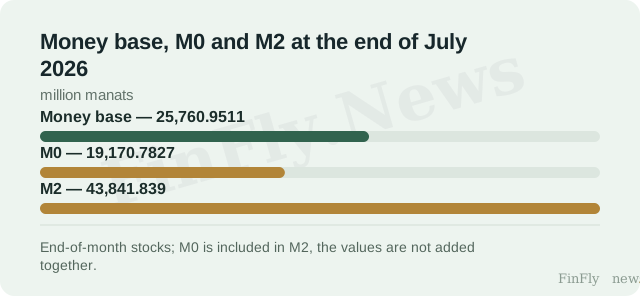
The money base is cash in circulation, banks' correspondent accounts and required reserves, that is, the central bank's liabilities to the banking system. M2 is broader: it includes the deposit component and therefore reflects not only the regulator's decisions but also the behavior of banks and their clients. M0 — cash outside banks — is included in M2, so these values cannot be added together. In July, the base decreased, while M2 and M0 increased: end-of-month stocks can move in different directions because they are backed by different balance sheets.
A separate detail is methodology. The Central Bank of Azerbaijan calculates required reserves within the base based on a calculation period covering the previous month, and deposits of non-residents and the central government are excluded from the aggregates. Therefore, the monthly comparison is partially lagged and does not reflect a snapshot picture. A decline in the base from June amid annual growth is a decline from the previous month amid year-on-year growth, not a break in the trend.
What this changes for business decisions
If a company is planning a borrowing, procurement or price-list budget for autumn 2026, the dynamics of the money base alone do not justify revising those plans. The stock of money is not the turnover of payments, not nominal demand and not contractual price volatility. Even the divergence in directions between the base and M2 does not prove either easing or tightening of monetary conditions: it shows only that different parts of the balance sheet moved differently. A decision requires monitoring tied to a specific obligation — for example, actual funding rates or the terms on already agreed credit lines.
The practical boundary here is this: as long as there is no data on the cost of borrowing and on the terms for which the company borrows, the signal from monetary aggregates remains background. Annual growth of M2 by 19.6% and M0 by 15.1% is a comparison of stocks at the end of July 2026 with the end of July 2025, not confirmation that loans have become cheaper. If the condition for revising the budget were the persistence of the divergence between the base and broad aggregates, then that is precisely what should be checked, not a single monthly figure.
The divergence in directions in July 2026 is an observation about the structure of stocks, not about a change in monetary policy. The money base declined from June but grew over the year; M2 and M0 increased both month-on-month and year-on-year. For business, this means that relying on a single aggregate when planning funding is risky: different parts of the monetary system can move apart, and methodological features — the reserve calculation period, the exclusion of deposits of non-residents and the government — amplify this heterogeneity.