
The Central Bank of Azerbaijan set the official euro rate at 1.9507 manats for September 21, 2026, whereas a month earlier, on August 21, it stood at 1.9877 manats. Over the same period, the official dollar rate did not change: 1.7 manats on both August 21 and September 21. This is not a general shift in the manat, but a divergence between two currency lines: the movement came through the euro, not through the manat against the dollar. For business, this distinction is fundamental, because the contract currency determines which quotation enters the calculation and which remains unchanged.
What three dates show and why this is not a general shift in the manat
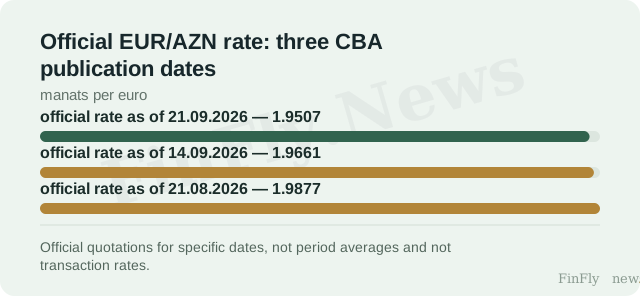
A comparison of three CBA publications gives a narrow but clear picture. On August 21, the euro cost 1.9877 manats; on September 14, 1.9661; on September 21, 1.9507. The dollar held at 1.7 manats on all three dates. If the manat were strengthening against all currencies at once, both lines would move in concert; here only one changed. Therefore, the correct formulation is a decline in the official EUR/AZN rate, not a strengthening of the manat overall. The difference matters for anyone recalculating liabilities or receipts between currencies.
The official rate is a quotation for a specific date, not an average for a period and not a transaction price. It sets a benchmark for conversion, but a bank or counterparty conducts the operation at its own rate, which may differ. From three observations, one cannot derive either a sustained trend or its causes: they show only that a divergence between the euro and the dollar existed during this period. For a contract in euros, the same amount in euros requires fewer manats when converted at the official quotation; for a contract in dollars, this effect does not appear, since USD/AZN did not change.
Where this changes a decision and where it does not
The practical significance of the divergence appears at the moment of conversion, not at the moment of signing. If a company has a liability or receipt denominated in euros, then when converted to manats at the official rate, the converted amount on September 21 will be lower than on August 21. If the liability is denominated in dollars, the official conversion will not change. This is not a recommendation to change the borrowing budget, prices, or procurement plan: the official quotation by itself describes neither payment turnover nor the actual cost of money for a specific transaction.
A decision to revise the contract currency, prices, or payment schedule requires a different observation — the rate at which the operation is actually conducted, and the terms of the specific agreement. The CBA official rate answers the question of conversion at the established quotation, but not the question of the price at which a bank or counterparty will close the deal. As long as this observation is absent, the divergence between EUR/AZN and USD/AZN remains a fact about quotations, not a basis for restructuring contract policy.
The main point in these three dates is not the size of the change, but its selectivity: the euro fell against the manat, the dollar stayed put. This makes the contract currency, rather than an overall assessment of the manat, the key distinction for conversion. The next comparable observation is the official EUR/AZN and USD/AZN rates on subsequent CBA publication dates: they will show whether the divergence in the dynamics of the two currencies persists or was a brief episode.