
Official CBA observations show a divergence between the administrative benchmarks of the money market and the actual price of one-day interbank money: the upper bound of the interest rate corridor is fixed at 7.5%, the policy rate at 6.5%, both in effect since February 5, 2026, while the AZIR rate as of September 17, 2026 was 5.8077%. This is not a ceiling on rates on loans to households and not a CBA decision to ease: the corridor sets operational frameworks, while AZIR reflects banks' daily transactions. The gap matters because it shows how far the market price of short-term liquidity stands from the upper bound, not because it predicts future rates.
What exactly is recorded in the observations
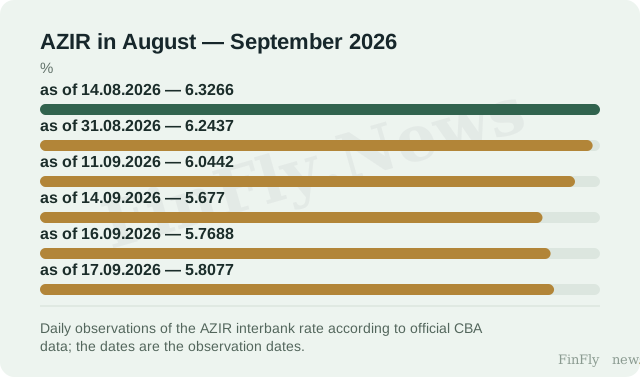
The CBA publishes three levels in effect since February 5, 2026: the upper bound of the corridor is 7.5%, the policy rate is 6.5%, the lower bound is 5.5%. These are the dates the values took effect, not the dates of decisions and not the history of their changes. The AZIR rate is a separate series of daily observations: on August 14, 2026 it was 6.3266%, on August 31 — 6.2437%, on September 11 — 6.0442%, on September 14 — 5.677%, on September 16 — 5.7688%, on September 17 — 5.8077%. All values are given in percent, as in the official observations.
Comparing these series is correct only as a comparison of levels on different dates. The upper bound of the corridor is not a rate on loans or deposits for households, and AZIR is not an administrative benchmark but the base rate of the one-day interbank market. Therefore 5.8077% on September 17 cannot be read as "the CBA rate has fallen": these are different instruments with different definitions. The observations do not contain a history of CBA decisions between February 5 and September 17, 2026, so the corridor's remaining unchanged over this interval is not confirmed.
Why the gap matters for business and where its limits are
For a company that is planning short-term funding or assessing its negotiating position with a bank, what matters is not the number 7.5% itself but the fact that the market price of one-day money on the observed dates in September stayed below the policy rate and noticeably below the upper bound of the corridor. If such a configuration persists, it may reflect softer short-term liquidity conditions than the upper bound suggests. However, this is conditional reasoning: the observations do not establish the causes of AZIR's movement and do not prove that banks pass this price into the cost of loans for non-financial borrowers.
The practical conclusion is a decision boundary, not a signal to act. A single AZIR level is not enough to change a borrowing budget, pricing or a procurement plan: that requires observations on a specific instrument — the actual rates on loans and deposits, the maturities and conditions available to the given company. It is also useful to track whether AZIR breaks through the lower bound of the corridor of 5.5% and whether at least one of the bounds or the policy rate changes after February 5, 2026. This will show whether the CBA is following the market or holding the corridor, but it will not give a ready answer about the cost of funding for an individual business.
The main observation is not that the corridor has "become outdated" but that the CBA's administrative levels and the market AZIR rate are in different planes and diverge on the observed dates. The upper bound of 7.5% and the policy rate of 6.5% have been in effect since February 5, 2026, while AZIR on September 17, 2026 was 5.8077%. This divergence should be read as an invitation to a more precise question: which specific rates on specific instruments are available to business, and not as a conclusion about the direction of policy or about an inevitable reduction in the cost of credit.