The official EUR/AZN rate published by the Central Bank of Azerbaijan declined from 1.9739 manats per euro on 7 September 2026 to 1.9095 manats per euro on 7 October 2026. On the same three dates — 7 September, 30 September and 7 October — the official USD/AZN rate remained 1.7. In other words, the observed movement passed through the EUR/AZN pair, not through the manat against the dollar. For business, this distinction is fundamental: if a contract is denominated in euros and settlements are made in manats, a decline in EUR/AZN means that the same amount in euros requires fewer manats. But the official rate is a reference for accounting and settlements, not a guaranteed transaction price.
What exactly the three dates showed
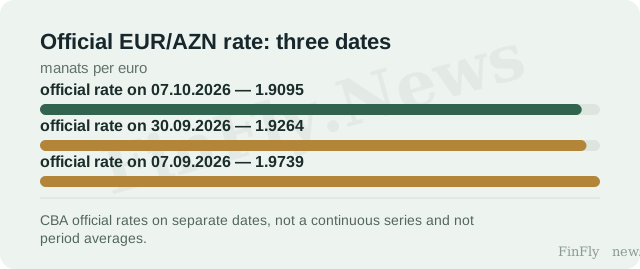
Let us compare three publications of the Central Bank of Azerbaijan. On 7 September 2026, one euro cost 1.9739 manats, on 30 September — 1.9264 manats, on 7 October — 1.9095 manats. The USD/AZN rate on all three dates is fixed at 1.7. This is not a continuous series but three separate observations, so we are talking about a recorded movement between dates, not a proven trend. Nevertheless, the structure of the movement is telling: the change relates entirely to the EUR/AZN pair, whereas the USD/AZN pair did not change in these observations.
The practical meaning of this distinction is that the currency risk of a contract depends on the currency in which it is denominated, not on the general backdrop of "the rate changed." If an obligation is expressed in euros and revenue comes in manats, a decline in EUR/AZN improves coverage: the same amount in euros requires fewer manats. If, however, revenue is denominated in euros and expenses are in manats, the effect is the opposite. At the same time, the CBA official rate serves as a reference for accounting and settlements, not as the price at which a bank or counterparty will actually execute a transaction.
Where the signal ends and a decision begins
From three observations, one cannot conclude that a bank will revise the price of a contract in euros. The provided data contain neither contract terms, nor bank tariffs, nor spreads, nor actual payment dates. Therefore, the correct formulation is conditional: if a counterparty ties the settlement to the official rate on the payment date, then a decline in EUR/AZN will reduce the manat amount of such a payment; if, however, the contract fixes a different rate, a different date or a different settlement currency, the observed movement may not affect the amount at all. This is not a recommendation to change a borrowing budget or a price list, but the boundary beyond which the contract's own data are needed for a decision.
To move from observation to decision, a business lacks one specific element: the contract's settlement linkage — the currency of denomination, the rate-fixing date and whether it coincides with the CBA publication date. Without this, one cannot assert that a change in the rate will change the payment. It is also useful to remember that the official rate is a value for a specific date, not an average for a period and not an exchange quotation; it does not describe intraday volatility and does not replace the terms of a transaction.
The main fact is simple: over the month, the euro became cheaper against the manat in the CBA's official publications, while the dollar against the manat on the same dates remained at 1.7. This makes the currency of denomination of a contract more important for settlements than the general impression of exchange-rate dynamics. But three dates are not a trend, and the official rate is not a transaction price. The practical conclusion is conditional: the effect arises where the contract ties the payment to this pair and to this date. Going forward, it is worth watching whether the unchanged USD/AZN persists as EUR/AZN moves further.