The Central Bank of Azerbaijan as of 8 October 2026 valued the euro at 1.9048 manats, whereas a month earlier, on 8 September, the official rate was 1.9763 manats. The dollar on both dates remained 1.7 manats. The divergence is the main fact: the movement of the euro against the manat was not accompanied by movement of the dollar against the manat. For a company, this is the difference between the contract currency and the price: the official rate changes the manat equivalent of an amount in euros, but by itself does not explain why the ratio shifted.
What exactly the official rates show on three dates
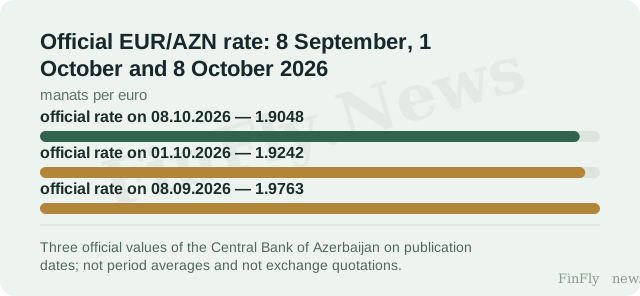
The Central Bank of Azerbaijan publishes official rates for specific dates, not period averages and not exchange quotations. As of 8 October 2026, one euro costs 1.9048 manats, on 1 October — 1.9242, on 8 September — 1.9763. The dollar rate on the same dates — 8 October, 1 October and 8 September — held at 1.7 manats. The comparison is correct precisely as a comparison of publication points, not as continuous dynamics.
The central fact is the divergence of the two currencies. If the manat's ratio changed equally against all currencies, USD/AZN would also have shifted. But the dollar against the manat did not change, while the euro became cheaper. The official rate is a conversion price: it determines how many manats will be required to pay an amount in euros, but it does not contain an explanation of the reasons for the movement. The data cover only the official rates of two currencies on four dates, and no conclusion about exchange-rate policy follows from them.
Where conversion changes a decision, and where it remains only conversion
For a company with a contract in euros, a decline in EUR/AZN, all other conditions being equal, means that the same amount in euros is converted into fewer manats. If this is a purchase denominated in euros, its manat cost position declines; if it is revenue in euros, its manat equivalent decreases. For a contract in dollars with an unchanged USD/AZN, there is no such effect. The intermediate link here is the contract itself: the currency of denomination, the amount and the payment date determine whether a specific transaction falls under this conversion.
The rate on the publication date is not a forecast and not a guarantee of the supplier's or bank's price. Therefore this publication alone is not enough to change a borrowing budget, a price list or a procurement plan: such a decision requires the terms of the specific agreement, the settlement date and the currency in which the invoice is actually issued. The limitation is fundamental: the data contain neither transaction volumes, nor the reasons for the movement, nor other currencies, so it cannot be asserted that the decline in EUR/AZN was caused specifically by a change in the value of the manat. The next comparable observation is the official EUR/AZN and USD/AZN rates on subsequent publication dates of the Central Bank of Azerbaijan: whether the divergence in the dynamics of the two currencies persists.
The main point is not a conclusion about the manat strengthening, but that the movement of the euro against the manat was not accompanied by movement of the dollar against the manat. For business, this is the difference between the contract currency and the price: the official rate changes the manat equivalent of an amount in euros, but by itself says neither about the cause of the shift nor about its future. A decision on the currency structure of expenses or revenue cannot rely only on this publication. What is worth watching is whether the divergence of EUR/AZN and USD/AZN persists on subsequent dates of the Central Bank of Azerbaijan.