
The Central Bank of Azerbaijan on 1 October 2026 set the official euro rate at 1.9242 manats, whereas on 1 September the same indicator was 1.9730 manats. Over the same period, the official dollar rate was published three times — on 1 September, 24 September and 1 October — at 1.7 manats. The movement went through the euro, not through the manat against the dollar. For business, this is the difference between the contract currency and the settlement currency: a euro amount, all else being equal, is converted into a smaller number of manats, while a dollar amount at a rate of 1.7 does not receive such a conversion.
What exactly changed in the official rates
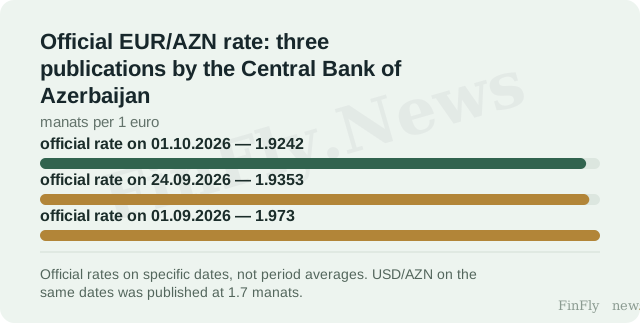
Let us compare three official points. On 1 September 2026, the euro was worth 1.9730 manats; on 24 September, 1.9353 manats; on 1 October, 1.9242 manats. This is a sequence of Central Bank of Azerbaijan publications on specific dates, not period averages and not market quotes. The dollar on the same three dates was published at a single level — 1.7 manats. The contrast visible here is not in the direction of movement as such, but in the fact that it is concentrated in one currency pair while the other remains unchanged.
It does not follow from this that the manat strengthened for fundamental reasons. The three official points contain neither transaction volumes, nor market quotes, nor data on rates or inflation that would make it possible to separate the movement of the rate from the regime by which it is set. A correct reading is more modest: over the month, the value of the euro expressed in manats changed, while the value of the dollar in manats at these points did not change. Everything else is interpretation requiring data that are not present in the rate publication.
Where this becomes a business decision and where it does not
The practical distinction runs along the contract currency. If an obligation is denominated in euros, then, all else being equal, the same euro amount is converted into a smaller number of manats at the rate of 1.9242 than at the rate of 1.9730. If an obligation is denominated in dollars, then at a rate of 1.7 this effect does not manifest itself at the indicated points. This is not a recommendation to choose a currency and not a conclusion about profitability: it is a description of exactly where the rate enters the budget — at the moment of conversion, not at the moment of signing.
The official rate by itself does not justify revising a borrowing budget, a price list or a procurement plan. Such a decision requires a magnitude tied to a specific obligation: the amount, the payment date and the rate at which the contract prescribes conversion. The publication of a rate on a date says nothing about rates, nor about the exchange rate regime beyond these points, nor about whether the movement will persist. If the contract fixes the rate or settlement is in manats, the observed change in EUR/AZN does not change the payment at all.
The limitation here is one and significant: three official points are not a time series. They cannot be used to judge volatility, the causes of the movement, or whether the dollar rate remains unchanged outside the published dates. The next comparable observation is the next publication by the Central Bank of Azerbaijan: whether EUR/AZN remains below 1.9242 and whether USD/AZN stays at 1.7. This is an observation, not a forecast.
The main thing in these data is not the direction but the localization: over the month, the value of the euro in manats shifted, whereas the value of the dollar in manats at the three official points did not change. For business, this is a reason to check in which currency the obligation is denominated and how the contract prescribes conversion, not a reason to change the budget. The official rate on a date remains a single number; a decision requires the amount, the payment date and the conversion rule from the contract itself.