The Central Bank of Azerbaijan increased the outstanding balance of notes in circulation, but this instrument did not become cheaper — it became more expensive. According to CBA data, the outstanding balance of notes rose from 503.8 million manats as of 09.07.2026 to 1758 million as of 01.10.2026; at the same time, the yield on 28-day notes, after a minimum of 5.63% at the auction on 29.07.2026, rose to 6.5% at the auction on 30.09.2026. This is the contrast between the amount of liquidity absorbed and the price at which it is absorbed: the scale of the operation grew, but not through cheaper borrowing of funds into notes.
What exactly the figures show
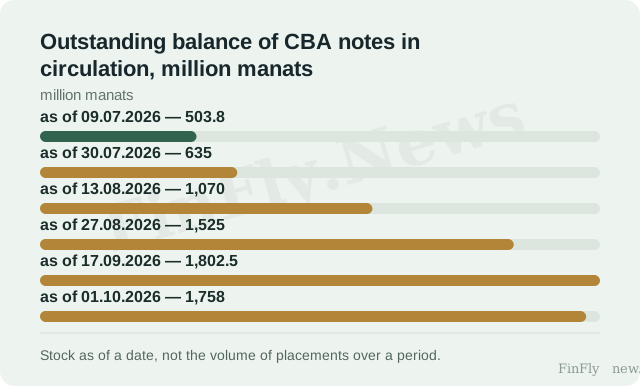
The series for the outstanding balance of CBA notes in circulation is a stock as of a date, not the volume of placements over a period. The trajectory within the third quarter of 2026: 503.8 million manats as of 09.07.2026, 635 million as of 30.07.2026, 1070 million as of 13.08.2026, 1525 million as of 27.08.2026, 1802.5 million as of 17.09.2026 and 1758 million as of 01.10.2026. FinFly's calculation based on official observations gives an increase of 17.5 million manats in one day — from 1740.5 million as of 30.09.2026 to 1758 million as of 01.10.2026.
The yield on 28-day notes at auctions developed differently: 5.63% on 29.07.2026, 6.56% on 16.09.2026 and 6.5% on 30.09.2026. That is, by the end of September the instrument cost more than at the end of July, although the outstanding balance had grown severalfold over that time. The one-day interbank AZIR rate as of 01.10.2026 was 5.8002% versus 5.677% as of 14.09.2026. These three series describe different objects: the outstanding balance, the auction yield and the money market rate as of a date.
Where this changes a business decision
The practical meaning of the contrast lies in the opportunity cost of manat funds. If a company holds a temporarily free balance or a bank plans short-term funding, the benchmark becomes not only the volume of absorption but also the price of the notes: with a yield of about 6.5% and AZIR of about 5.8%, placing funds in CBA notes looks different from July, when the auction yield was 5.63%. This is a conditional logic of comparison, not a statement that loan rates have already changed.
The outstanding balance of notes itself is neither payment turnover, nor nominal demand, nor volatility of contract prices. Therefore it does not provide grounds for revising the borrowing budget, pricing or the procurement plan. Such a decision requires a different benchmark tied to a specific obligation — for example, the actual cost of short-term manat funding for a comparable borrower on the same date. The growth in the outstanding balance of notes says only that more funds were withdrawn through this instrument, and says nothing about the availability of credit for an individual company.
The contrast is stable within the observed window: the outstanding balance of CBA notes in circulation rose from 503.8 million manats as of 09.07.2026 to 1758 million as of 01.10.2026, while the yield on 28-day notes rose from 5.63% at the auction on 29.07.2026 to 6.5% at the auction on 30.09.2026. This does not prove that the growth in absorption was caused by excess liquidity or that it has tightened monetary conditions: the outstanding balance is a stock as of a date, the yield is the result of a separate auction, and AZIR is a one-day rate as of a date. The next comparable observation is the outstanding balance of notes and the yield on 28-day notes at the auction after 01.10.2026: whether the outstanding balance will remain above 1802.5 million manats (the peak on 17.09.2026) and whether the yield will remain around 6.5% or exceed 6.56% (16.09.2026).