
The yield on 28-day notes of the Central Bank of Azerbaijan at the auction on 14 October 2026 was 6.44%, down 0.03 percentage points from the previous auction on 7 October (6.47%). What matters here is not the weekly move itself but the shape of the trajectory: over the available series, the yield rose to 6.99% at the auction on 29 April, fell to 5.63% at the auction on 29 July, and then approached the level at the start of the series — 6.21% at the auction on 15 April — while remaining above it. The fluctuation within the period proved noticeably wider than the net shift.
What the auction values show
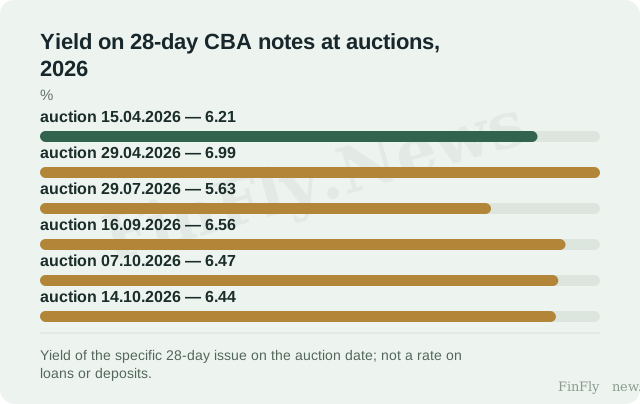
The available yield series for 28-day notes covers auctions from 15 April to 14 October 2026. The starting value is 6.21%, the maximum is 6.99% (29 April), the minimum is 5.63% (29 July), and the intermediate point on 16 September is 6.56%. The current 6.44% lies between these reference points: above the July minimum, below the April peak and slightly above the starting value. This is a description of the trajectory, not a conclusion about the direction of policy.
The note yield is the cost of short-term liquidity at a specific auction of the 28-day issue, not a rate on loans, deposits or an inflation indicator. Therefore its movement cannot be read as a signal about future funding conditions for companies. A comparable reference point is the one-day AZIR interbank rate: according to CBA data, on 15 October it was 5.8% versus 5.7923% the day before. Different instruments and different maturities — their levels are not identical.
Note volume and the limits of comparison
The volume of CBA notes in circulation on 15 October was 1,753 million manats, up 27.5 million from the previous day. Within the available series, the volume rose from 533 million manats on 23 July to a local maximum of 1,802.5 million on 17 September, after which it declined somewhat. The volume series begins later than the yield series, so the expansion of sterilisation cannot be directly compared with the April yield peak.
For a company holding short-term liquidity in manats, these data set the boundary of a decision, not a ready-made conclusion. A note yield of about 6.4% and an AZIR rate of about 5.8% are reference points for the cost of liquidity at different maturities, but they do not determine a borrowing budget, the price of supplies or overdraft terms. To change these parameters, information specific to the decision is needed: the actual rates on the credit and deposit products available to the company over its horizon.
The key observation is not the weekly decline of 0.03 p.p., but that the yield on 28-day notes approached the level at the start of the series after passing through a peak and a minimum, while remaining above it, whereas the volume of notes in circulation rose noticeably over a shorter stretch. These two series describe different sides of the money market and do not prove a causal link between them. The next auction after 14 October will show whether the yield remains near 6.44% at the current volume of notes in circulation.