The outstanding balance of Central Bank of Azerbaijan notes in circulation rose from 525.5 million manats on 16.07.2026 to 1733 million on 08.10.2026, meaning the volume of sterilized liquidity increased more than threefold. At the same time, the yield on 28-day notes at the auction on 07.10.2026 was 6.47% — below the April high of 6.99% — and the AZIR interbank rate on 07.10.2026 was 5.7632% versus 6.2307% on 03.09.2026. The growth in absorption is not accompanied by a tightening of money market price indicators.
What exactly the figures show
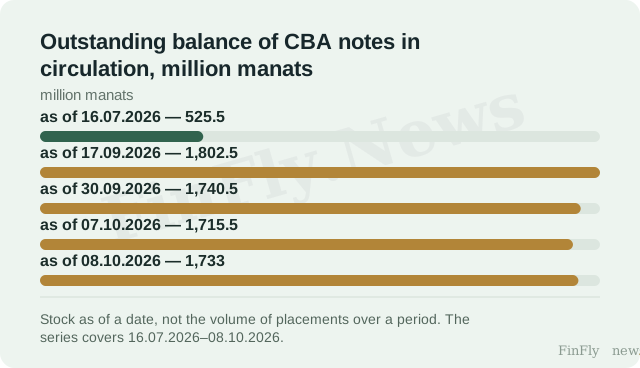
The notes balance series covers the period from 16.07.2026 to 08.10.2026. During this time, the indicator passed through a local high of 1802.5 million manats on 17.09.2026, stood at 1740.5 million by the end of September, and at 1733 million by 08.10.2026. According to a FinFly calculation based on official observations, in one day the balance rose by 17.5 million manats, or by 1.02%. This is a balance as of a date, not the volume of placements over a period: growth means more liquidity withdrawn, but it is not equal to note issuance.
Price indicators behave differently. The yield on 28-day notes at the auction on 07.10.2026 was 6.47% versus 6.5% at the auction on 30.09.2026, while the series minimum was 5.63% at the auction on 29.07.2026. The AZIR rate on 07.10.2026 was 5.7632%, with its series minimum at 5.677% on 14.09.2026. That is, with a multiple-times larger notes balance, the cost of short money in the money market remains below the levels observed earlier.
Why this matters for business and what the data do not prove
For a company or bank planning short-term funding in manats, what matters is not the notes balance itself, but how it combines with note yields and the AZIR rate. If, with further growth in the balance, the yield on 28-day notes and AZIR begin to rise steadily, that will become an observable signal of short money becoming more expensive. If, however, the balance grows while note yields and AZIR remain below previous highs, the current configuration gives no grounds to revise the borrowing budget, prices, or the procurement plan.
The outstanding balance of notes in circulation is a stock as of a specific date, not the volume of issuance over a period, and it is not equal to either payment turnover, nominal demand, or the volatility of contract prices. The note yield is the result of the latest auction, not an average over a period; AZIR is a one-day interbank rate. The data do not establish a causal relationship between the notes balance, yields, and the AZIR rate: declines in yields and AZIR may reflect other factors of supply and demand in the money market. The source does not state a publication date, and the notes balance series is limited to 16.07.2026–08.10.2026.
The key fact is the divergence between the growth in absorption and the behavior of money market price indicators. The outstanding balance of CBA notes in circulation rose from 525.5 million manats in July to 1733 million in October, but the yield on 28-day notes (6.47%) and the AZIR rate (5.7632%) remain below the April yield high (6.99%) and the AZIR level of early September (6.2307%). This is an observation, not proof that absorption does not affect rates. The next comparable observation is the next notes auction and the AZIR value: whether the balance will continue to grow above 1802.5 million manats and whether note yields and AZIR will begin to rise steadily.