
The Central Bank of Azerbaijan increased liquidity sterilization: the outstanding balance of notes in circulation rose from 483.8 million manats on 25.06.2026 to 1802.5 million manats on 17.09.2026. At the same time, the yield on 28-day notes at the auction on 16.09.2026 was 6.56% versus 5.63% at the auction on 29.07.2026, while the AZIR interbank rate on 17.09.2026 was 5.8077% versus 6.3266% on 14.08.2026. That is, the growth in the outstanding balance of notes was accompanied by mixed dynamics in money market rates, rather than a single movement.
What exactly the figures show
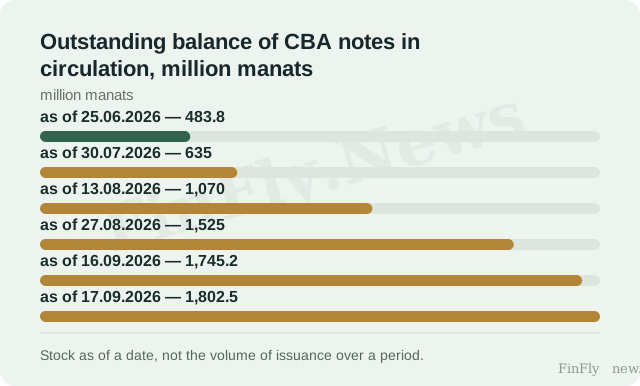
The outstanding balance of notes is a stock as of a date, not the volume of issuance over a period. The rise from 483.8 million manats on 25.06.2026 to 635 million on 30.07.2026, then to 1070 million on 13.08.2026, 1525 million on 27.08.2026, 1745.2 million on 16.09.2026 and 1802.5 million on 17.09.2026 means that more sterilization instruments were in circulation. According to a FinFly calculation, over one day, 16–17.09.2026, the outstanding balance added 57.3 million manats, or 3.28%. This is a one-day change in the outstanding balance between two dates, not proof of causes.
Rates behaved differently. The yield on 28-day notes rose from 5.63% at the auction on 29.07.2026 to 6.56% at the auction on 16.09.2026. The AZIR interbank rate, by contrast, declined from 6.3266% on 14.08.2026 to 5.8077% on 17.09.2026. Note yield is the result of a specific auction, AZIR is an overnight rate; they cannot be added together or one derived from the other.
What this means for business and where the limit of the conclusion lies
For banks and corporate treasuries, the observed values are the yield on 28-day notes of 6.56% at the auction on 16.09.2026 and AZIR of 5.8077% on 17.09.2026. But this does not mean that loans will automatically become cheaper or more expensive. The outstanding balance of notes is not the volume of placements, not payment turnover and not demand for credit. If a company is planning borrowings, it needs data on actual loan rates and funding conditions, not only the outstanding balance of notes.
The limitation is that the data do not contain the volumes of note redemption, so the net volume of sterilization over the period cannot be calculated, and daily fluctuations in AZIR do not prove a causal link with the outstanding balance of notes. The next comparable observation is the publications of the CBA's outstanding balance of notes and the yield on 28-day notes at auctions together with AZIR values: whether the divergence between the growth in sterilization and money market rates persists.
The rise in the outstanding balance of CBA notes in circulation from 483.8 million on 25.06.2026 to 1802.5 million manats on 17.09.2026 is a rise in the outstanding balance between two dates, not the accumulated volume of sterilization over the period. The yield on 28-day notes at the auction on 16.09.2026 was 6.56%, AZIR on 17.09.2026 was 5.8077%. For business, this is a reason to take into account the observed values of note yield and the interbank rate, but not to change the borrowing budget without data on loan rates. The next test is to observe whether this divergence persists.