At the auction on 07.10.2026, the yield on 28-day notes of the Central Bank of Azerbaijan was 6.47%, down 0.03 percentage points from the previous auction on 30.09.2026, when it stood at 6.50%. This is not a one-off episode but a point within a wide corridor: from 6.99% at the auction on 29.04.2026, the yield fell to 5.63% by 29.07.2026, then rolled back up to 6.56% by 16.09.2026 and again declined slightly. In parallel, the volume of CBA notes in circulation rose from 525.5 million manats on 16.07.2026 to 1733 million manats on 08.10.2026. The price of short-term liquidity and its sterilized volume moved in opposite directions during this period.
What the auctions show: a corridor instead of a trend
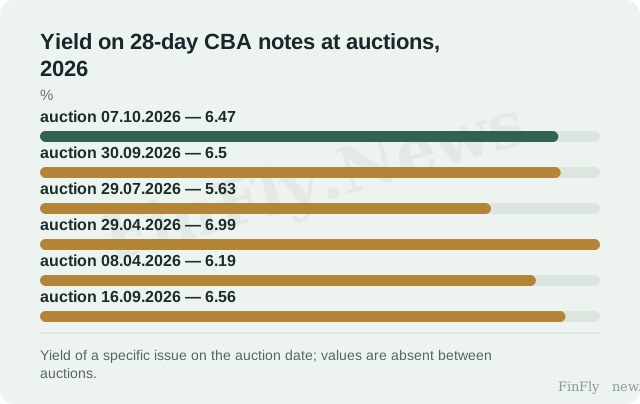
The available history of 28-day CBA note yields covers the period from 08.04.2026 to 07.10.2026 and represents not a smooth trend but fluctuations within a corridor. At the start of observations, on 08.04.2026, the yield was 6.19%; by 29.04.2026 it had risen to a maximum of 6.99%, followed by a decline to a minimum of 5.63% at the auction on 29.07.2026. September brought the yield back up: on 16.09.2026 it reached 6.56%, after which by 30.09.2026 it fell to 6.50%, and by 07.10.2026 to 6.47%. The spread between the extreme points — from 5.63% to 6.99% — shows that the short-term price of liquidity on this instrument changes noticeably even within a single half-year.
It is important that the yield on 28-day notes is the result of a specific auction for a specific issue, not the policy rate, not the AZIR interbank market rate, and not the rate on loans or deposits. The AZIR rate on 07.10.2026 was 5.7632%, that is, it is a separate series with its own dynamics and its own definition. These indicators must not be conflated: they measure different segments of the money market. That is precisely why note yields should be read as an indicator of the cost of short-term liquidity at central bank auctions, and not as a universal rate for the entire economy.
Volume of sterilization: a rising balance amid falling yields
The volume of CBA notes in circulation is the balance on a specific date, and it moved in the opposite direction from the yield. On 16.07.2026, 525.5 million manats were in circulation; by 17.09.2026 the balance reached a local maximum of 1802.5 million manats, and on 07.10.2026 it stood at 1715.5 million manats, rising to 1733 million manats on 08.10.2026. At the same time, the yield traveled from a minimum of 5.63% at the end of July to 6.47% in October. These are two separate official series, and their opposite directions are an observation, not proof of causality.
For business, this means a specific decision boundary. If a company or bank is planning short-term funding and is guided by the yield on 28-day notes, then this indicator alone is not enough to change the borrowing budget, pricing, or procurement plan. Note yields are the price of liquidity at a central bank auction, not the cost of credit for a specific borrower and not a contract term. To make a decision, additional observation specific to the decision is needed: for example, the actual rate on a short-term loan or deposit available to a specific counterparty, as well as the terms of the contract that fix or link the rate.
The central contrast of this period is the divergence between price and volume: the yield on 28-day CBA notes fluctuated within a corridor of 5.63–6.99%, while the volume of notes in circulation rose from 525.5 million to 1733 million manats. This does not prove that the growth of sterilization caused the decline in yield or vice versa: in the data provided, no causal relationship is stated. The next comparable observation is the yield and volume of notes at the auction after 08.10.2026: whether it will show a continuation of the October decline or a return to the September level.