
At the auction on September 16, 2026, the yield on 28-day notes of the Central Bank of Azerbaijan was 6.56% — 0.30 percentage points higher than at the auction on September 9 (6.26%), and almost one percentage point above the minimum of 5.63% recorded on July 29. The upward reversal occurred against the backdrop of a sharp expansion of sterilization: the volume of notes in circulation, according to the CBA, rose from 483.8 million manats on June 25 to 1,745.2 million manats on September 16 and 1,802.5 million manats on September 17. The price of short-term liquidity in manats is rising simultaneously with the increase in absorption, not despite it.
What exactly the note auctions show
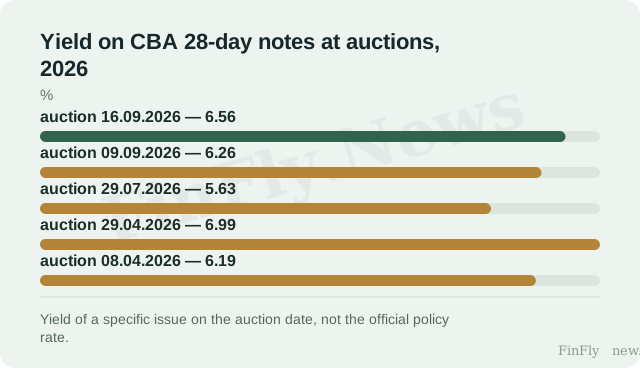
The yield on 28-day notes is the result of a specific auction, not the official policy rate and not the rate on loans or deposits. Therefore, it is correct to compare it only with other auctions of the same issue. In this series, what is visible is not a monotonic trajectory but fluctuations: 6.19% on April 8, 6.99% on April 29, 5.63% on July 29, 6.26% on September 9 and 6.56% on September 16. The current value is below the April peak, but above both the July minimum and the previous week. For business, this means that the benchmark cost of short money in manats has again shifted upward relative to mid-summer.
The volume of notes in circulation is a separate quantity reflecting the scale of sterilization, not the yield. The rise from 483.8 million manats on June 25 to 1,802.5 million manats on September 17 shows that the CBA actively absorbed liquidity through this instrument. Comparing the two series is appropriate as a description of simultaneity: the price of the notes rose, and their volume rose. But this does not prove that the first was caused by the second, and it does not replace data on the CBA rate, inflation or the state of banking liquidity, which are not in the observations.
Where this changes a decision and where it does not
The practical boundary lies where a company plans short-term funding in manats. If the yield on 28-day notes remains near the current level, and the sterilization volume remains high, the cost of liquidity for banks may remain more expensive than at the end of July. For a company with a floating rate or near-term refinancing, this is an argument for budgeting the price of money no lower than the current level of the notes, rather than focusing on the July minimum. This is a conditional discussion of a boundary, not a recommendation to borrow or invest.
The limitation here is fundamental: the yield on notes is not the rate on loans and not the funding cost of a specific borrower. It does not directly say how much more expensive a loan will become or how demand will change. The next comparable observation is the next auction of 28-day notes after September 16: if the yield exceeds 6.56% with the volume of notes in circulation not below 1,802.5 million manats, this will be a continuation of the same picture; if the yield declines with a high volume, the signal will be mixed.
The yield on CBA 28-day notes returned to 6.56%, that is, above both the weekly and July levels, while the volume of notes in circulation reached 1,802.5 million manats. This is not proof of policy tightening and not a verdict for borrowers: the yield of a specific issue is only one benchmark for the price of short liquidity. But for companies that in the coming weeks enter the short-term funding market in manats, it is reasonable to treat the current level of the notes as the lower bound of expectations, rather than focusing on the minimum of the end of July.