The yield on CBA 28-day notes at the September 30, 2026 auction was 6.5% — this is above the minimum of 5.63% recorded at the July 29 auction. The volume of notes in circulation rose from 503.8 million manats on July 9 to 1758 million on October 1. However, the yield of a specific issue on the auction date is not the official policy rate and not the rate on loans or deposits. Therefore, the rise in note yield cannot automatically be read as a signal of tightening monetary conditions: the provided data contain neither rate decisions nor information on demand at the auctions.
What the auctions show: a reversal from the July minimum
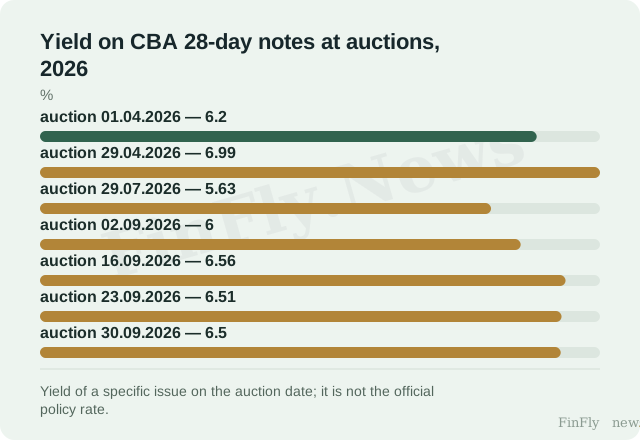
In the available history, the yield on CBA 28-day notes went from 6.2% at the April 1 auction to a maximum of 6.99% on April 29, then declined to 5.63% on July 29 — the minimum for the available period. In September, the movement reversed: on September 2 the yield was 6%, on September 16 — 6.56%, and by September 30 it had fallen to 6.5%. Relative to the previous auction on September 23 (6.51%), the change was minus 0.01 percentage point — that is, at the last auction the yield practically did not change, remaining near the September local maximum.
At the same time, the volume of notes in circulation grew: from 503.8 million manats on July 9 to 1740.5 million on September 30 and 1758 million on October 1. This is a liquidity sterilization instrument, and the increase in volume by itself does not explain the yield movement. The yield on 28-day notes is the yield of a specific issue on the auction date; it is not identical to either the rate on loans and deposits or the official policy rate. The one-day interbank market rate AZIR on October 1 was 5.8002% versus 5.7688% the day before — this is a separate series with a different maturity, and it cannot be directly compared with the yield on 28-day notes as confirmation of the same signal.
Why this is a benchmark for business, not a decision
For a company or bank planning short-term funding in manats, what matters is not a single figure but the persistence of the level. If the yield on 28-day notes remains around 6.5%, this will mean that the short-term cost of liquidity has settled above the July minimum of 5.63%. But it does not follow from this that funding conditions for a specific borrower have already changed: the note yield is the market price of one instrument at auction, not the rate at which a bank is prepared to lend or accept a deposit. The decision to revise the borrowing budget, pricing or procurement plan requires separate monitoring — actual rates on loans and deposits, which are absent from the provided data.
The practical conclusion is conditional in nature: if at the next auctions the yield holds near 6.5% or exceeds the September local maximum of 6.56%, this will be grounds to pay closer attention to short-term liabilities with a floating link. If it returns to 5.63%, the July minimum will turn out not to have been a one-off episode. In both cases this is an observation about the cost of one instrument, not proof of a change in the policy course: the sources contain neither rate decisions nor data on demand and auction coverage, nor reasons for the yield movement.
Key observation: the yield on CBA 28-day notes on September 30 (6.5%) is noticeably above the July minimum (5.63%), but practically does not differ from the previous auction (6.51%). This makes the current level more of a plateau than a continuation of growth. For business, this means that the benchmark for short-term liquidity in manats has shifted upward relative to mid-summer, but a decision to revise funding conditions is premature without data on actual rates on loans and deposits. The next comparable 28-day note auction will show whether the level near 6.5% becomes entrenched or the movement continues.