
Term deposits are reaching a broader group of savers in Azerbaijan. The Central Bank counted 226,056 unique term depositors at the end of August 2026, up by 48,405 from a year earlier. The 27.2% increase is substantial. But it answers “how many participants?”, not “how much wealthier is each person?”.
The Central Bank’s depositor-count table identifies customers by unique FIN. It counts people rather than deposit contracts. Someone can hold several deposits, so the number of accounts and the number of unique customers are different measures.
A strong annual increase, a gentler monthly pace
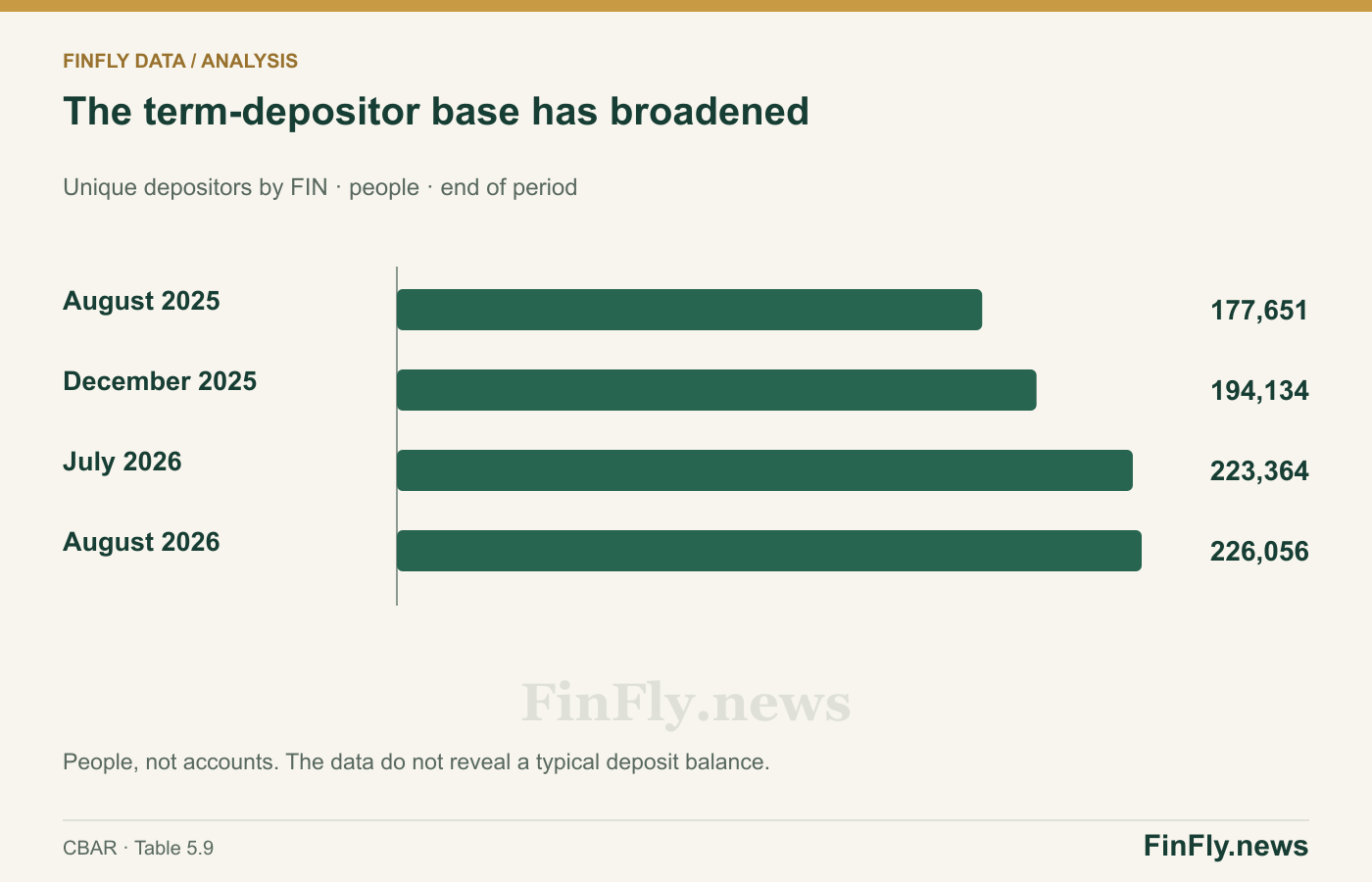
The count was 177,651 at end-August 2025 and 194,134 in December. The increase in the first eight months of 2026 was 31,922, or 16.4%. August alone added 2,692, or 1.2% from July. A large annual increase does not mean the customer base expands by one quarter every month.
For a bank, a broader base can create opportunities to attract funding and offer services. But customer numbers do not reveal acquisition costs. If funds arrive only through expensive promotional offers, more depositors do not necessarily mean cheaper funding.
The average-deposit trap
Broader banking statistics can report household deposits of different types. Dividing that total by the term-depositor count would mix demand and term balances in the numerator with only one customer segment in the denominator. The result would look precise without describing a coherent group.
Even a correctly matched average would not identify the typical saver. One very large deposit and several small ones can produce a high mean that almost nobody holds. Assessing how widely savings are distributed requires a median, balance-size bands and comparisons with income.
| Measure | What it tells us |
|---|---|
| Unique term depositors | How many people participate in the segment |
| Number of contracts | How many deposits exist, including multiple deposits per person |
| Median balance | The balance of the depositor in the middle of the distribution |
More participants do not necessarily mean newly created savings
A new term depositor may move money from a current account, bring cash into the banking system or reallocate existing assets. Saving out of current income is another possibility. The table does not separate these sources, so the entire increase cannot be treated as new household wealth.
Persistence matters too. Will customers renew when their first deposit matures? A promotional surge and lasting engagement can produce the same reporting-date count but very different outcomes a year later. Renewals, withdrawals and maturities would help distinguish them.
The firm conclusion is that the term-depositor base has broadened considerably. That is a useful signal of participation in bank savings products. The next task is to establish how balances are distributed and whether customers remain over time. Only then can participation be linked to the strength of household financial cushions.