Azerbaijan’s banks earned more even as their deposit bill and provisions increased. Sector net profit reached AZN 949.7 million in January–August 2026, compared with AZN 774.3 million a year earlier. The gain was AZN 175.4 million, or 22.7%. Understanding the quality of those earnings requires looking beyond the bottom line.
We examined the Central Bank’s banking-sector income statement for matching eight-month periods. Income growth outpaced non-interest cost growth. Lower provisioning cannot explain the improvement: charges for possible losses on assets increased.
Lending supplied most of the additional interest income
Interest income increased by AZN 457.4 million to AZN 3.70 billion. Interest on loans contributed almost AZN 437.9 million of that net increase, approximately 96%. Other categories added much less in aggregate. Securities income actually fell from AZN 371.7 million to AZN 310.3 million. Not every revenue stream was moving in the same direction.
Interest received is not the same as earnings retained. Interest expenses increased by AZN 186.8 million, including a rise of AZN 167.6 million in deposit expenses to AZN 995.0 million. Banks paid more for deposits in aggregate, but the statement does not isolate the effects of rates, balances and changes in the funding mix.
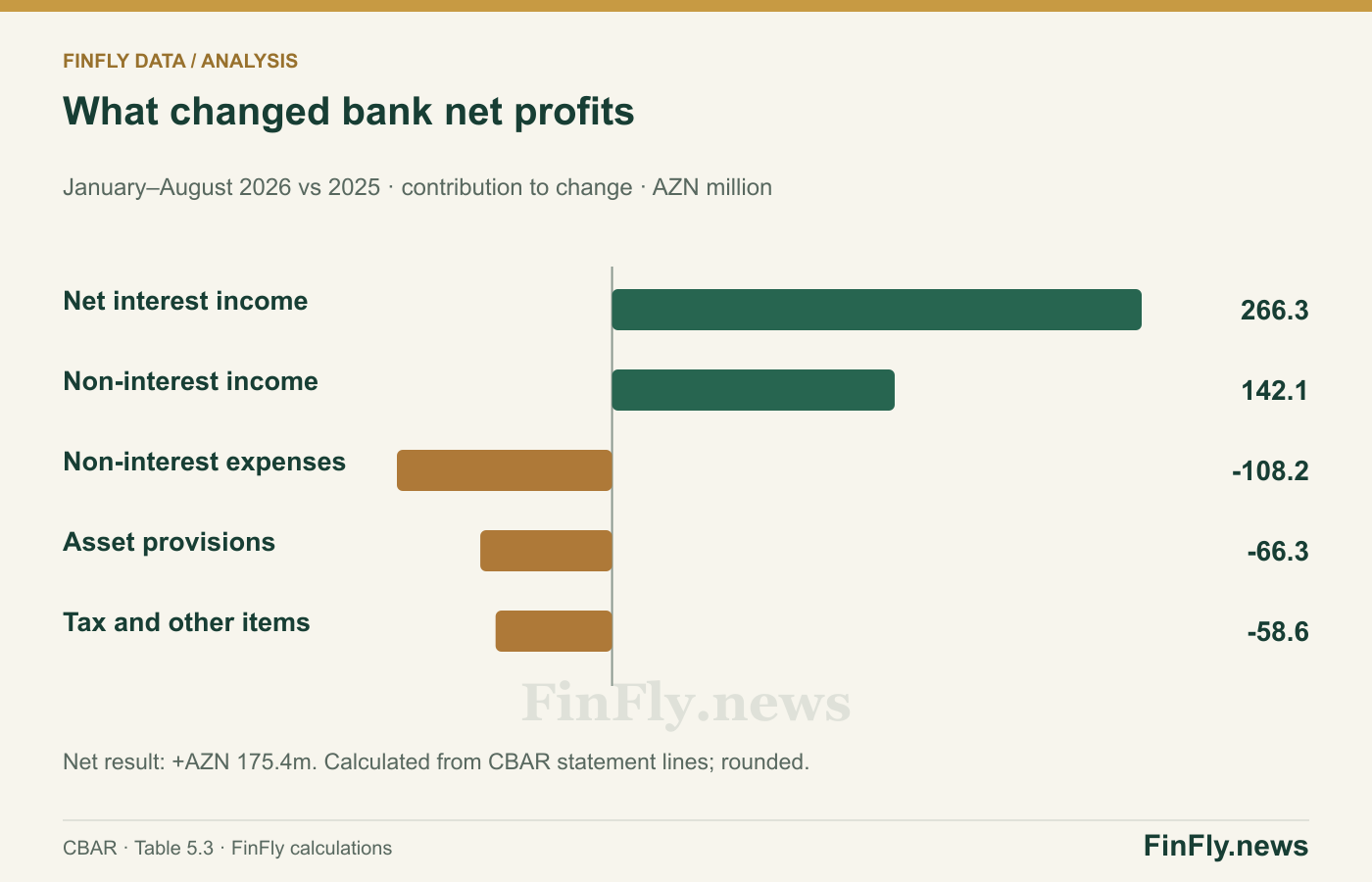
Reported net interest income reached AZN 2.28 billion, an increase of AZN 266.3 million. The Central Bank’s definition already deducts targeted provisions against interest receivable. Simply subtracting interest expenses from interest income would therefore not reproduce the published line.
Revenue growth created room for higher costs
| Indicator, AZN million | Jan–Aug 2025 | Jan–Aug 2026 |
|---|---|---|
| Operating profit | 1 187.5 | 1 487.7 |
| Asset loss provisions | 225.9 | 292.2 |
| Net profit | 774.3 | 949.7 |
Non-interest income rose 11.7%, while non-interest expenses increased 5.3%. Together with the net interest improvement, this lifted operating profit by AZN 300.2 million. Additional asset provisions and profit tax then absorbed part of that gain, leaving about AZN 175.4 million at the net-profit line.
That distinction matters. Earnings supported by revenue growth are different from earnings boosted by smaller risk charges. Here, provisions for possible asset losses rose 29.3% to AZN 292.2 million. A provision is an accounting estimate of risk, not proof that the same amount has already been lost or written off.
Sector profits are not a promise of cheaper loans
Higher aggregate profits do not automatically produce cheaper borrowing or better deposit offers. Banks differ in funding sources, portfolio quality and growth plans. The sector total also does not show how evenly earnings are distributed across institutions.
We would monitor three relationships: loan income against loan quality; deposit expenses against funding costs; and operating revenue against the cost of running the business. So far, revenue expansion has absorbed higher funding and risk charges. Extending the eight-month growth rate to the full year would require further evidence.