
A decline in attacks on ships looks like a convincing safety indicator until it is compared with the consequences for people and the geography of incidents. IMB’s October statistics show why shipowners and insurers need more than one global total.
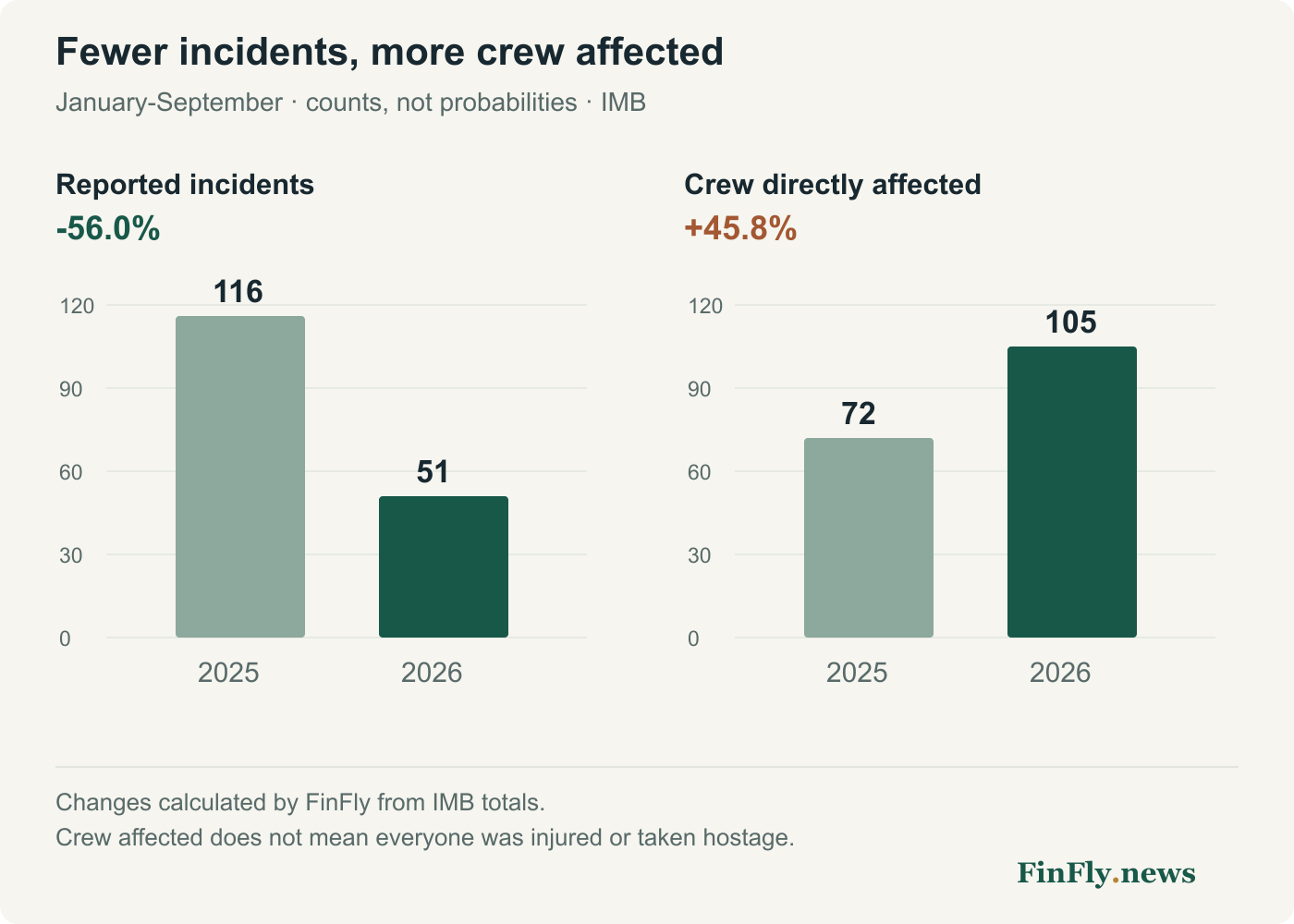
The IMB report published on 15 October compares January-September 2026 with the same months in 2025. The chart distinguishes reported piracy and armed robbery incidents from crew directly affected. The latter category does not mean that everyone counted was injured, killed or taken hostage.
Frequency and consequences move in different directions
The reported figures imply a 56.0% decline in incidents and a 45.8% increase in crew directly affected. These are our arithmetic calculations, not estimates of the probability that a particular ship will be attacked.
The divergence is not a contradiction. One hijacking can affect an entire crew, while several separate intrusions may have more limited consequences. The number of incidents describes the frequency of reported events, not their severity distribution.
We do not convert the number of affected people into a monetary measure of insured loss. That would require information about individual events, the nature of claims, contractual obligations and actual settlements. The public summary does not provide those inputs.
The global improvement is geographically concentrated
Singapore Straits incidents fell from 73 to 13. The reduction there therefore accounts for 60 of the overall decline of 65, or approximately 92.3%. This is the region’s arithmetic contribution to the difference between two totals, not its share of worldwide risk or proof of what caused the improvement.
For an operator on another route, the global percentage may consequently offer little guidance. Changes along its own passages, anchorages and port approaches matter more. Fewer reports in one strait do not demonstrate an equivalent change in safety elsewhere.
There is also a denominator problem. An incident count does not say how many ships used a route or how long they remained exposed. Without those inputs, a reliable per-voyage attack probability cannot be calculated. Commercial decisions would also need comparable information about reporting completeness.
Piracy and war risks are not one contractual category
Gard’s war-risk rule treats piracy separately from certain exclusions, but ransom is not automatically recoverable: it is subject to a separate provision concerning the club’s discretion. This illustrates why the word piracy in a risk description cannot replace the contract.
The consequences for the vessel’s earnings require a separate check. A disrupted voyage can create costs without physical damage. Allocation of that loss depends on insurance terms and commercial obligations, not simply the incident’s label.
For example, Gard’s description of its specific Loss of Hire product for offshore contractors excludes detention due to piracy and points to a separate product for that risk. This cannot be generalised to the whole market; it demonstrates the need to examine the extensions and exclusions of the actual policy.
| Consequence | What must be established |
|---|---|
| Property damage | Insured object, cause, exclusions and limit |
| Crew-related claims | Employer obligations and applicable cover |
| Lost time and earnings | Interruption terms, waiting periods and specific extensions |
FinFly analytical framework. This does not confirm cover for any particular incident.
The voyage profile matters more than the average
We would separate a voyage assessment into four parts: geography and time in an exposed area; severity of a plausible event; the crew’s ability to detect and respond; and financial consequences retained by the company. Together these allow a more meaningful comparison of routes and protection.
For an Azerbaijani cargo owner, checking a carrier means considering not only insurance but also routing, stops and incident procedures. This is not a reason to equate a Caspian passage with ocean piracy areas: threats must be assessed for the location and conditions of the shipment.
Our conclusion is that fewer reported attacks represent a significant positive development, but not a universal reason to reduce protection or expect a lower premium. The October figures require frequency, geography and consequences to be considered together. Cover is determined by contracts and circumstances, not by the global percentage.