
For a cargo owner, a carrier’s insurance certificate is only the starting point. After a vessel is attacked, different parts of one shipment may fall under different contracts, exclusions and notification requirements. October’s Hormuz incidents show why the entire transport chain needs checking.
According to the Singapore maritime authority’s 14 October statement, GFS PRIDE and GFS GISELLE were struck by unknown projectiles on 13 and 14 October, Singapore time. The former sank; the latter reached safe anchorage. Their crews were safe. The statement neither identifies the attacker nor quantifies insured losses.
One damaged ship can generate several distinct claims
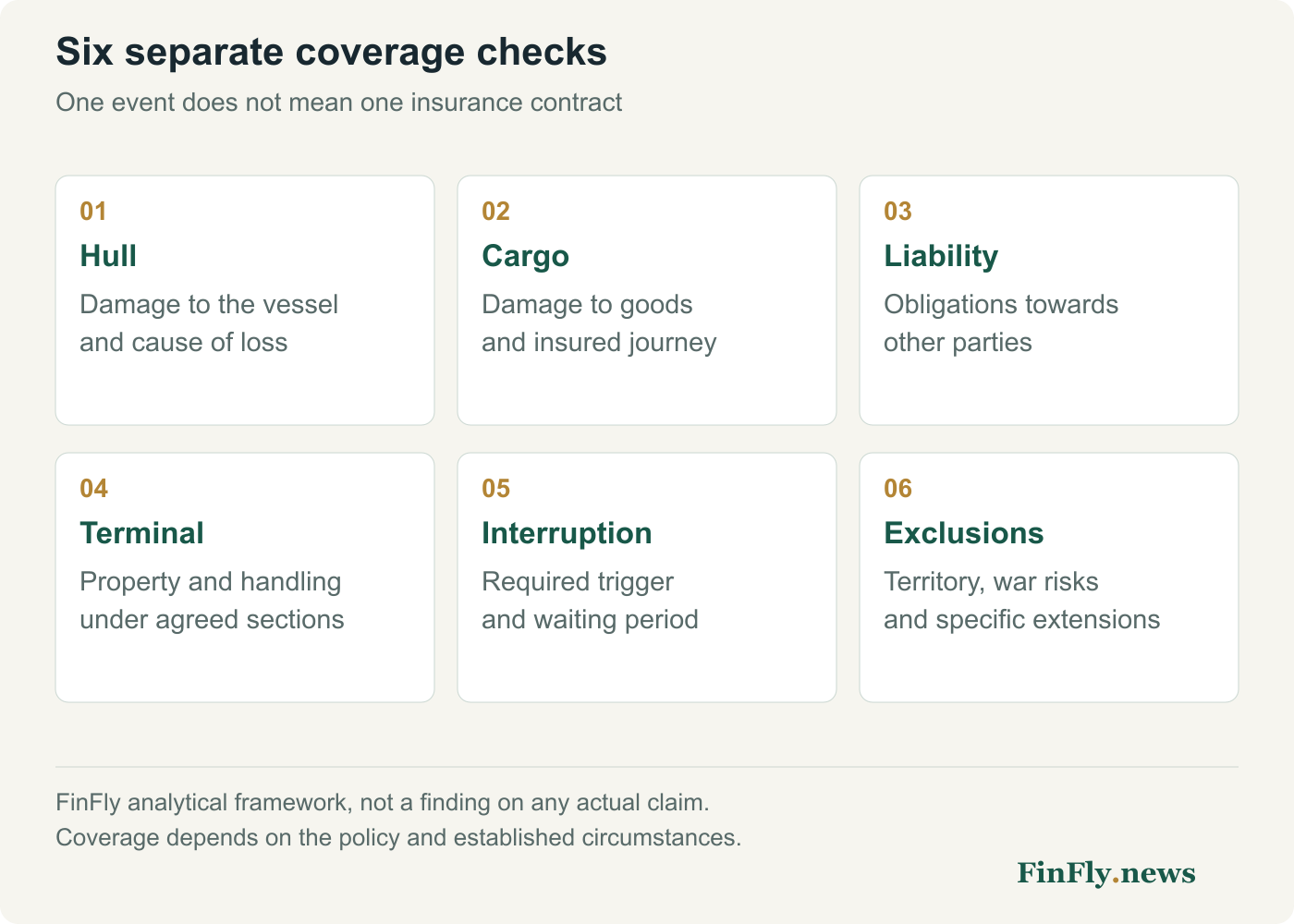
Potential hull loss, damaged goods and third-party liabilities are not one insured amount. Each party has a different interest: the owner protects the vessel, the cargo owner the goods, and the carrier its agreed liabilities. A common event does not make those interests interchangeable.
The classification of the cause also matters. For example, Gard’s war-risk rule provides exclusions from ordinary protection and indemnity insurance, which covers shipowner liabilities. This is an illustration from one club, not a finding about either affected vessel’s contracts. Without the policies and established circumstances, neither cover nor denial can be asserted.
A practical review starts with the insured object and the cause, then examines exclusions and specific extensions. Only then do the deductible, limit and possible payment become meaningful. A large limit offers no protection against a risk outside the contract.
The October circular has a defined scope
TT Club’s 28 October circular changes excluded territories from 5 November for strikes, riots and terrorist risks under A3, A6, A7 and A8: equipment, property and specified interruption covers. The list includes countries already excluded; it is not a list of entirely new restrictions.
This is not evidence that all marine insurance in the Middle East has ceased. Terminal insurance terms cannot automatically be applied to cargo, hull or carrier-liability policies. Nor is there evidence that the circular was issued specifically in response to the GFS PRIDE and GFS GISELLE attacks.
The 2026 TT Club wording illustrates the distinctions. A7 links interruption to specified insured damage, while A8 concerns physical blockage of access to an insured berth. Lower turnover or a longer delivery time alone does not establish the required insured event.
Delay and destruction need different calculations
Suppose undamaged goods worth $2m are delayed for ten days. At an illustrative annual financing cost of 12%, the additional capital cost is approximately $6,575: $2m × 12% × 10 / 365. Adding assumed storage of $400 a day takes the total to roughly $10,575. This is our explanatory scenario, not an estimate of losses from the October attacks.
The calculation excludes buyer penalties, lost sales, deterioration, freight changes and any recoveries. Each requires separate support. The central distinction is that an economic loss can be calculated without establishing that an insurer is contractually required to pay it.
| Item | Assumption | Cost |
|---|---|---|
| Financing | $2m × 12% × 10 / 365 | ≈ $6,575 |
| Storage | $400 × 10 days | $4,000 |
| Total before possible recoveries | Other losses excluded | ≈ $10,575 |
FinFly scenario, not a market quotation or insurance settlement. The cargo’s full value is not counted again as a cost.
Exporters need to map the route and responsibilities
An Azerbaijani exporter whose shipment crosses affected regions needs to examine more than the sea passage. Warehousing, transshipment and the handover to another carrier change the location of goods and the parties responsible. Insurance terms must be compared with the route actually being used.
When a route changes, written confirmation from the insurer or broker can establish which legs are agreed, how intermediate storage is treated and what notices are required. A forwarder’s verbal assurance does not replace the policy. A country’s absence from one exclusion list does not guarantee cover under another contract.
Our conclusion is that the cost of a higher-risk voyage includes both the insurance premium and losses retained by the business. October’s events do not establish a universal rate or settlement amount. They support a more practical approach: check physical damage, liabilities, interruption and the territorial scope of each contract separately.