
In shipping, a digital failure can become an operational problem affecting control, cargo handling or the ability to continue a voyage. Financial protection therefore starts not with the cyber policy limit but with identifying what may stop, how it can be restored and which consequences are actually insured.
In its 5 October article, Gard discusses existing-ship protection and IACS Recommendation 194. E26/E27 target new ships contracted for construction from 1 July 2024, while existing fleets have a separate practical baseline. This is not an announcement of a new universal law introduced in October for every vessel.
A ship’s operations are more than an office network
Our starting point is the distinction between losing information and losing the ability to perform an operation safely. A document-processing outage may cause an administrative delay. Unavailable control of a critical function requires a different assessment before a voyage continues.
That makes dependencies as important as equipment: who can connect from shore, which systems share credentials, what happens when communications fail and whether safe operation can continue without an external service. A software inventory alone does not answer those questions.
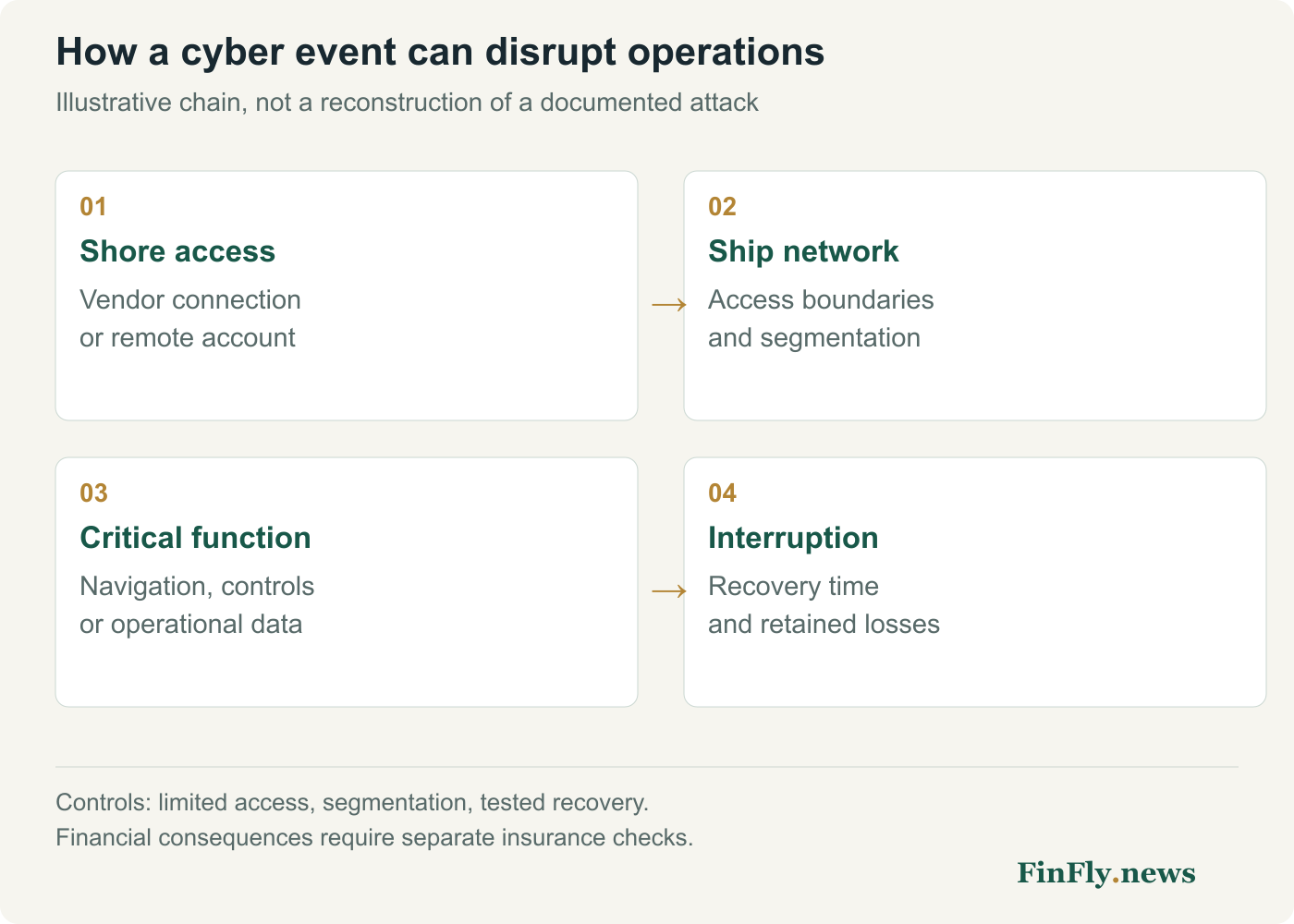
The diagram below presents an illustrative path through which a disruption could spread. It is not a reconstruction of an actual attack and does not imply that every remote connection inevitably stops a vessel. It identifies points where organisational and technical controls can limit consequences.
Cyber resilience already belongs in safety management
The International Maritime Organization links cyber risk management to safety management systems. Resolution MSC.428(98), adopted in 2017, encourages administrations to address these risks at the relevant verification after 1 January 2021. A ship’s position outside newbuilding requirements does not therefore mean the absence of all cyber-security work.
A practical test for an operator is demonstrated ability to contain a failure and restore the function. Having a backup is not the same as having tested recovery: a copy may be outdated, inaccessible during the same incident or incompatible with current equipment. The outcome must be tested against a defined scenario.
We would assess maturity through demonstrable actions: remote-access records, separation of privileges, retained logs and recovery exercises. These are analytical criteria, not a claim that each is an identical legal obligation for every ship.
The product name does not define every insured loss
The Lloyd’s Market Association publishes distinct model provisions, including Marine Cyber Exclusion and Marine Cyber Endorsement. It stresses their illustrative status and market participants’ ability to amend them. The word cyber in a document therefore does not establish which losses a particular policy includes.
A useful review separates consequences into system-restoration costs, property damage, customer liabilities, lost earnings and emergency specialist services. Each category needs its own check of the insuring provision, limit, retained share and causal connection to the event.
The absence of an explicit exclusion should not be read as a promise to pay any digital loss. The contract still needs to cover the relevant interest and type of damage. If the hull is intact but the voyage stops, possession of vessel insurance alone does not answer whether lost earnings are recoverable.
| Question | Evidence worth requesting |
|---|---|
| Which function could fail | System description and dependencies |
| How propagation is limited | Tested access and isolation arrangements |
| How operation is restored | Exercise record and assigned responsibilities |
| Which costs are recoverable | Specific policy provisions and extensions |
FinFly framework for discussion with technical specialists and insurers, not a universal regulatory checklist.
Interruption costs depend on recovery, not just intrusion
Consider the same technical incident on two ships with identical daily interruption costs. If one returns to safe operation in one day and the other in five, the recovery difference alone multiplies that cost component by five. It would be wrong to multiply the entire loss in the same way: investigation, repairs and liabilities may behave differently.
Recovery investment therefore deserves discussion separately from the probability of intrusion. Security may reduce incident frequency, while redundancy and rehearsed procedures can limit consequences after a failure. Insurance performs a third task: transferring an agreed portion of financial consequences, not restoring vessel control in real time.
For Azerbaijani operators and logistics businesses, the practical issue is dependence on digital services aboard ship and ashore. We do not claim specific vulnerabilities in the local fleet; that would require a separate assessment. Contract review can nevertheless begin with a defined scenario rather than after a voyage has stopped.
Our conclusion is that effective protection combines prevention, recovery and insurance without substituting one for another. Gard’s October guidance provides a reason to test that connection across existing fleets. Commercial value comes not from possessing three documents but from their consistency in the same operational scenario.