
Combining shipowner-liability and transport-logistics insurers could improve coordination on complex losses. But shared management does not turn separate contracts into one policy or guarantee a lower price. Clients will judge the transaction by changes in service, not simply the size of the group.
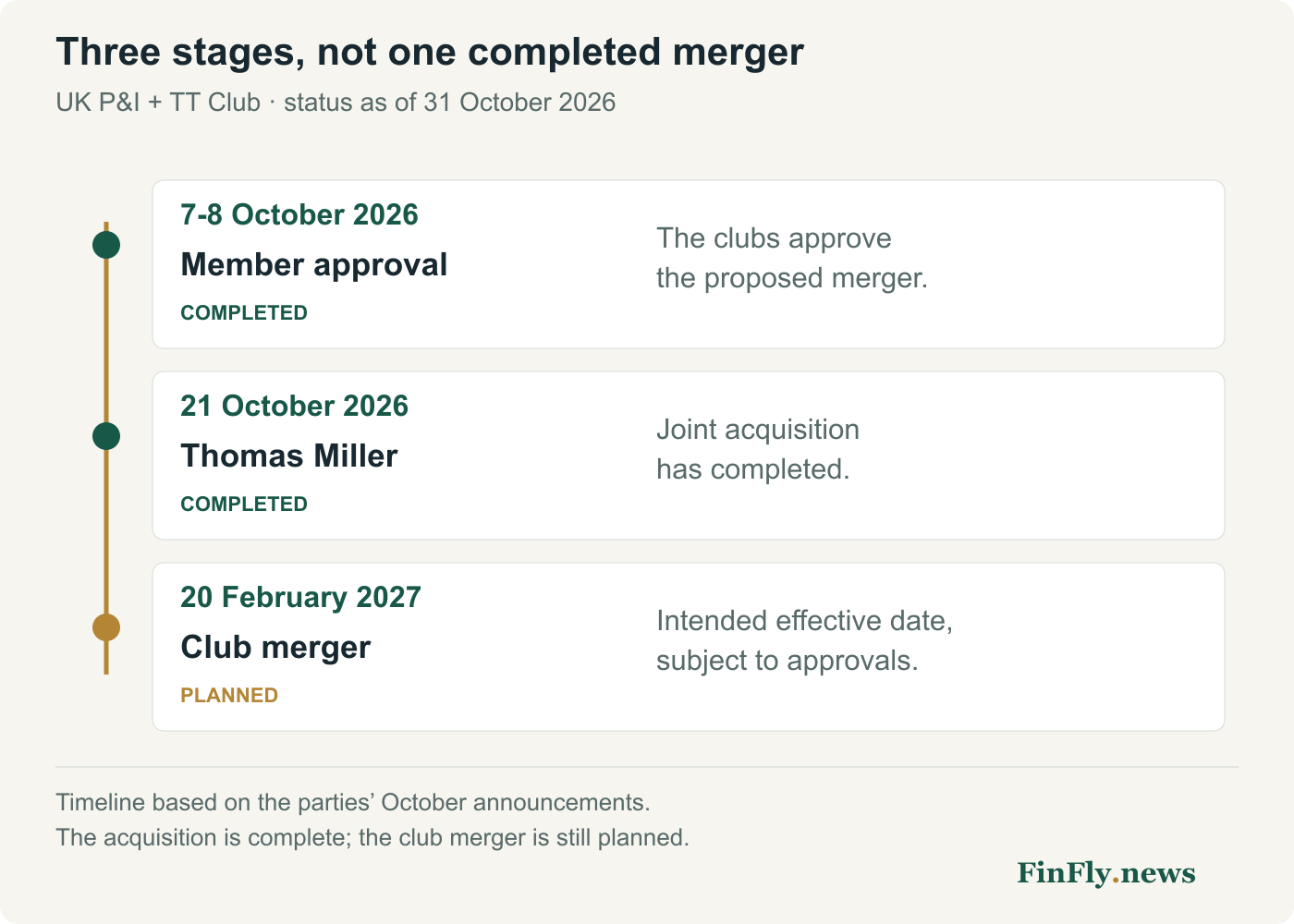
UK P&I and TT Club members approved the merger at meetings on 7 and 8 October. It is intended to take effect on 20 February 2027, subject to the necessary regulatory approvals. Their joint acquisition of Thomas Miller completed on 21 October. These are distinct stages: the management business has been acquired, while the club merger remains ahead.
Shared ownership does not eliminate separate insured interests
A shipowner, terminal operator and forwarder can all be affected by one event while remaining separate contracting parties. Damage to a container during handling, for example, requires evidence about when it occurred, who controlled the operation and what loss is established. A shared corporate centre may improve information exchange without removing those questions.
That is where integration could create value. Shared technical expertise, access to specialists and coordinated documentation may reduce repeated requests. Yet conflicting interests between transport participants do not disappear because their insurers belong to the same group. Each client retains its own rights and contract terms.
It would therefore be premature to describe the transaction as universal cover. Document-transfer speed, expert appointment procedures and independent handling of disputed claims matter more than combining brands.
Financial scale is not a policyholder discount
The merger announcement cites roughly $750m in combined annual premiums and about $888m in free reserves. The clubs intend to retain their names and separate underwriting approaches. These figures describe the planned organisation’s scale, not the renewal price of a specific contract.
Dividing free reserves by annual premium income would not produce a regulatory capital adequacy ratio. Such an assessment requires liabilities, capital requirements, asset risks and other information. Equally, an efficiency commitment is not an achieved saving available to a customer.
Even if administrative costs decline, released resources might fund technology, service, capital or higher claims costs. Conclusions about pricing require actual post-integration quotations with the same limits, deductibles and risk characteristics.
| Stage | What is established | What remains to assess |
|---|---|---|
| Member vote | Merger approved | Completion conditions |
| Thomas Miller purchase | Closed on 21 October | Management integration in practice |
| Club merger | Planned for 20 February 2027 | Approvals and implementation |
| Customer outcome | Not determined by group size | Renewal terms and claims service |
Timeline follows the parties’ statements. The final column contains FinFly assessment criteria, not promised outcomes.
Competition depends on the customer’s alternatives
A larger group does not by itself demonstrate stronger or weaker competition in every segment. The relevant question is how many insurers can offer comparable terms for a particular ship, port or logistics operator. Global scale and a customer’s practical choice are different analytical levels.
For a smaller transport participant, the benefit may be deeper expertise in an unusual claim. A large terminal operator may place more weight on limits, rapid approval of loss-mitigation measures and reinsurance arrangements. These advantages need testing against documentation and experience rather than the combined organisation’s name.
Placing several risks with one group raises a separate question. Administrative convenience is useful but does not replace an assessment of dependence on a single provider. A business should understand which alternatives remain at the next renewal and how portable its claims information will be.
The changes worth measuring after completion
We would assess integration using observable indicators: initial response time on a notified loss, repeated document requests, the time to appoint an expert and the clarity of coverage explanations. Comparisons should use similar claims; a major casualty and routine cargo damage are not equivalent.
For Azerbaijani businesses involved in international transport, the deal is principally a reason to clarify future service arrangements with their broker. They should not assume that an existing policy is automatically replaced or that obligations change without the appropriate documentation.
Our conclusion is that the transaction’s strategic value lies in coordinating protection across transport activities. Financial scale creates possibilities, but customer outcomes will appear in contract terms and claims handling. The management acquisition is complete; the practical advantages of the future club combination remain to be demonstrated.