
An insurance quotation is not permission or operational clearance to sail. A policy allocates specified financial consequences of an incident; it does not remove danger to people, open a closed route or make a port operational. Additional insurance capacity should therefore not be treated as evidence that shipping has automatically resumed.
In its half-year report released on 3 September, Lloyd’s said some shipowners declined available cover because of risks to vessels and crews. That describes conditions when the report was prepared, not the safety of a Strait of Hormuz transit today.
Extra capacity addresses the financial component
On 19 June, Lloyd’s announced a Chubb-led consortium offering capacity of up to $200 million each for hull and P&I risks, plus an additional $200 million for cargo. Access is subject to underwriting, sanctions screening and contract terms. Those maximums are neither a promised payout to each applicant nor a single agreed limit for a specific voyage.
The distinction between available capacity and a placed risk is fundamental. The former describes potential market support. The latter is an agreed contract identifying the vessel, cargo, territory, period and exclusions. Risk assessment and commercial negotiation sit between them.
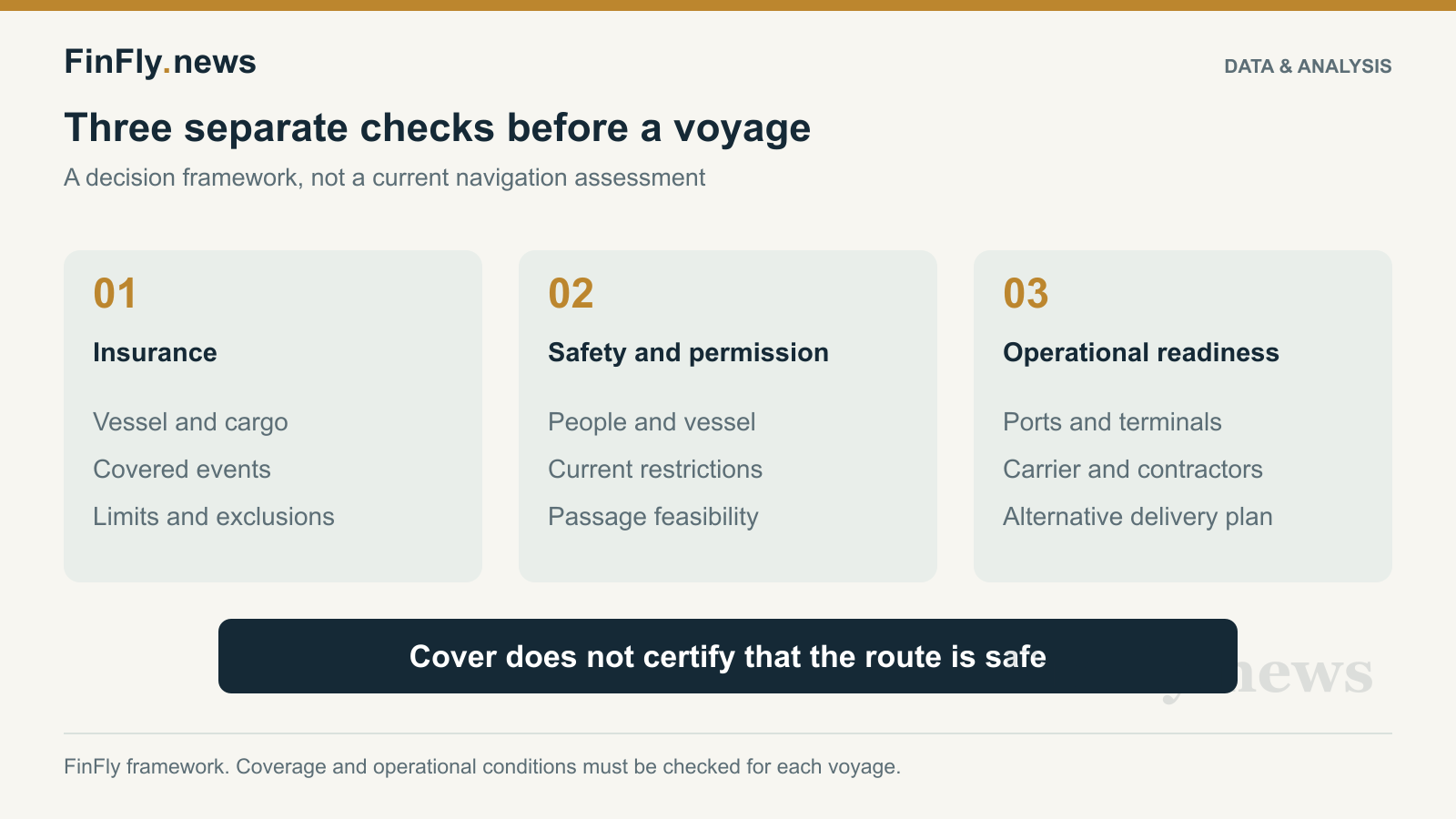
Three checks, not one price question
| Check | What needs to be established |
|---|---|
| Insurance | The interests, events, territories, periods and limits actually covered |
| Safety and permissibility | Threats to people and the vessel, current restrictions and passage feasibility |
| Operations | Port and terminal readiness, contractors and an alternative delivery plan |
The type of loss matters to a cargo owner. Damaged goods, a delayed consignment and failure to fulfil a sales contract are different exposures. None should be assumed covered merely because a marine policy exists. Assessment should start with the loss scenario and the relevant wording.
The economics of another route
Consider a hypothetical importer. An alternative route adds AZN 40,000 to transport costs, while delay on the original route produces AZN 15,000 in additional daily costs. Under those assumptions, the comparison turns at roughly 2.7 days. This is a FinFly illustration, not a freight quote or a forecast of actual delays.
The comparison also needs inventory financing, spoilage risk, warehouse availability and customer obligations. Costs should not be counted twice, for example by adding the full value of unsold goods to the entire lost margin on the same goods. An insurance recovery belongs in the model only where the event and expense meet the actual coverage terms.
The relevance for regional businesses
For an Azerbaijani company, analysis begins with its actual supply chain: whether it passes through the affected area and which counterparties depend on it. Importing goods or using a shipping service does not by itself establish direct exposure to Hormuz.
The management task is to preserve delivery capability and liquidity when delivery is disrupted. Insurance addresses part of the second issue. Another route, a time buffer, a backup supplier and an agreed carrier response address the first. A voyage decision requires both sets of tools and an up-to-date check of restrictions.