An expensive ticket does not necessarily mean a highly profitable airline. When fuel costs rise faster than fares can adjust, additional revenue can be absorbed by expenses. Passengers may pay more while the carrier has less room to expand its schedule or improve its product.
The central question is how much of the fuel bill an airline can pass on without losing customers. FinFly examines that trade-off using industry forecasts and company results.
Higher revenue, a thinner margin
Delta’s third-quarter 2026 report illustrates the divergence: adjusted revenue increased 16% and fuel expenses rose 62%, while operating margin fell from 11.1% to 9.4%. These are the company’s non-GAAP comparative measures.
One carrier is not the whole industry, but the example exposes the limits of simply charging more. A company can increase sales while retaining a smaller share of revenue. Revenue growth then sustains operations without necessarily improving business economics.
Fuel claims more of the budget
IATA’s June forecast put fuel at 31.4% of industry operating expenses in 2026, compared with 25.4% in 2025. It projected a 2% net margin. These are forecasts published on June 7, not completed full-year results.
With little profit to spare, even a moderate cost increase demands a response. The choice is not limited to raising or holding fares. Airlines can reduce frequencies, drop weaker routes, change what a fare includes or postpone investment. Each has a trade-off: saving money today can weaken the offering tomorrow.
How fuel prices affect total costs
Consider a hypothetical carrier that spends 30 of every 100 operating-cost units on fuel. Holding flying activity, fuel use and all other expenses constant, a 20% fuel-price increase raises total costs to 106 units. A 40% increase takes them to 112. This is FinFly’s sensitivity calculation, not a forecast for any airline’s fares.
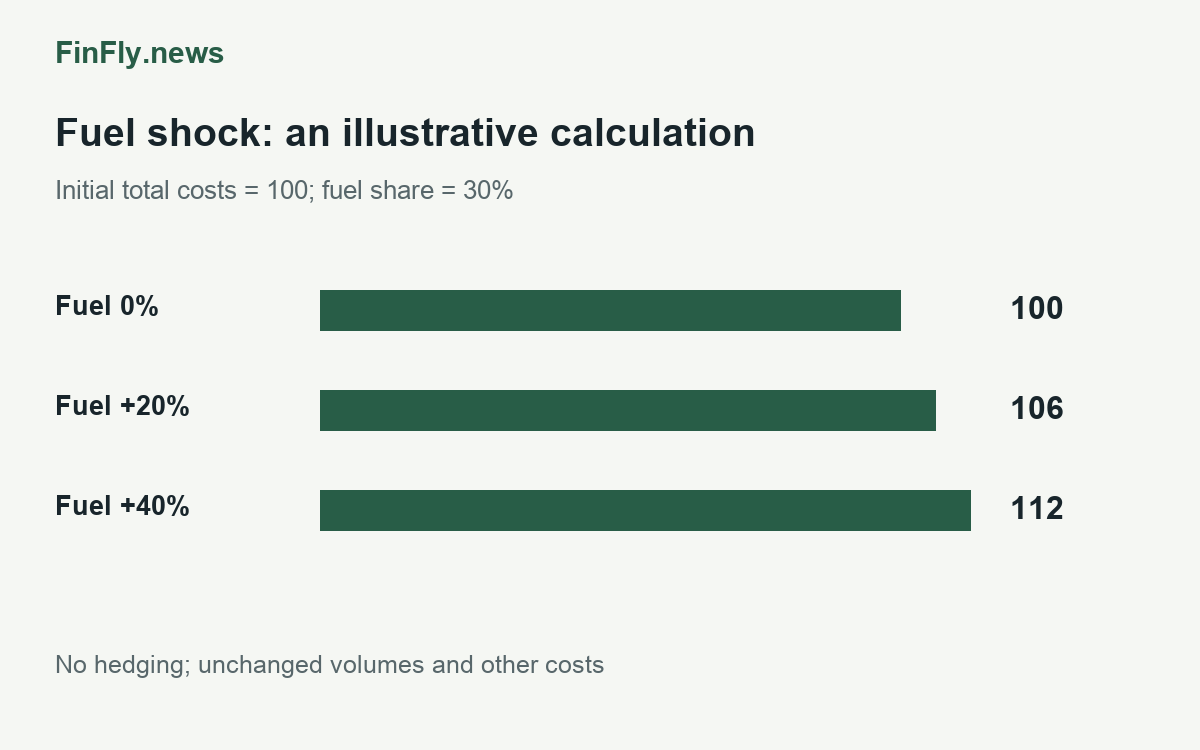
A 6% cost increase does not automatically require a 6% ticket-price increase. Revenue combines different fares and ancillary services, while costs are shared across flights and passengers. The outcome depends on occupancy, competition and customers’ willingness to pay.
Hedging buys time, not permanent protection
IATA’s June industry outlook estimated that airlines had hedged roughly one third of expected 2026 fuel consumption, with significant regional differences.
Such protection can smooth cost fluctuations. Once coverage expires, however, replacement terms may be more expensive. A market shock can therefore appear in financial results and fares with a delay. Knowing that an airline hedges says little about future savings without the volumes, maturities and contractual terms.
Implications for travellers from Baku
For routes from Azerbaijan, competition matters alongside global prices. On routes served by several airlines, passing through the entire cost increase may lose customers. Where alternatives are limited, there may be more room to raise fares. This is scenario analysis, not an announcement by AZAL or another carrier.
Travellers can experience the change through the total trip cost: the ticket, baggage, seat selection and the convenience of connections. Flight frequency also matters to tourism businesses. Even an unchanged base fare may become less attractive if convenient departures disappear.
What to watch next
Three measures need to be read together: revenue per unit of offered capacity, costs on the same basis and operating margin. Looking only at the first can mistake higher prices for a healthier business. A declining margin indicates that revenue has not fully offset cost pressure.
A resilient airline needs a price customers will accept and enough profit to maintain operations and investment. Expensive fuel makes that balance harder. The verified evidence does not, however, justify predicting an identical, inevitable fare increase across all routes.