
A discussion of Azerbaijan's transport sector almost inevitably begins with the corridors between Europe and Asia. But the country's transport economy is broader than international transit. It includes domestic freight, passengers, pipelines, warehouses and postal services. Reducing it all to containers on the Caspian risks overlooking a significant share of demand and misreading the sector's growth.
What the market is made of
In January-September 2026, the volume of transport and warehousing services amounted to 12.82 billion manats, up 10% in real terms. Freight transport accounted for about 7.65 billion manats, passenger transport for 3.50 billion, and warehousing and postal services for 1.67 billion. The State Statistics Committee data were published by APA on October 13.
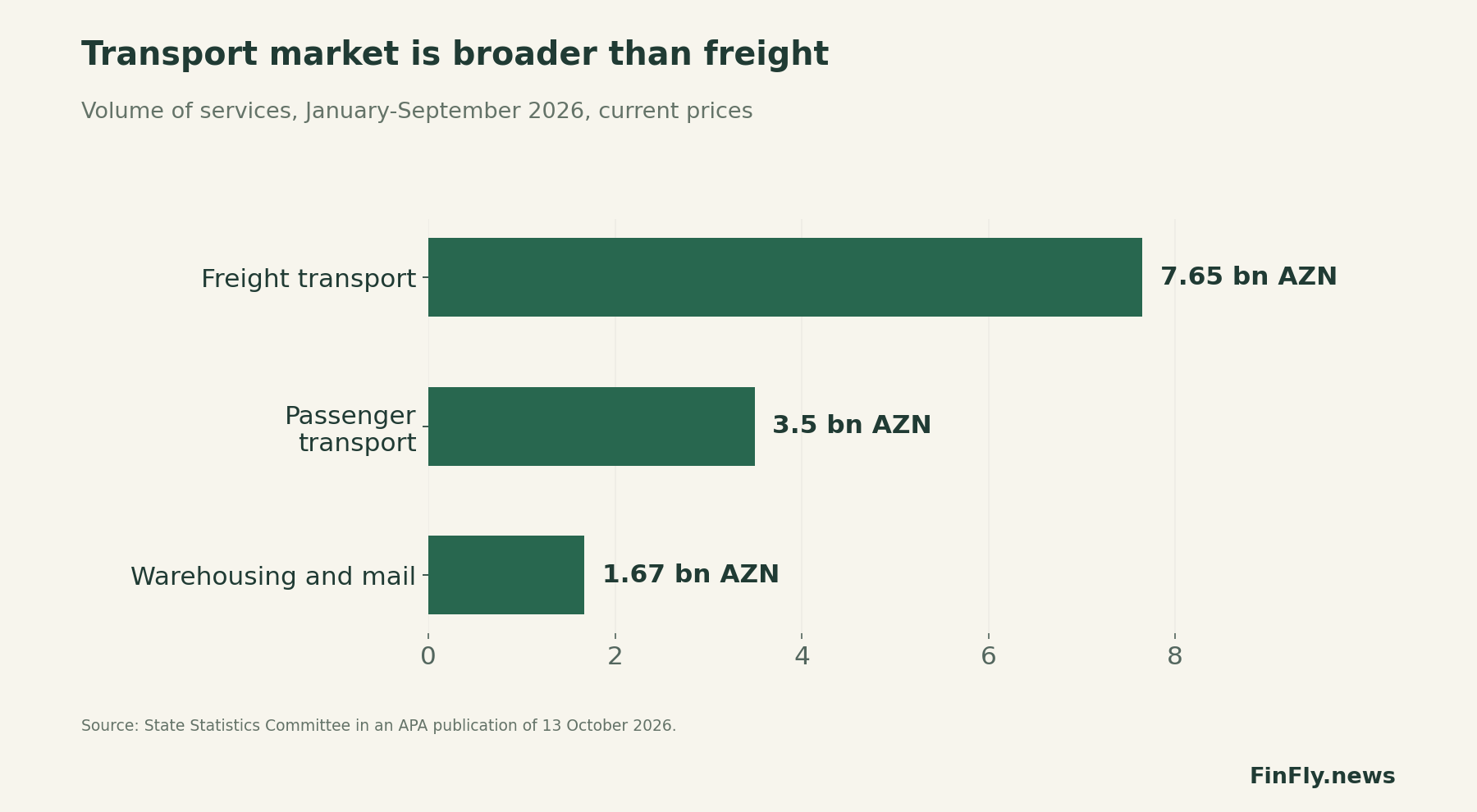
A simple conclusion follows from this structure: not all revenue is tied to moving export goods across a border. The passenger segment accounts for more than a quarter of the volume of services. And the combined warehousing and postal category does not allow revenue from international distribution centers to be counted separately. More detailed statistics would be needed for that.
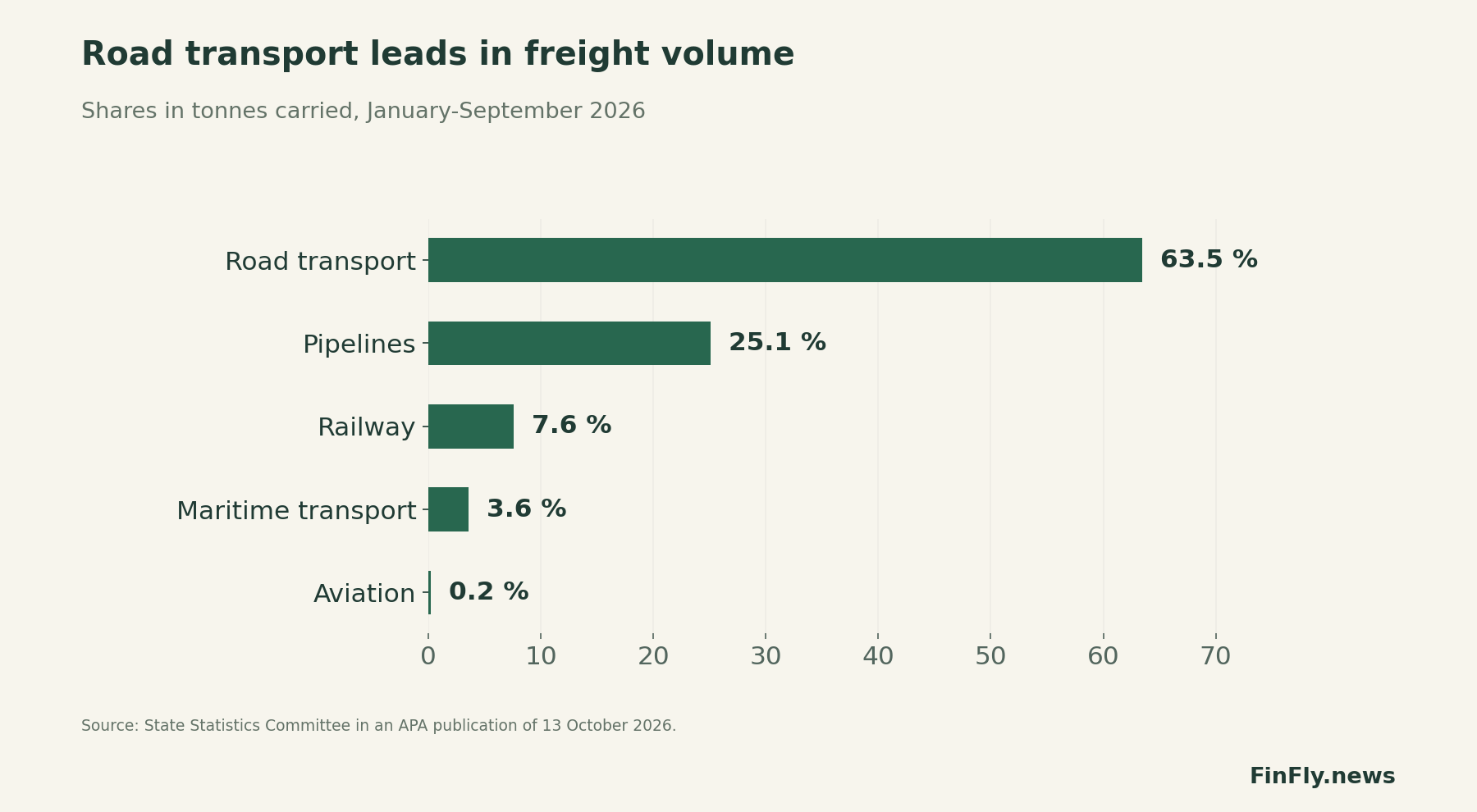
Total freight volume rose 3% to 183.1 million tonnes. Road transport leads by mass, at 63.5%. Pipelines accounted for 25.1%, rail for 7.6%, sea for 3.6% and aviation for 0.2%. These shares describe tonnes, not profitability, the value of goods or the transit role of each mode of transport.
Why revenue cannot be divided by tonnes
At first glance, 10% growth in services alongside 3% growth in freight might look like transport becoming more expensive. But that conclusion does not follow from the data presented. The first indicator is calculated in real terms and includes passengers and other services. The second measures the physical mass of goods. Moreover, a tonne on a short route and a tonne carried across the country require different amounts of work.
Freight turnover in tonne-kilometres is useful for assessing freight activity, while the commercial result requires the tariff, load factor and route costs. Even a large tonnage can yield a modest return when the return trip is empty. Conversely, a small consignment of urgent or high-value goods can generate high revenue even though it is barely visible in the overall mass.
That is precisely why aviation's share of tonnes cannot be used to judge its economic significance. A pipeline and container rail transport are likewise not interchangeable services. They serve different cargoes and have different cost structures.
What the client is willing to pay for
For a shipper, what matters is the full cost of delivery and predictability. A delay increases the capital tied up in goods and can halt production or derail a sale. A slightly more expensive route can therefore sometimes prove more advantageous if it reduces uncertainty. However, that benefit must be confirmed by actual delivery times, not by an advertised deadline.
This is where an opportunity emerges for local businesses: consolidation of small consignments, customs support, cold storage, repair, packaging and distribution. Such services make it possible to earn revenue around the shipment. But building a warehouse without a clear client and cargo flow is risky. Infrastructure with low utilization remains a cost, even if it is located on a promising route.
For perishable cargo, a few extra hours can mean a loss of quality. For an industrial component, delivery precision matters more. For e-commerce, returns and last-mile delivery are essential. The transport market is therefore better analyzed by client need rather than by geography alone.
What the next stage of growth will show
The resilience of a transport business is determined by delivery reliability, utilization in both directions, revenue from ancillary services and the financial result of operators. A growing flow without profit does not support sustainable investment. And revenue from handling cargo can matter more than the mere fact of its passing through the territory.
The published figures confirm the expansion of the transport market. But they provide no basis for attributing all of the growth to a single corridor. A more substantive question for Azerbaijan is what share of the value of the delivery chain the country can retain. The answer depends on the quality of operations, the connectivity of services and the ability to solve the client's problems after the train or vessel has already arrived.