
Tonnes of oil and cubic metres of gas are convenient for a headline, but insufficient for assessing how much money the economy receives. Between production and the budget stand exports, price, contract terms, costs and income distribution. October statistics show particularly well why these stages must be kept separate.
Oil volume continues to decline
According to operational data from the Ministry of Energy, in January-September 2026 Azerbaijan produced 19.9 million tonnes of oil with condensate. That is 3.9% less than a year earlier. Exports accounted for 15.5 million tonnes, while refining volume amounted to 4.5 million tonnes. The operational figures were published on 15 October.
Falling production limits the volume that can be monetised if other conditions remain unchanged. But dollar revenue also depends on price. Therefore a decline in physical indicators does not automatically mean an identical decline in income. Likewise, a rise in price does not guarantee an increase in budget receipts by an identical percentage.
A calculation of revenue sensitivity under an assumed 3.9% reduction in sales shows how the result depends on price. All other conditions in the model are unchanged. With a stable price, revenue also falls by 3.9%. If the price simultaneously falls by 10%, the decline is approximately 13.5%. If the price rises by 10%, revenue increases by approximately 5.7%. This is a sensitivity calculation, not a forecast of exports or oil quotations.
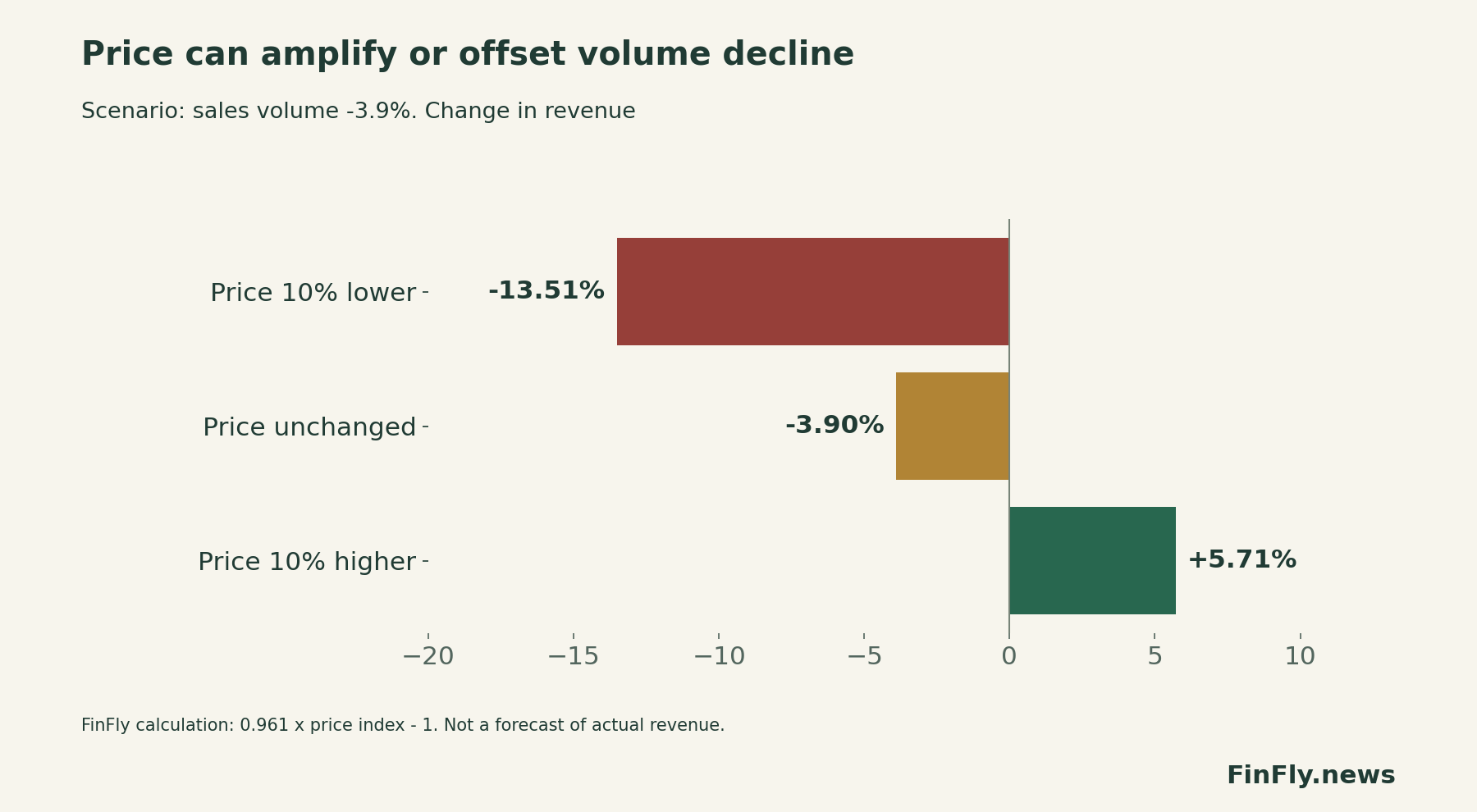
To merely offset the 3.9% reduction in volume, the price in this model would need to rise by approximately 4.1%. The actual picture will depend on the export share, the product mix, delivery schedules and contract terms. The scenario is useful because it shows a double risk: when volume declines, the margin of safety against a price fall becomes smaller.
Gas provides several sales destinations
The Ministry of Energy's operational summary estimates gas production for the nine months at 37.9 billion cubic metres, with exports at 18.4 billion. Of the export volume, 8.6 billion went to Europe, 7 billion to Turkey, 1.6 billion to Georgia and 1.2 billion to Syria. TANAP supplies are included in the Turkish destination; they cannot be added to it a second time.
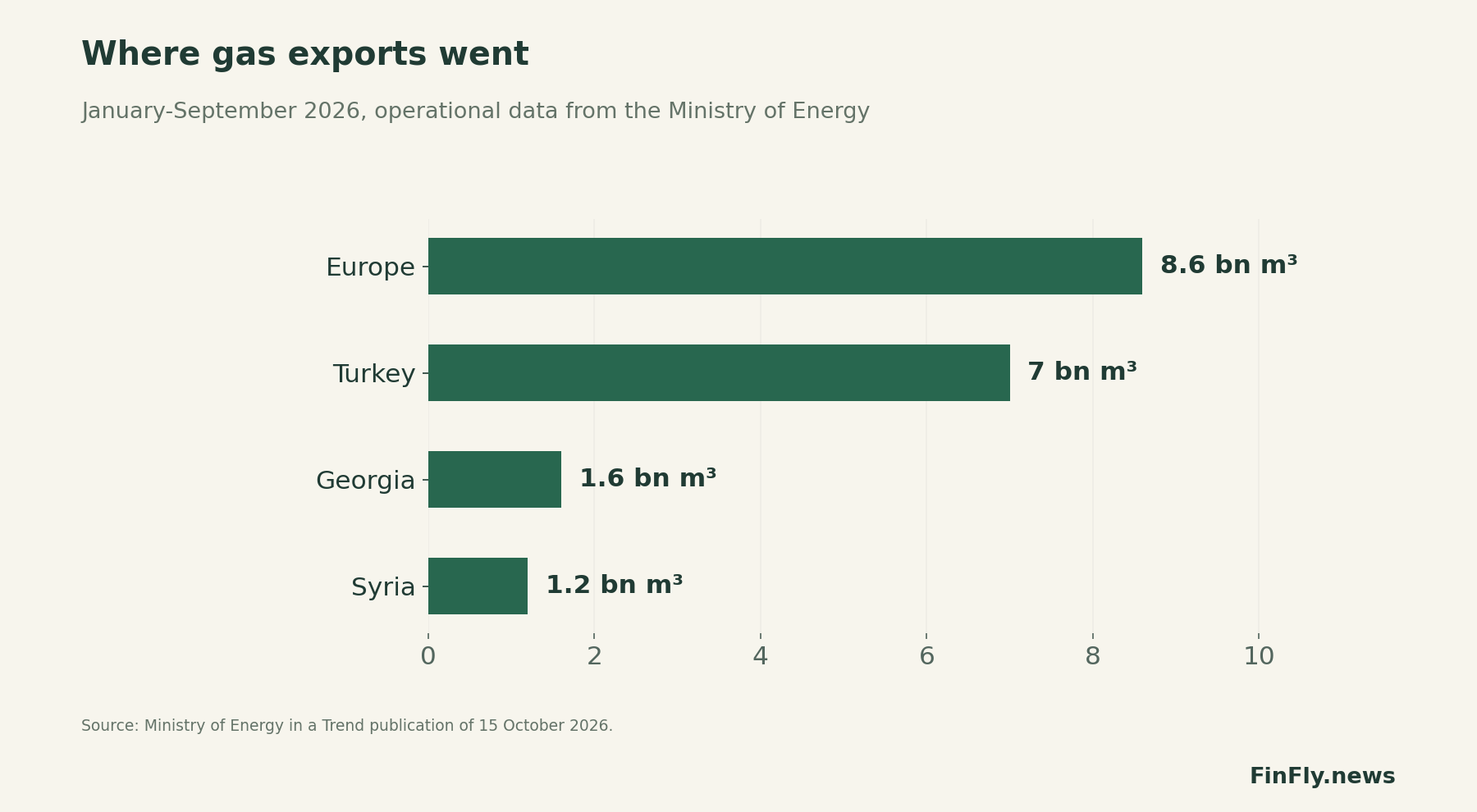
This structure shows the distribution of physical supplies, but not of revenue. Different buyers may have different prices, revision schedules and other terms. Without contract data, it cannot be asserted that a destination with a larger share of volume brings proportionally greater profit. Nor can exports be subtracted from gross production and the entire remainder declared domestic consumption: such a balance would require data on technological use, gas processing and other flows.
What the economy receives after the sale
Export value, company profit and state income are different quantities. Revenue pays for operations, maintenance and investment. State receipts depend on tax and contractual mechanisms. Therefore changes in world prices pass through the economy not as a simple multiplication of the number of barrels by a new quotation.
For mature oil assets, the cost of sustaining production is especially important. Additional work can slow the natural decline, but requires capital. The effectiveness of such investment cannot be assessed from a single summary of volumes. Costs, timelines and expected additional output are needed. Similarly, a gas contract should be assessed together with production and delivery costs, not only with the announced volume.
Refining, too, does not turn every tonne into a guaranteed more profitable sale. The result depends on the difference between the cost of crude and of petroleum products, the output mix and the plant's expenses. For the economy, what matters is income after these costs, not the movement of product to the next stage in itself.
Production, exports and the budget give different pictures
Assessing the sustainability of energy revenues requires four data series: commercial production, export volumes, actual export prices and receipts to the state. They must be compared for identical periods. Otherwise payment delays or differing definitions of indicators may look like an economic turning point that did not actually occur.
A reduction in oil output increases the importance of income from each unit sold. When oil volume declines, one cannot rely on a favourable price alone. Gas supplies help distribute sales across markets, but they do not remove costs and contractual risks. The more precisely public debate separates physical output from money earned, the more substantively it can discuss investment and the economy's dependence on commodity revenues.