
Selling a fresh product abroad and putting a finished branded good on a foreign shelf are different kinds of business. In the second case, packaging, shelf life, distribution and responsibility to the buyer are added. October export data show an interesting shift in favor of processing. But turning it into a simple piece of advice for every farmer to build a plant would be a mistake.
What grew faster
According to preliminary data from the Center for Analysis of Economic Reforms and Communications, in January-September 2026 exports of agricultural products reached $776.8 million, up 16.5%. Exports of agro-industrial products amounted to $299.7 million, with growth of 28.6%. In total, the two groups produced about $1.08 billion. The data were published on October 12.
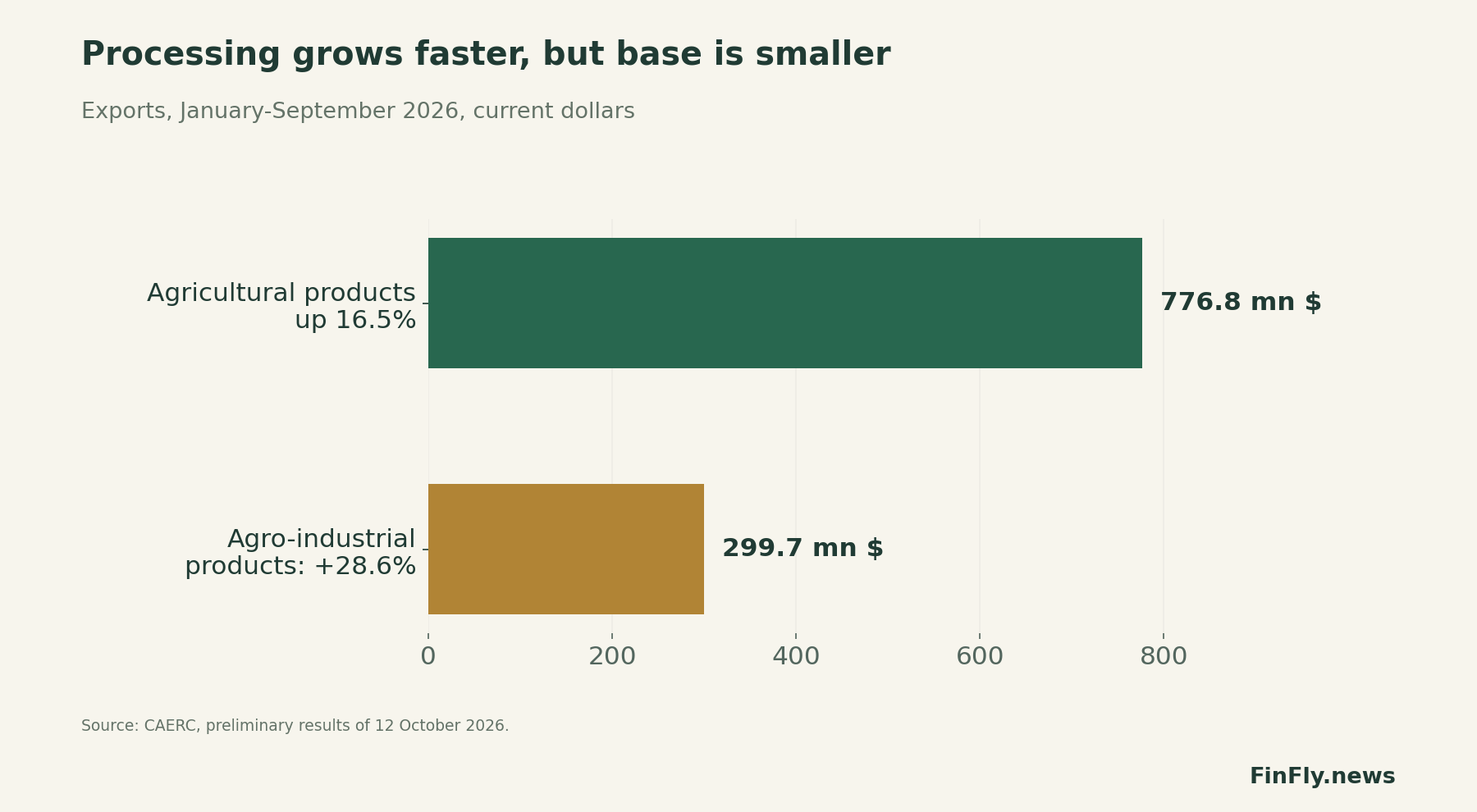
The processed group is growing faster, but so far remains the smaller part of this export. Its share in the sum of the two categories is roughly 28%. This matters more than the headline growth percentage: the sector has room to expand, yet its starting base is noticeably smaller than that of agricultural goods.
At the same time, real agricultural output over the nine months grew by only 1.1%. The divergence from export dynamics is not an error in itself. Exports are stated in current dollars, while output is measured adjusted for prices. Exports are also affected by the composition of shipments, external prices and the distribution of products between the domestic and foreign markets.
Processing sells more than just raw material
The buyer of a finished product pays for convenience, consistent quality and storability. This gives the producer a chance to earn more per unit of raw material. However, extra money in the price does not yet mean extra profit. Out of it, packaging, energy, equipment, quality control, rejects, logistics and the trade channel's commission must be covered.
An agricultural producer has the seasonal risk of the harvest. For a processor, the risk of line utilization is added to it. If raw material arrives unevenly or sales do not allow large batches to be produced, fixed costs are spread over a small number of units. Then an expensive product on the shelf may leave the producer with a very small margin.
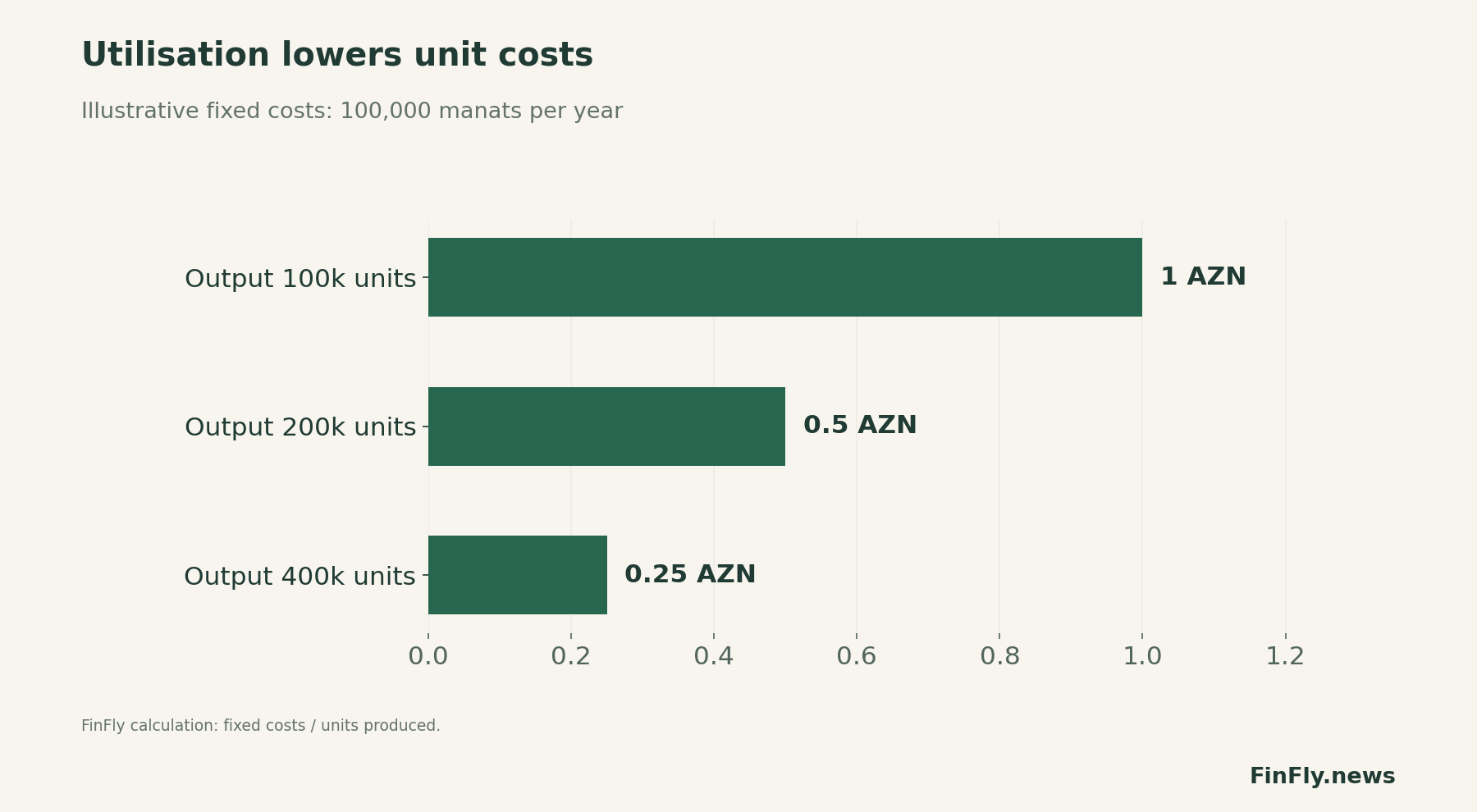
With illustrative fixed production costs of 100,000 manats per year, the unit cost depends noticeably on utilization. At an output of 100,000 units, this is one manat per unit; at 200,000, 50 gapiks; at 400,000, 25 gapiks. Raw materials, packaging and delivery are not included in this calculation. The example shows the effect of utilization, not the cost structure of a specific Azerbaijani enterprise.
First the buyer, then the line
The economics of a new production facility begin with confirmed demand and sales conditions. The choice of equipment depends on order volume and buyer requirements. A retail chain may require deferred payment, a certain shelf life, regularity of supplies and participation in promotions. All of this affects the working capital needed.
An exporter can show revenue growth and at the same time experience a shortage of cash if raw materials are paid for immediately while the foreign partner settles later. Therefore, the development of processing requires not only investment in the workshop but also financing of inventory and receivables. The currency terms of contracts also matter: revenue and expenses may be denominated in different currencies.
There is also the question of the origin of value. Growth in exports of finished products does not automatically show how much income local farmers received. Part of the raw materials, equipment or packaging may be imported. To assess the effect on the economy, the value of the shipped goods must be separated from the value added created inside the country. This cannot be done from overall export totals.
Where the sustainable opportunity lies
The most convincing projects are those that link stable raw materials, confirmed demand and manageable logistics. In one case this may be sorting and packaging of fresh produce, in another freezing, in a third the production of a finished good. Deeper processing is not always better: it must pay back the additional costs and risks.
The published data give reason to study agro-industrial exports more closely. The sustainability of this growth depends on enterprise utilization, repeat orders and profit after expenses. It is these indicators that will show whether processing is becoming a sustainable source of income or is so far resting on a few successful sales.