
A decline in construction is usually seen as a harbinger of cheaper apartments. But Azerbaijan's October figures paint a different picture: construction activity is shrinking while housing keeps getting more expensive. The contradiction disappears once you separate what exactly these data measure. The volume of construction work and the price of an apartment belong to different parts of the market.
Two indicators that cannot be subtracted from each other
In January-September 2026, real value added in construction fell by 8.7%. The sector includes not only residential buildings but other construction projects as well. This indicator is not equal to the number of apartments put up for sale, and it does not describe the Baku market separately.
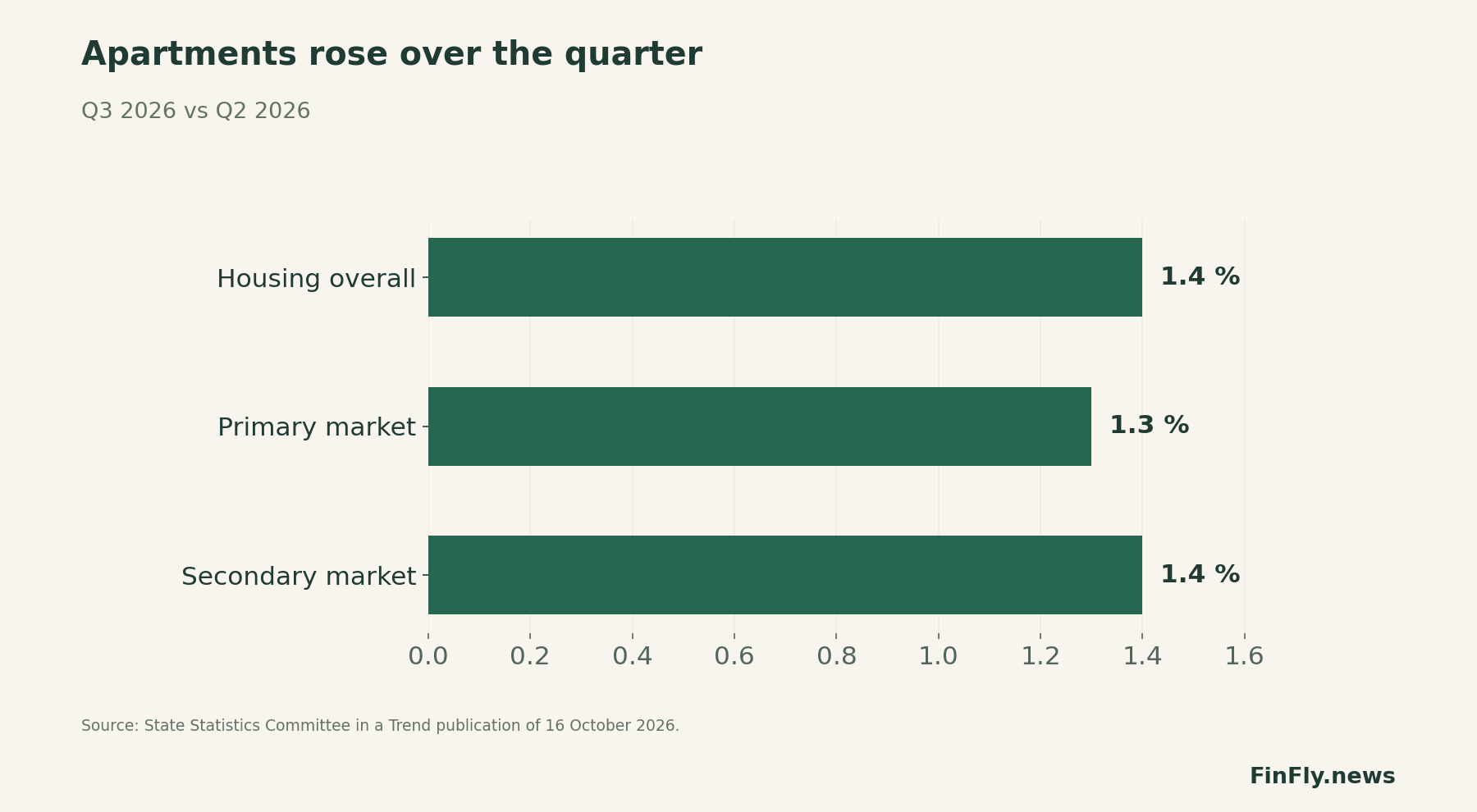
At the same time, the housing price index in the third quarter rose by 1.4% compared with the second. In the primary market the increase was 1.3%, in the secondary market 1.4%. These State Statistics Committee data are cited by Trend in a publication dated October 16. Here adjacent quarters are being compared, whereas the construction indicator covers nine months relative to the same period a year earlier. These percentages cannot be added together, nor can the difference between them be treated as an economic gap.
Why the price can hold up when activity is weak
The housing market consists of a stock of already-built apartments and a flow of new projects. A decline in current construction does not automatically increase supply. If fewer new projects are launched, there may be fewer available apartments in a few years. But even this conclusion requires qualification: it is important to know whether it is specifically housing construction that is shrinking, in which districts, and at what stage the projects are.
A seller of a finished apartment has different logic from a contractor. The seller may have no urgent need for money and may prefer to wait for a buyer while holding the price. A developer, by contrast, must pay for the work and service the financing. The developer sometimes offers installments or a discount without changing the public price per square meter. That is why listings alone do not reveal the value of completed transactions.
There are also differences between apartments. Location, documents, transport, the condition of the building and how ready it is for renovation can influence the choice more than the average index. A rise in the statistical price does not mean all properties became equally more expensive. Answering a question about a specific district requires comparable transactions, not a selection of the most expensive listings.
Affordability is determined by the payment
A buyer with a mortgage assesses more than just the price of the apartment. What matters is the down payment, the rate, the term and the income requirements. Even an unchanged cost of housing can become less affordable with more expensive financing.
The cost of financing is clearly visible in a calculation for an illustrative loan of 100,000 manats over 20 years with equal monthly payments. At a rate of 8%, the payment is about 836 manats; at 10%, about 965; at 12%, about 1,101. This is a mathematical calculation without insurance, commissions and other expenses, not offers from Azerbaijani banks.
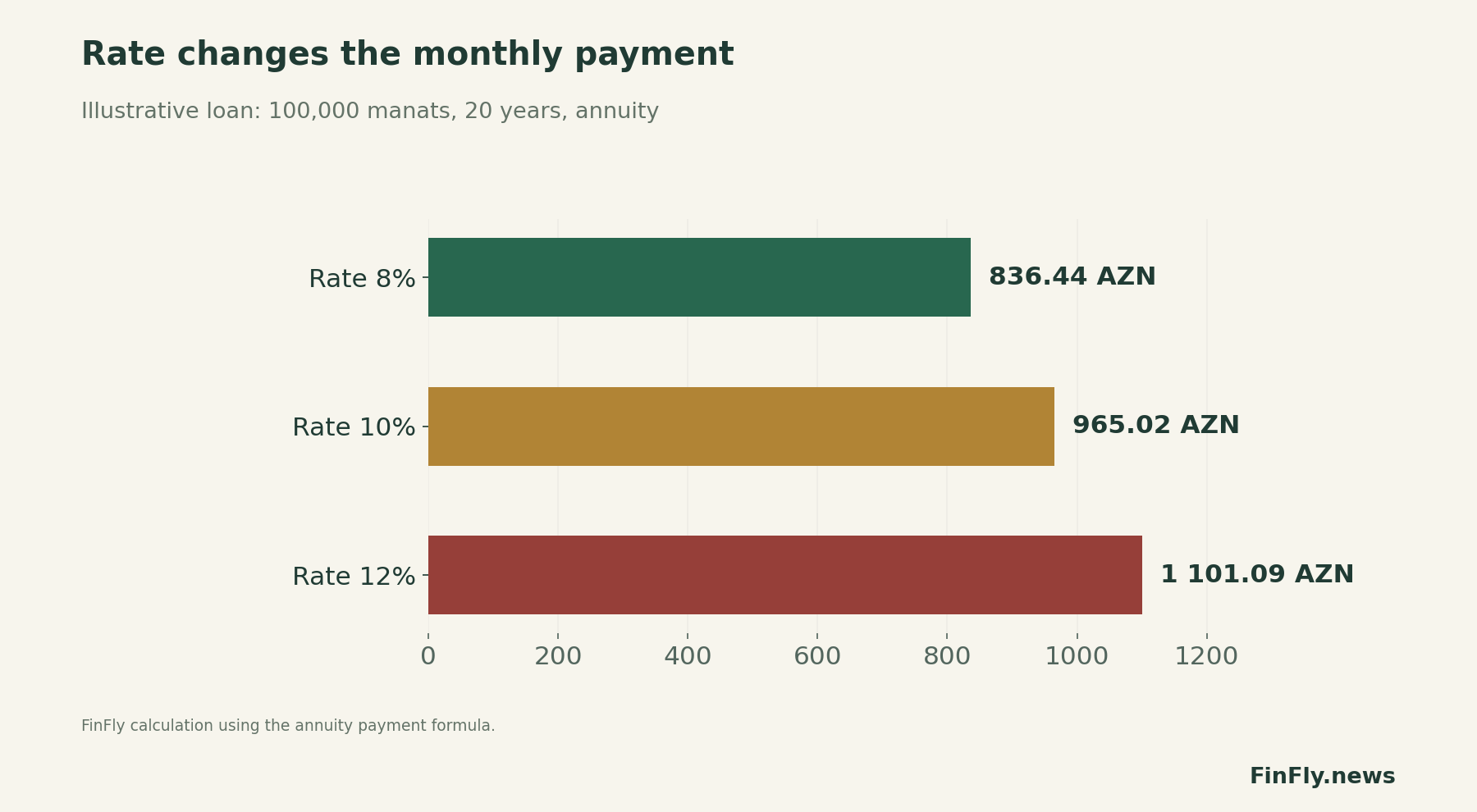
The difference between the extreme options exceeds 260 manats every month. It cannot be offset by a small amount of haggling over the apartment price. That is precisely why analyzing the market only through the square meter misses a significant part of the problem. The constraint may lie in the ability to service the debt, even when the bank is formally ready to issue the loan.
The asking price does not reveal the state of the market
At present, it is impossible to justifiably promise either an imminent collapse or an inevitable continuation of growth. A forecast requires the volume of housing commissioned, the number of transactions, time on the market, discounts to the initial price and the share of sales made with borrowed money. Weak sales with unchanged listings and active transactions at rising prices look similar only on the surface.
For a developer, the key question is whether the project can withstand a slowdown in sales. For a buyer, it is whether the payment will remain manageable if income temporarily declines. For the city, it is where new supply matches jobs and infrastructure. These questions are more useful than trying to guess a single percentage of growth for the entire market.
The October statistics show that construction activity and housing costs are currently moving in opposite directions. They do not prove a bubble and do not promise the buyer a discount. But they give reason to look more closely at financing and real transactions. Housing affordability emerges where supply, income and purchase conditions converge, not where the average price simply stops rising.