Advanced equipment, software development and the right to use an invention can all generate foreign-currency revenue. They are not the same business. For Azerbaijan, the distinction is fundamental: a discussion of non-oil technology exports becomes useful only after identifying what is being sold and which part of its value remains in the country.
In its GII 2026 profile, Azerbaijan ranks 121st for high-tech exports relative to total trade and 113th for ICT services exports. The table records values of 0.1% and 0.4%, respectively. These are starting points for analysing trade structure, not ready-made estimates of export potential.
The denominator changes the meaning
WIPO’s definitions calculate total trade for these indicators as imports plus exports of goods and commercial services, divided by two. The 0.4% figure therefore cannot automatically be described as ICT’s share of all Azerbaijani exports. That would use a different denominator.
An increase in commodity trade can reduce a technology flow’s relative weight even if that flow grows in money terms. Conversely, lower total trade can improve the ratio without technology firms winning new customers. Changes in these measures need to be checked against absolute values and the years of observation.
The GII 2026 edition does not mean these are completed-year 2026 outcomes. The methodology gives 2024 as the export indicators’ base year, while actual data availability varies across economies. Converting rounded shares into current dollar values without the underlying series would be inappropriate.
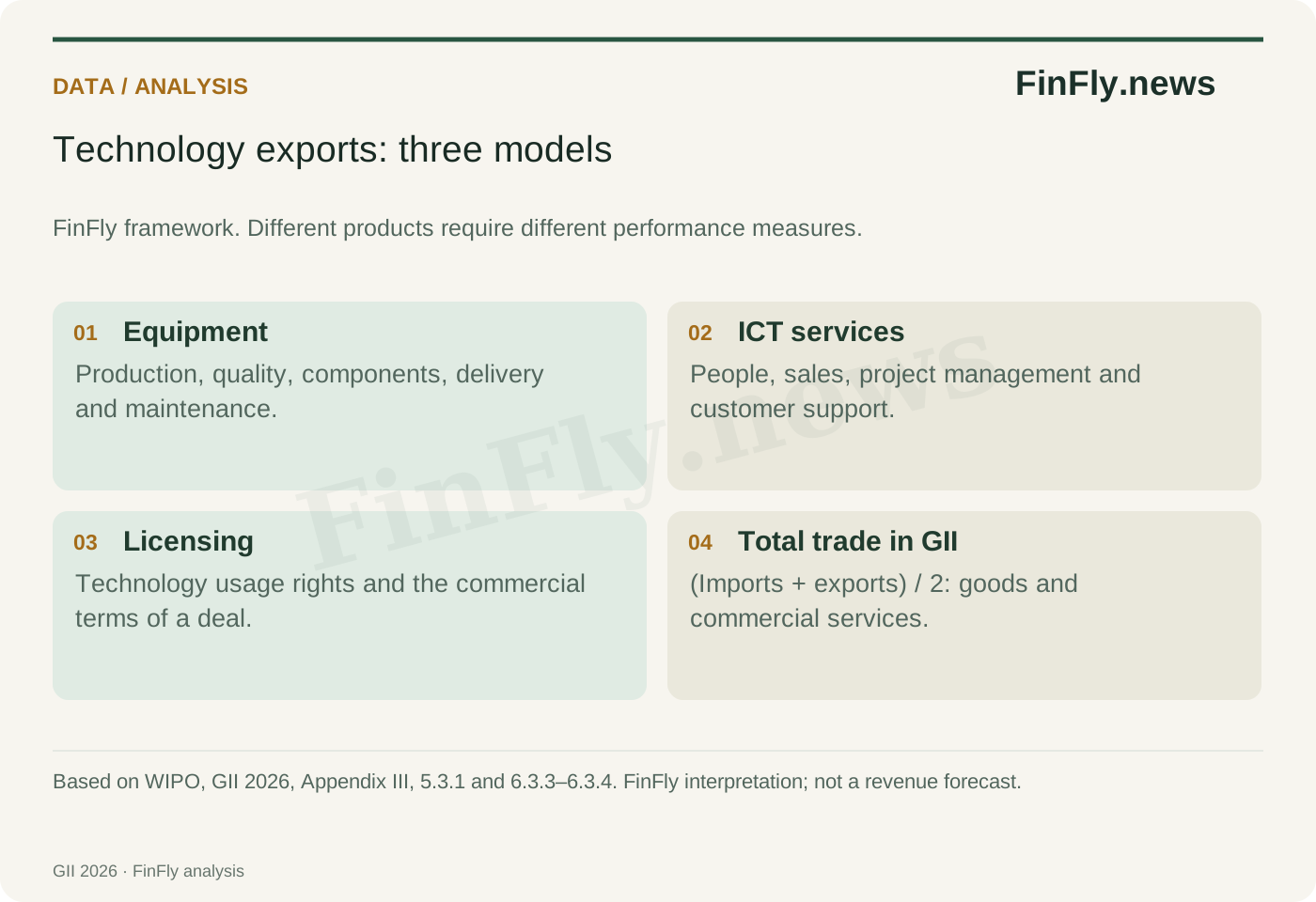
Three models, three sets of constraints
The first model is a physical product: an instrument, electronic component or another piece of equipment. A buyer purchases reproducible quality, and the seller takes responsibility for production, logistics and support. The presence of a sophisticated export does not by itself establish how much research, component production or profit belongs to the local economy.
The second model is a service. ICT services include telecommunications, computer and information services. A company may not need a factory, but it does need people, project management, data protection and relationships with overseas buyers. Its growth constraint may be the ability to sell and support consistently abroad rather than the ability to develop the product.
The third model licenses intellectual property. Revenue comes from specified usage rights, rather than necessarily from every hour worked or device shipped. Yet a patent does not automatically produce licensing income. A commercially useful technology, a partner and workable conditions of use are required.
Does more export revenue mean more local value?
Not necessarily. An equipment sale may include substantial imported components. A service company may spend heavily on overseas infrastructure or subcontractors. Export receipts should consequently be considered alongside local employment, costs, profit and control of the product.
This is not an argument against international supply chains. Foreign components and partners may be prerequisites for market entry. The relevant question is whether the local company accumulates capabilities and customer relationships or remains dependent on a single operation and counterparty.
For a small team, serving foreign businesses may be a realistic initial route. For a research-based venture, industrial partnerships and testing may be more important. A common support measure for both is difficult to assess through one count of registered residents or a total of announced investments.
What makes export activity durable?
Repeat sales, independent customers, revenue from a proprietary product and the ability to cover support costs provide useful evidence. They do not sit in one ready-made GII indicator, but they help translate the statistical objective of diversification into an assessment of an actual business.
FinFly does not infer that Azerbaijan should choose a single technology sector for everyone. The report identifies a more limited problem: technology flows occupy a small position in the trade base used by these measures. Selecting a niche requires a separate assessment of demand and supplier capabilities. Sustainable income and accumulated expertise should be the objective; a better index position should follow from that result rather than substitute for it.