
The average growth of information and communication services in Azerbaijan looks calm: according to the State Statistics Committee, in January–September 2026 the volume amounted to 3,257.1 million manats, with real growth compared to the same period last year at 11.1%. But this aggregate describes a sector within which directions with incomparable dynamics coexist. In January–August 2026, software development and consulting in this area grew in real terms by 39.4%, whereas mobile telephone communications grew by only 2.4%. Focusing on the average indicator means failing to see that mature telecom and fast-growing technology services are different objects of observation.
Scale and pace are not the same thing
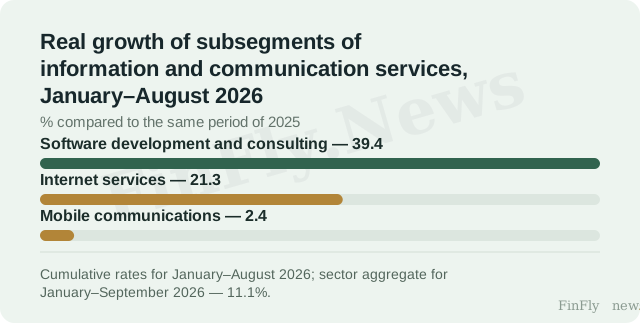
In January–August 2026, information and communication enterprises provided services worth 2,748.1 million manats, with real growth compared to the same period of 2025 at 10.7%. Within this sum, mobile telephone communications accounted for 868.0 million manats, or 31.6% of the total volume, internet — 455.0 million, software development and consulting — 435.0 million, information services — 318.0 million, other services — 672.1 million. The largest segment by money grows the slowest of all: mobile communications added 2.4% in real terms.
The gap in growth rates does not cancel the difference in scale. Software development and consulting is not the largest segment, but the fastest: 39.4% real growth versus 21.3% for internet services, 13.4% for information services, 4.6% for other services, and 2.4% for mobile communications. The aggregate for January–September 2026 is 11.1%, while data on subsegments are available only for January–August 2026, so the contribution of individual segments to this aggregate is not disclosed in the sources. That is precisely why the sector's average figure poorly describes any specific part of it.
Where the aggregate ceases to be a basis for decision-making
For a company choosing partners or planning hiring in the "IT sector of Azerbaijan," the aggregated indicator of 11.1% is a weak basis: it describes the sector as a whole, not the segment where the decision is being made. If the matter concerns software development and consulting, the relevant dynamics are 39.4% for January–August 2026; if it concerns mobile communications, 2.4%. The intermediate link here is simple: growth in the sector's volume of services does not automatically translate into orders for a specific firm — the result is mediated by the size of contracts, access to customers, and the availability of capacity.
The limitation is fundamental: growth in information and communication services is not growth in value added in GDP and not software exports. The State Statistics Committee separately reports that value added in information and communications for January–August 2026 grew by 10.7%, and the industry's share in GDP production was 2.0%. The coincidence of the rate of services and value added for the same period does not prove that it is the same process: the indicators are defined differently. Data on subsegments are available only for January–August, whereas the aggregate is for January–September, so direct comparison of shares between these periods is limited.
The gap between 39.4% in software development and 2.4% in mobile communications is not proof of a structural shift, but a signal of the heterogeneity of the sector that the aggregate hides. The next comparable observation is the next publication by the State Statistics Committee: whether the gap between real growth in software development and mobile communications persists and whether the share of software in the structure of information and communication services changes relative to 15.8% for January–August 2026.