
Serval has raised $150 million at a $3 billion valuation while announcing an expansion of its implementation workforce. The case illustrates why enterprise AI is not simply a model-access business: customers need a functioning process.
In its October 29 announcement, the company named Sequoia as lead investor in the Series C. Serval plans to hire more than 500 people over 12 months, including over 100 automation engineers for its ProServal services business. These are hiring plans, not positions already filled.
Automation starts with responsibility
An enterprise workflow is more than a sequence of actions. It includes permissions, exceptions, approvals and accountability for incorrect execution. Generating code is insufficient if nobody has defined who may change payment details or revoke an employee’s access.
Implementation engineers can therefore perform work that lines of code do not measure: finding contradictory rules, agreeing responsibilities and defining safe behavior when a process fails. This is part of automation’s cost, rather than evidence that automation is impossible.
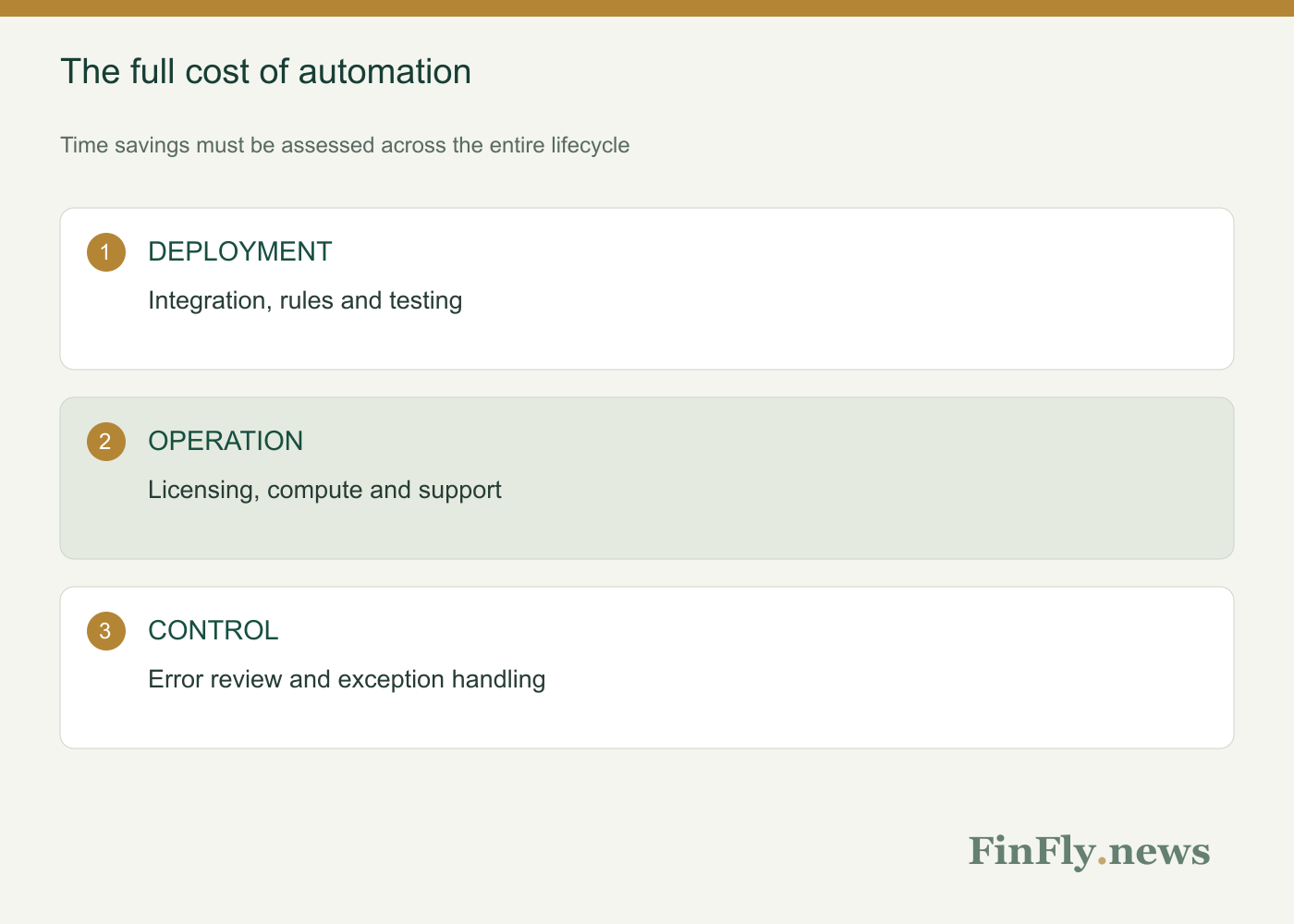
Measure returns at the process level
The economic benefit should be measured per completed process, not per generated response. A useful unit is a task completed correctly, including human review and exception handling.
For illustration, saving 1,000 work hours valued at $10 creates $10,000 of monthly gross savings. If licensing, support and additional controls cost $6,000, the remainder is $4,000 before initial implementation costs. These are hypothetical inputs, not Serval or customer financial results.
| Component | Amount |
|---|---|
| Gross value of time saved | $10,000 |
| Licensing, support and controls | $6,000 |
| Remainder before implementation costs | $4,000 |
FinFly example: 1,000 hours × $10. Not a forecast or company financial data.
Services and software scale differently
Software can be distributed to many customers, but bespoke integration requires specialist time. If each new contract needs a unique implementation, revenue growth may bring a comparable increase in staffing costs.
Assessing the model therefore requires identifying repeatable work: reusable integrations, standard rules, tests and documentation. The more implementation can be reproduced without reducing quality, the easier it becomes to distinguish a scalable platform from a consulting engagement.
The practical lesson for regional businesses
An enterprise buyer should examine full deployment costs, support obligations, permission boundaries and recovery procedures. A successful demonstration of the normal workflow does not replace testing its exceptions.
For Azerbaijani developers, integration, local process design and quality assurance may offer a specialization. Demand still needs to be established through contracts. Serval’s funding demonstrates investor interest in this category, not a guaranteed market for every new supplier.