The number of occupations in which AI can perform some tasks is often interpreted as a count of future redundancies. That is an invalid leap. Surveys and estimates discussed by the World Bank for Uzbekistan show how far technical possibility can be from everyday adoption.
Around 80% of clerical support workers are estimated to have medium or high exposure to AI, while 27% of this occupational group report personally using AI at work. This does not mean 80% are already being replaced. Nor can the difference between the two shares be labelled the number of workers who will become unemployed.
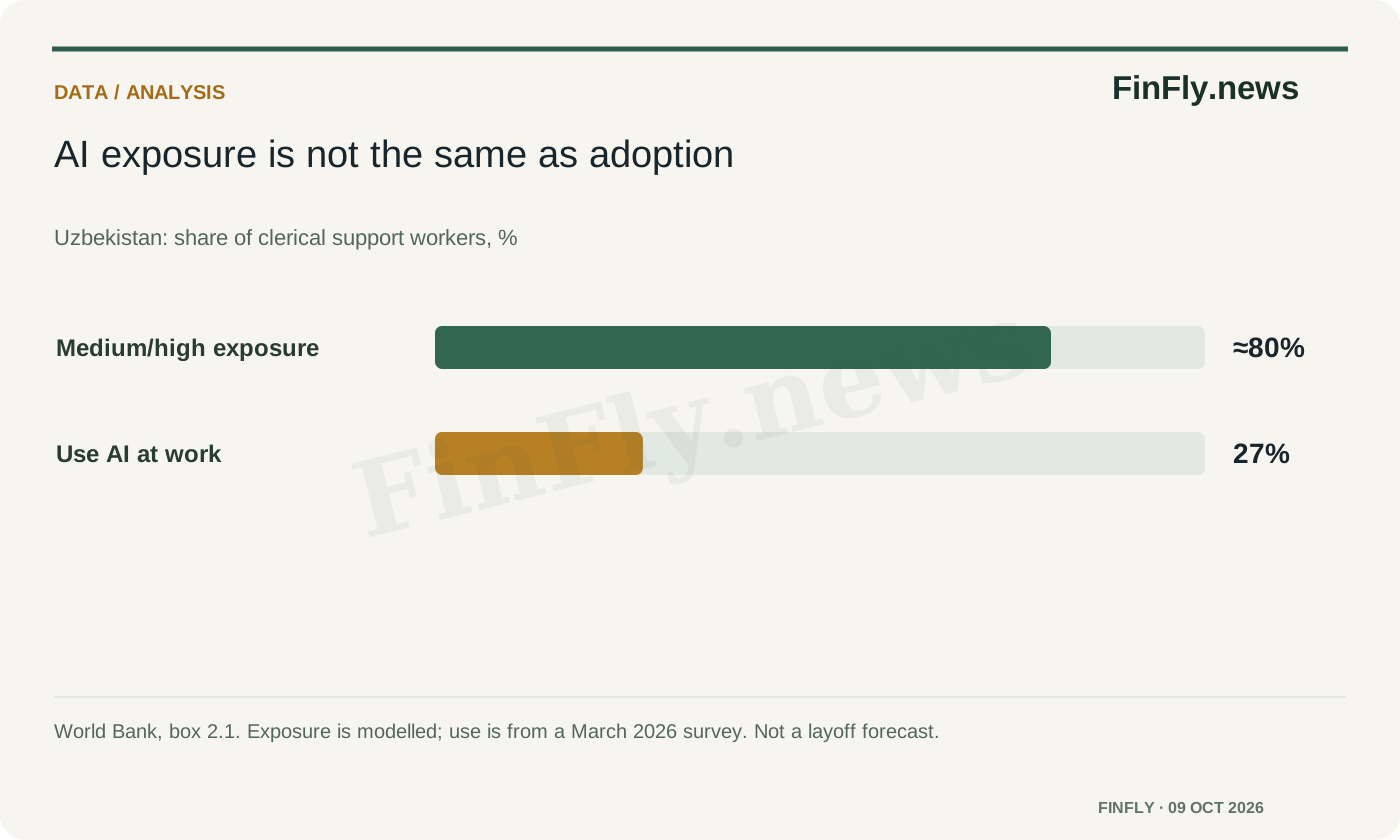
Independent FinFly analysis drawing on World Bank (2026), Making AI Work: Jobs, Firms, and Productivity, ECA Economic Update (October 2026). FinFly’s interpretations are not endorsed by the World Bank. DOI · CC BY 3.0 IGO.
What the two measures capture
Exposure estimates relate occupational tasks to technological capabilities. Actual use is measured by a person’s answer about applying AI in their job. One is modelled from occupational structures; the other concerns respondents’ reported behaviour. Both are informative, but they answer different questions.
The methodological note identifies the 2024 Uzbekistan household survey and the March 2026 Listening to Uzbekistan round. Kyrgyz occupational structures are used to provide detail within broader occupation groups. The exposure estimate therefore involves assumptions. It is not an inspection of every Uzbek worker’s tasks, and certainly not a measurement of Azerbaijan’s labour market.
Internet access is not the same as capability
In Uzbekistan, reported AI use at work reaches 48% among professionals and 43% among managers, exceeding the share among clerical support workers. In a later survey round, around 39% of employed respondents said they could not copy or move a file on a phone or computer without help. Among clerical support workers, that share approached 60%.
This helps explain why connectivity does not establish readiness to use a tool. The authors do not attribute the entire gap to digital skills, however. Some occupations with low estimated exposure also report AI use. Work organisation, specific tasks and respondents’ interpretation of technology use may influence the results.
A job is more than a set of independent buttons
The report distinguishes automating a task from replacing a job. A single operation cannot always be separated from a connected process without losing value. Producing a draft, interpreting context, agreeing a decision and taking responsibility for consequences are different parts of work. Automating the first does not automatically remove the others.
There is another possible effect: a cheaper operation can generate additional demand. A company may analyse more documents or serve more customers, rather than only cut the labour needed for its existing output. The dominant effect depends on the market, tool quality and management’s reorganisation of work. There is no universal outcome for all occupations.
What Kazakhstan adds to the picture
The April–June 2026 Kazakhstan survey finds a close association between using AI at work and elsewhere. The authors interpret this as evidence that overall diffusion of skills and practice matters, not just employer restrictions. They also explicitly caution that worker characteristics and firms’ digital maturity are related, so one explanation does not rule out the other.
For Azerbaijan, these findings are a starting point for questions, not ready-made local percentages. Employers can examine which operations staff actually perform with AI, how outputs are checked and which skill gaps impede progress. Training that is disconnected from a real task is harder to evaluate through results.
The useful distinction is not between professions with and without a future. It is between a technically available capability and the ability to use it responsibly. The report supports adapting tasks and skills; it does not support calculating future redundancies from an exposure table alone.