
A university–company agreement, a scientific paper and a technology sale can belong to the same project. Economically, however, they are three different outcomes. Azerbaijan’s Global Innovation Index 2026 profile shows why they should not be merged into a single assertion that science is working with business.
The country ranks fifth in a survey-based measure of university–industry collaboration in research and development. Its position for public research–industry co-publications is 84th, with a profile value of 1.0%. The apparent contradiction is not necessarily factual: the indicators capture different forms of interaction.
Cooperation is not a single observable event
WIPO’s methodology defines the first indicator as responses to a World Economic Forum question about business–university R&D collaboration. The second relies on bibliographic data, uses a five-year average and covers selected scientific fields. It is not a register of every research contract.
A joint development project may end with a confidential technical report rather than a paper. Conversely, a publication can have scientific value without an immediate commercial result. A low co-publication position cannot automatically be interpreted as an absence of cooperation; a high perception score cannot establish substantial technology sales.
The buyer needs reproducible performance
For an industrial company, a laboratory result becomes useful when it can be reproduced at the required scale, quality and cost. Production conditions differ from experimental conditions. Materials, maintenance, safety, batch consistency and equipment downtime become part of the commercial decision.
The transition from discovery to demonstrated performance is central to the GII 2026 thematic chapter. It treats testing facilities, pilot capacity and certification as distinct parts of the commercialization process. Neither another presentation nor a patent application can substitute for them. Each stage requires its own skills and funding.
This does not establish that every Azerbaijani technology stalls at the same point. The country profile contains no such project-level detail. It offers a testable question instead: where did a project stop reducing the buyer’s risk, and what evidence is missing before the next decision?
Technology rights affect project economics
When research moves into a company, the parties need clarity about who can use the results and on what terms. WIPO describes technology transfer as a process involving assessment of the invention, its commercial potential and a route to market. Licensing and forming a separate company are possible pathways, not universal prescriptions.
Complex negotiations can delay a business. Transferring rights without clear obligations does not guarantee deployment either. The analytical task is to assess the complete arrangement: the team’s access to the technology, its ability to attract investors, development commitments and the research institution’s interests. An individual agreement requires separate legal review.
A patent is not a profit statement. It can protect a technical solution and underpin a transaction, but it does not establish demand, freedom to use every required technology or readiness for manufacturing. Patent counts are useful; treating them as commercialization outcomes is not.
Two scorecards, rather than one
A university needs academic measures: research quality, training and contributions to knowledge. A commercial project needs a different set: validation, paid deployments, licensing receipts and repeat sales. The two scorecards can reinforce one another without competing for a single definition of success.
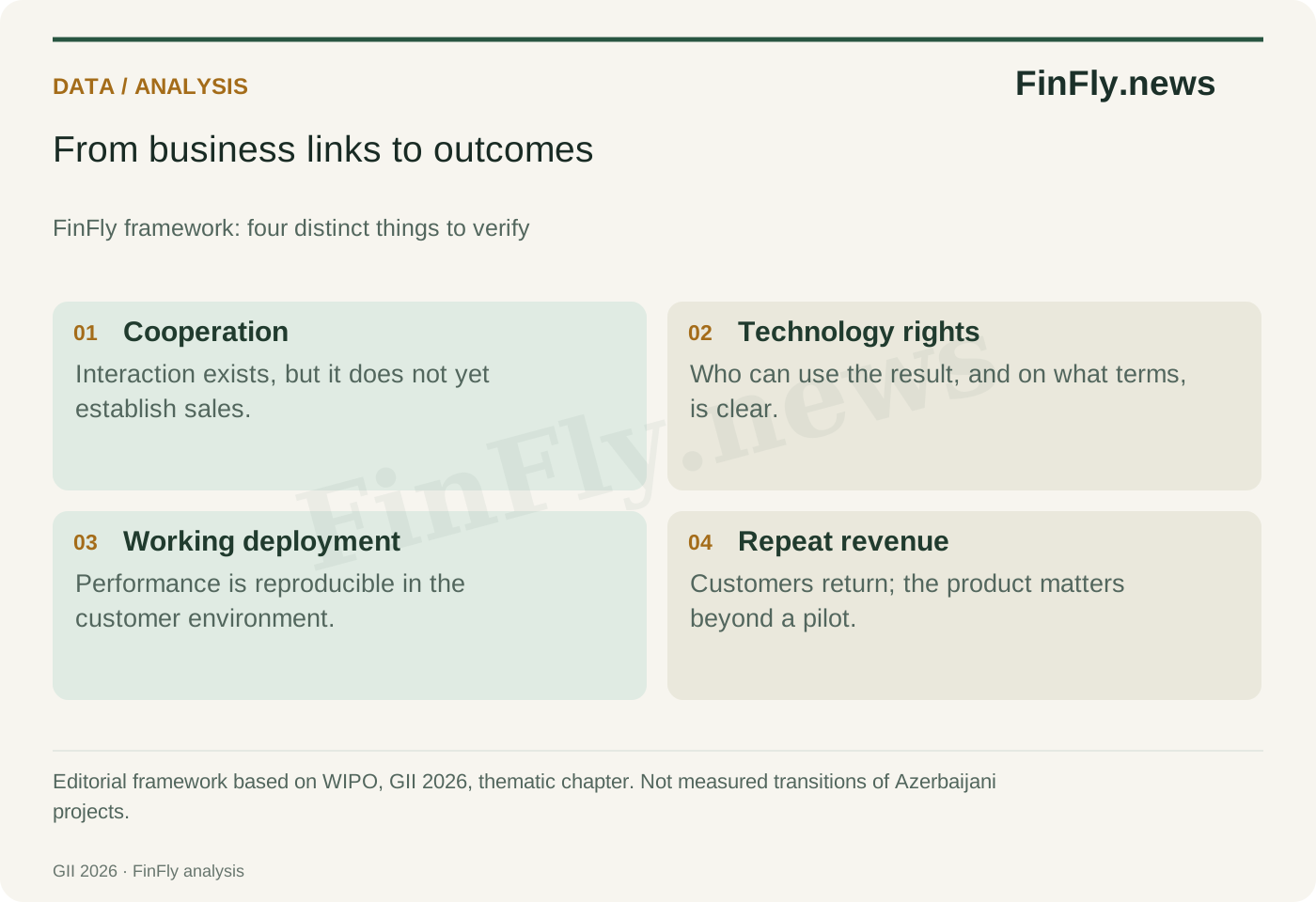
For Azerbaijan, a practical monitoring approach would follow anonymized project transitions: technologies selected for validation, technologies passing tests, projects obtaining a customer contract and businesses still operating after support ends. This is FinFly’s proposed evaluation framework, not a claim that such a national register already exists.
Timing matters too. A commercial result may arrive years after a paper is published, and GII itself combines observations from different periods. The appropriate conclusion is not that the country has overestimated its science. The central question is whether promising individual connections become a repeatable practice of deployment. Completed contracts and technologies working for customers will provide a stronger answer than any single ranking position.